
How to Update Your Adjuster License Address Online
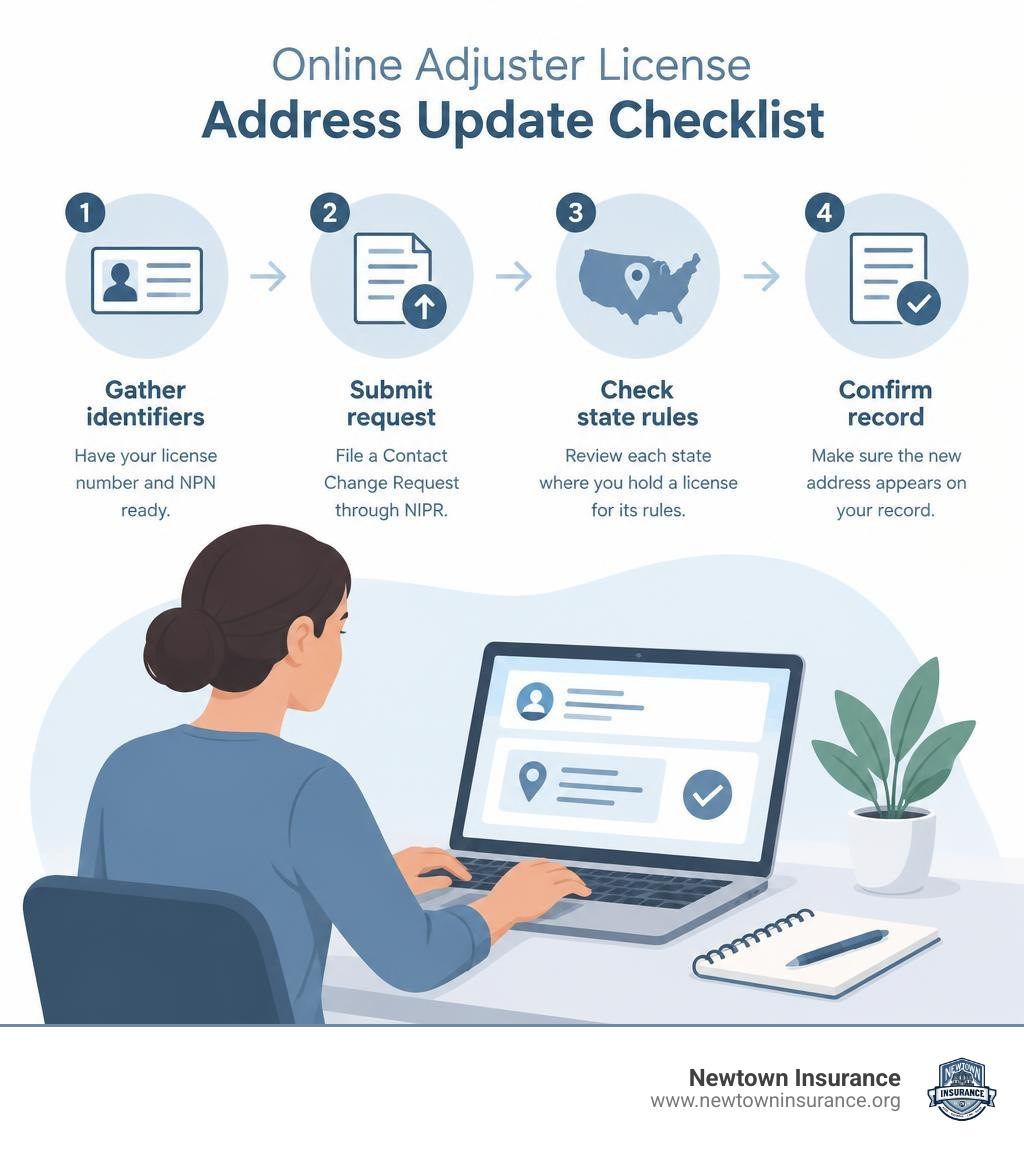
To update your adjuster license address, gather your license number and National Producer Number (NPN), then submit a Contact Change Request through NIPR. Check each state where you hold a license for its rules, and confirm the new address appears on your record. If you hold a Pennsylvania license, review the state’s license update instructions.
Your license record and insurance policies are separate. Updating one does not update the other. If you’ve moved, tell your insurers too so they can check your coverage and explain any change in price.
I’m Shawn Beihl. I’ve spent more than 15 years working across insurance lines, helping people sort through coverage, risk, and address change insurance adjustment questions.
Basic address change insurance adjustment terms:
- auto insurance glass coverage
- average cost of commercial vehicle insurance
- best commercial vehicle insurance company
Step-by-Step Guide to Updating Adjuster and Producer License Records
Keeping your professional insurance credentials current is a fundamental regulatory requirement. Whether you work as an independent claims adjuster, a public adjuster, or a licensed insurance producer, your resident and non-resident state insurance departments require an accurate record of your physical residence, business address, and mailing address.
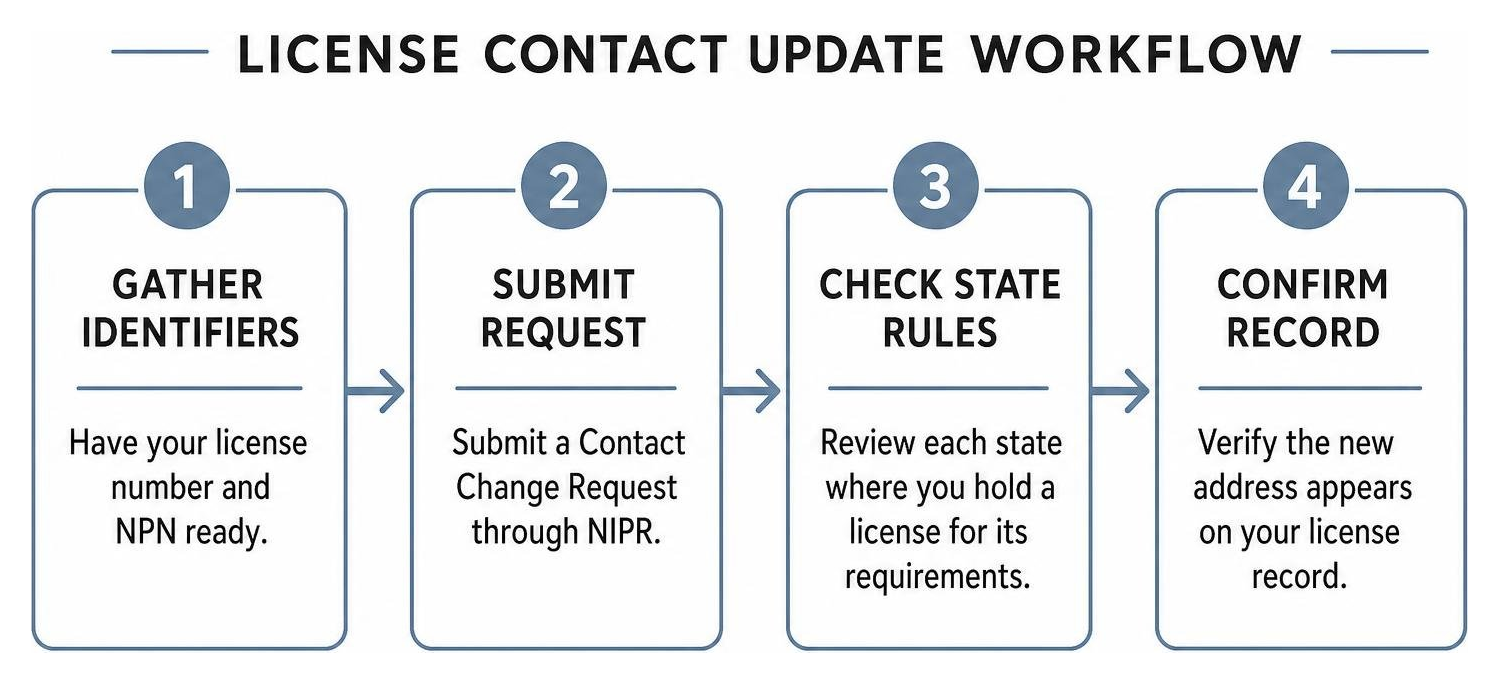
The primary electronic portal used across the United States is the National Insurance Producer Registry (NIPR), alongside state-specific portals like Sircon. Maintaining accurate licensing information prevents regulatory lapses, ensures you receive vital renewal notices, and keeps you compliant with state insurance commissioner mandates.
Managing the Address Change Insurance Adjustment for Resident and Non-Resident Licenses
When you move or relocate your agency, you must update both your resident state and all non-resident states where you are licensed to adjust claims or sell insurance policies.
To process your change smoothly, use the official electronic address submission portal or the NIPR Contact Change Request (CCR) tool. You will need specific identifying credentials depending on whether you are updating an individual adjuster license or an agency entity:
| Requirement / Field | Individual Adjuster / Producer | Agency / Business Entity |
|---|---|---|
| Primary Identifier | National Producer Number (NPN) | National Producer Number (NPN) |
| Tax Identification | Last 4 digits of SSN & Date of Birth | Federal Employer ID Number (FEIN) |
| License Information | Resident State License Number | Resident State Agency License Number |
| Address Types Updated | Residential, Business, Mailing | Principal Business, Branch, Mailing |
| Contact Data | Individual Email, Mobile, Phone | Agency Email, Contact Person, Phone/Fax |
After submitting your request through the portal, always check your state department record to confirm the update has populated correctly.
State Compliance Deadlines and Regulatory Penalties
State insurance departments strictly enforce contact update deadlines. In Pennsylvania and most jurisdictions, licensees are required to report any change of address, legal name, or primary email within 30 days of the change.
Failing to meet this 30-day window can lead to serious administrative headaches:
- Administrative Fines: State insurance departments regularly assess monetary penalties for failure to maintain accurate contact information.
- Missed Renewal Notices: If your mailing or email address is outdated, you will not receive mandatory renewal alerts, which can lead to license expiration.
- Continuing Education Audit Issues: When renewing credentials or demonstrating compliance with mandatory public adjuster continuing education credits, notifications regarding compliance audits will be sent to the address on file.
- Communication Failures: Understanding insurance consumer rights in Pennsylvania requires open channels of communication; if the state cannot deliver official notices, your authority to operate may be suspended.
Understanding the Address Change Insurance Adjustment on Premiums and Risk
While updating your professional licensing records ensures legal compliance, relocating also triggers an address change insurance adjustment on your personal and commercial insurance policies.
Insurance companies do not view a change of address as a simple clerical task. Every physical address belongs to a specific rating territory that reflects localized risk factors such as population density, accident frequencies, vehicle theft rates, weather exposure, and local repair costs. Our Pennsylvania auto insurance guide highlights how moving just a few miles into a different zip code can alter your underlying premium rates.
The financial and legal reality of address changes was clearly illustrated in the landmark appellate case Smith v. N.H. Indem. Co.. In that case, an address change caused a $321.18 premium increase. Because the additional premium went unpaid, the policy was cancelled, ultimately leaving the driver without coverage when an accident occurred. This case underscores why policyholders must promptly review amended policy documents and understand statutory notice rules, particularly when balancing selections like full tort auto insurance.
How Moving Triggers an Address Change Insurance Adjustment
When you notify your insurance carrier that you have relocated, the underwriting department recalculates your policy premium based on the new garaging territory or property location.
- Underwriting Discovery: Insurance carriers maintain underwriting audit windows to verify that garaging locations and property addresses match state registration databases.
- Territory Reclassification: If you move from a rural setting to a congested urban center, your statistical likelihood of filing a claim increases, which pushes rates up.
- Policy Endorsements: The insurer issues an official policy endorsement showing the new location, the updated risk classification, and the resulting premium revision. Using proven auto insurance savings tips can help offset territorial rate increases.
- Avoiding Material Misrepresentation: Failing to report a move—or deliberately leaving an old address on file to secure lower rates—is considered rate evasion and material misrepresentation. In the event of a total loss, an insurer may deny your claim or void your policy altogether. Make sure to get updated home insurance quotes whenever you move to keep your property protected.
Impact on Property, Auto, and Bundled Insurance Policies
A change of address ripples across every personal line of coverage:
- Personal and Commercial Auto Insurance: Garaging location is one of the heaviest-weighted factors in auto rating. Moving a vehicle from a quiet driveway to street parking in a dense area increases vandalism and collision risks. You can mitigate these shifts by asking about anti-theft discounts.
- Homeowners and Property Coverage: Property premiums depend heavily on the home’s square footage, construction materials, age of the roof, and the local Public Protection Classification (fire protection grading).
- Renters Insurance: Moving to a new apartment building changes your liability exposure and personal property limits. Carrying updated renters insurance ensures your belongings remain covered against fire, smoke, and theft during and after the move.
- Bundled Policies: If you carry combined home and auto bundles, updating your address allows the carrier to keep multi-policy discounts intact without triggering billing mismatches.
Calculating Mid-Term Adjustments: Proration, Refunds, and Retroactive Charges
When an address change occurs in the middle of a standard 6-month or 12-month policy term, the insurer does not bill you for a full annual rate revision all at once. Instead, they issue a mid-term premium adjustment.

According to the comprehensive mid-term adjustment proration guide, insurance companies apply a standard daily proration formula using a 365-day divisor:
Daily Rate Difference = (New Annual Premium - Old Annual Premium) / 365
Mid-Term Adjustment Amount = Daily Rate Difference × Number of Days Remaining in Policy Term
For instance, if your address change causes a $300 annual rate increase and there are 100 days left on your policy term, the insurer calculates a daily rate difference of $0.822 ($300 / 365). Multiplying that by the 100 remaining days results in a prorated adjustment charge of $82.20 for the rest of the term.
The handling of cancellations and adjustments generally falls under two calculation methods:
| Factor | Pro-Rata Adjustment | Short-Rate Adjustment |
|---|---|---|
| Calculation Basis | Exact daily calculation based on elapsed time | Pro-rata amount minus an administrative penalty |
| Penalty Fee | No penalty assessed (100% unearned premium credited) | Typically a 10% penalty on unearned premium |
| When Applied | Mid-term address changes, endorsements, insurer cancellations | Voluntary policyholder cancellation before term end |
| Financial Outcome | Fair, mathematical distribution of earned vs unearned premium | Reduced refund to offset carrier administrative costs |
Prorated Return Premiums for Lower-Risk Relocations
Relocating does not always mean higher costs. If you move from a dense city center to a suburban or rural township with lower accident and crime rates, your statistical risk drops.
When your risk decreases, the insurer recalculates your premium downward and issues a prorated return premium (refund) for the remaining days of your policy term. If you are searching for cheap auto insurance options, moving to a safer territory can generate an immediate credit on your statement.
Depending on your selected auto insurance payment plans, the carrier will either apply this credit to reduce your upcoming monthly installments or issue a direct refund check.
Retroactive Rate Increases and Discovery Audits
What happens if you move in January but forget to notify your insurance carrier until April?
During underwriting discovery audits—which typically occur at renewal or within a 60-day audit window—carriers run address checks against national motor vehicle and credit reporting databases. If an insurer uncovers an unreported move, they have the legal right to apply retroactive charges.
This means you will be billed retroactively for the rate difference from the exact date of your move to the present, alongside the prorated increase for the remainder of the policy term. Under the Fair Credit Reporting Act (FCRA), if third-party data reports trigger adverse rating actions, the insurer must issue an Adverse Action Notice explaining the source of the data and how you can dispute inaccurate records. Ensuring your business stays current with comprehensive commercial insurance coverage protects your enterprise from surprise audits and billing disruptions.
Handling Address Changes for Health Insurance and Marketplaces
Updating your address is equally critical for healthcare policies. Health insurance plans are organized around distinct rating regions and localized provider networks.
When you relocate within Pennsylvania, your access to local doctor networks, hospital systems, and prescription formularies may change. A move across county lines or zip codes qualifies you for a Special Enrollment Period (SEP), granting you a 60-day window to evaluate new Pennsylvania health insurance plans and adjust premium tax credits or subsidies.
When updating your address on a state exchange or private health plan, prepare the following documentation for address verification:
- A newly issued driver’s license or state ID card reflecting the new residence
- A recent utility bill (electric, gas, or water) displaying your name and service address
- A signed residential lease agreement or mortgage closing disclosure statement
- Official change-of-address confirmation letters from the United States Postal Service (USPS)
Frequently Asked Questions About Insurance Address Changes
What happens if I forget to report an address change on my insurance?
If you fail to report a change of address, you put your coverage at risk. In the event of a significant accident or property claim, the claims adjuster will verify your actual residence and vehicle garaging location.
If the insurer discovers that you live in a higher-risk area than the address listed on your policy declarations, they may investigate for material misrepresentation. This can lead to delayed claim settlements, reduced payouts, outright claim denials, or policy cancellation. Maintaining accurate policy details ensures your comprehensive and liability insurance protection responds when you need it.
How fast must an insurance adjuster or producer update their licensing address?
Licensed insurance adjusters, public adjusters, and producers must update their licensing address within 30 days of a move. Updates can be submitted electronically through NIPR or Sircon. Failing to notify state regulators within this window can lead to administrative fines, missed regulatory notices, and potential license suspension.
Can an address change lower my insurance premiums mid-term?
Yes. If your new address is located in a territory with lower traffic congestion, lower crime rates, or improved fire protection, your risk profile decreases. Your insurer will calculate a prorated return premium for the unused portion of your term, lowering your future monthly payments or generating a refund check. Reviewing our tips for saving money on insurance can help you identify additional discounts after a move.
Conclusion: Keeping Your Licensing and Insurance Policies Up to Date
Whether you are managing your professional credentials as a claims adjuster or protecting your family’s home and vehicles, keeping your address records accurate is essential. Proactive updates prevent regulatory fines, eliminate coverage gaps, and ensure you are never blindsided by retroactive premium bills.
At Newtown Insurance, we believe in transparent pricing, tailored coverage, and responsive local support. If you are preparing for an upcoming move or need to adjust your existing policies, our experienced team is here to help you review your coverage and secure every available discount. Explore our full suite of insurance services and coverage options to protect what matters most.