Why Auto Insurance Rates Are Draining Your Budget (And What You Can Do Right Now)
Auto insurance savings tips are more important than ever — the average American now pays $2,679 per year for car insurance, up more than 30% since 2023.
Here are the fastest ways to lower your premium:
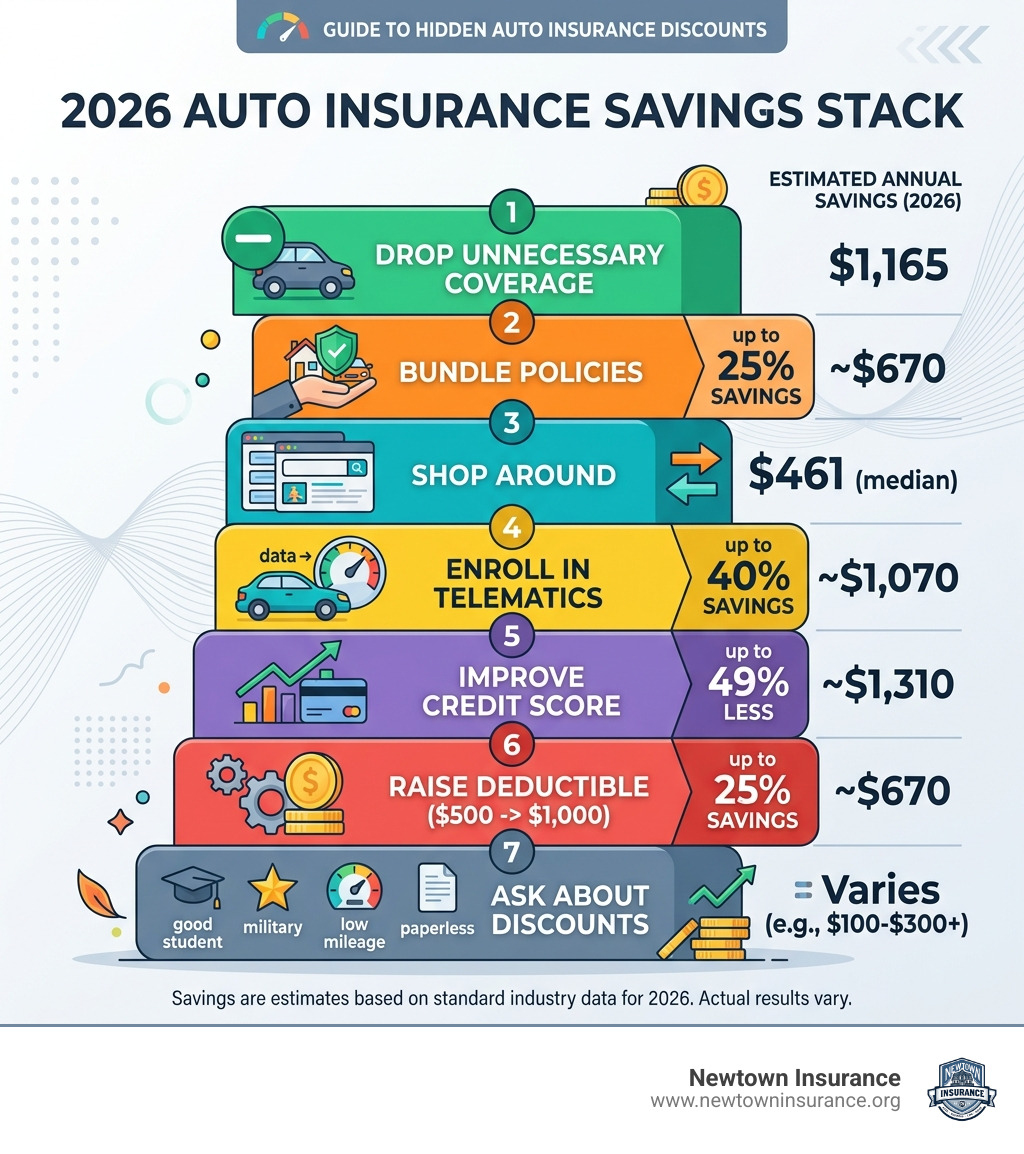
- Shop around — quotes for identical coverage vary by 40% to 75% between insurers; drivers who switched saved a median of $461/year
- Raise your deductible — going from $500 to $1,000 can cut premiums by 20% to 25%
- Bundle policies — combining home and auto typically saves 5% to 25%
- Improve your credit score — excellent credit holders pay up to 49% less than those with fair credit
- Enroll in telematics — safe drivers can save up to 30% to 40% through driver monitoring programs
- Drop unnecessary coverage — removing collision and comprehensive on low-value vehicles can save ~$1,165/year
- Ask about discounts — good student, military, low mileage, paperless, and occupational discounts are often unclaimed
Why are rates so high right now? A combination of expensive repair technology, inflation on parts and labor, severe weather claims, and trade tariffs on imported vehicle components have all pushed premiums sharply higher. Even safe drivers with clean records have seen their bills climb — which is exactly why knowing how to find savings matters so much in 2026.
I’m Shawn Beihl, and with over 15 years in specialty insurance — including commercial P&C, health, and benefits management — I’ve helped countless Pennsylvania drivers apply practical auto insurance savings tips to reduce what they pay without sacrificing real protection. In this guide, I’ll walk you through every lever worth pulling, from quick wins to long-term strategies.
High-Impact Auto Insurance Savings Tips for 2026
If you feel like your car insurance bill is a second mortgage, you aren’t alone. In the current 2026 market, “price optimization” is a real thing — insurance companies often raise rates on loyal customers because they assume you won’t take the time to look elsewhere. Breaking that cycle is the single most effective way to keep your money in your pocket.

The most impactful of all auto insurance savings tips is simple: comparison shopping. Research shows that car owners who switched insurers in the past five years saved a median of $461 in annual costs. Because every company uses a different “risk recipe,” rates for identical coverage profiles can vary by 40% to 75% between competitors.
When you look for Auto Insurance Quotes, you are essentially forcing the market to compete for your business. We recommend getting at least three to five quotes every 12 months to ensure you aren’t paying a “loyalty penalty.” For more detailed guidance on the shopping process, you can explore resources from the Insurance Information Institute (III) to understand how companies evaluate your risk.
Strategic Deductible Adjustments
One of the quickest levers you can pull is adjusting your deductible. The deductible is the amount you pay out of pocket before your insurance kicks in for a claim. While it’s tempting to keep this number low (like $200 or $500) to avoid a big bill after an accident, it significantly inflates your monthly premium.
Increasing your deductible from $500 to $1,000 can bring annual premiums down by 20% to 25%. If you have a healthy emergency fund, this is a “no-brainer.” You are essentially betting on your own safe driving. Over four or five years of claim-free driving, the savings you’ve accumulated in lower premiums will likely far exceed the extra $500 you’d have to pay if an accident did occur.
| Deductible Level | Estimated Premium Savings | Out-of-Pocket Risk |
|---|---|---|
| $250 | Baseline | Low |
| $500 | 15% – 30% Savings | Moderate |
| $1,000 | 20% – 25% Additional Savings | High |
| $2,000 | Up to 40% Total Savings | Very High |
Dropping Coverage on Older Vehicles
Is your car a “vintage” model (and not the cool, expensive kind)? If so, you might be over-insuring it. A common industry standard is the “10% Rule.” If the annual cost of your collision and comprehensive coverage exceeds 10% of the car’s total market value, it’s time to consider Moneysaving Car Insurance strategies like dropping those optional coverages.
Collision pays for damage to your car from an accident, while comprehensive covers things like theft, fire, or falling trees. If your car is worth $3,000 and your premium for these coverages is $500 a year with a $1,000 deductible, the maximum you’d ever receive from the insurance company is $2,000. Dropping these can save approximately $1,165 a year on average, which you can then put toward the down payment on your next vehicle.
Maximizing Common and Hidden Policy Discounts
Discounts are the “low-hanging fruit” of the insurance world. Many drivers qualify for savings they never even bother to ask about. At Newtown Insurance, we make it a point to dig for these hidden gems so you don’t have to.
The biggest heavyweight here is bundling. When you combine your car insurance with homeowners or renters insurance, you can see massive reductions. Bundling home and auto can save an average of $1,273 annually with certain carriers. Beyond just the auto policy, you often get a discount on the home side as well. To see how this works in practice, check out our guide on Car Motorcycle And Home Insurance Combined coverage.
Don’t stop at bundling, though. There are at least 6 Car Insurance Discounts You Should Ask About during your next review, ranging from anti-theft devices to multi-car savings.
Telematics and Usage-Based Auto Insurance Savings Tips
In 2026, technology is your best friend when it comes to savings. Usage-based insurance (UBI), or telematics, uses a smartphone app or a small device in your car to track how you drive. It looks at things like:
- Braking habits: Are you a “slammer” or a smooth stopper?
- Speed: Do you treat the PA Turnpike like a racetrack?
- Time of day: Do you drive late at night when accidents are more common?
- Mileage: The less you drive, the less you pay.
Safe drivers often see 30% to 40% potential discounts through these programs. If you’re someone who works from home in Newtown or has a very short commute, this is one of the most effective auto insurance savings tips available. You can also look into Auto Insurance Payment Plans that offer further incentives for automatic or paperless billing.
Professional and Group-Based Auto Insurance Savings Tips
Are you a member of a credit union? A veteran? A teacher? A student with a 3.0 GPA? All of these can lead to lower rates.
- Senior Drivers: Many insurers offer “mature driver” discounts for those aged 50-65.
- Good Students: Drivers under 25 who maintain a “B” average or higher can save significantly.
- Military and Professions: Active duty, veterans, and certain professions like nursing or engineering often qualify for affinity group discounts.
We always encourage our clients to share their professional and educational backgrounds so we can apply these Tips For Saving Money On Insurance to their specific profiles.
Financial and Behavioral Factors Influencing Rates
Your premium isn’t just about how you drive; it’s also about how you manage your finances. In Pennsylvania, your credit score plays a massive role in what you pay for insurance.
In 45 out of 50 states, including PA, insurers use credit-based insurance scores to predict risk. The data is clear: drivers with excellent credit (800+) pay 49% less in premiums than those with fair credit. Conversely, drivers with bad credit can pay 76% to 115% more on average.
If your credit is currently in the “fair” or “poor” range, improving it is one of the most powerful long-term auto insurance savings tips. Even a 100-point improvement can reduce your premiums by 15-25%. You can find more about how this impacts local rates in our article on Low Cost Auto Insurance Pa. For a deeper dive into how safe drivers are being impacted by these financial metrics, Consumer Reports offers excellent insights into the “hidden” factors behind your bill.
Maintaining a Clean Driving Record
This might seem obvious, but its impact cannot be overstated. A single at-fault accident typically increases premiums by 30% to 50% for three to five years. A DUI is even more devastating, raising rates an average of 90%, while a simple speeding ticket can lead to a 39% hike.
If you already have a “ding” on your record, consider taking a state-approved defensive driving course. In Pennsylvania, completing one of these courses can secure up to a 10% to 15% discount for three years. It’s a small investment of time for a significant financial return. When you’re ready for a fresh start, we can provide Personalized Insurance Quotes that take your improved habits into account.
Vehicle Selection and Insurance Costs
Before you sign the papers on that new SUV or sleek sedan, check the insurance cost! Not all cars are created equal in the eyes of an actuary.
- Repairability: Complex tech like sensors in bumpers makes minor fender-benders expensive.
- Theft Risk: Some models are simply more attractive to thieves.
- Safety Features: Cars with high IIHS safety ratings and advanced anti-theft devices often cost less to insure.
- Domestic vs. Foreign: With 2026’s trade environment, cars requiring imported parts or specialized EV batteries may face a 4% tariff-driven premium increase.
Using a Car Insurance Quote No Personal Info Guide can help you estimate these costs before you buy, ensuring your new ride doesn’t come with an insurance surprise.
Frequently Asked Questions about Lowering Premiums
Why have car insurance rates increased so much recently?
It’s a “perfect storm” of factors. First, vehicle technology has become incredibly complex; a simple side-mirror replacement now involves cameras and sensors, costing thousands instead of hundreds. Second, inflation has driven up the cost of labor and raw parts. Third, 2025 and 2026 have seen a rise in severe weather claims (flooding and hail). Finally, trade tariffs on foreign components and EV batteries are projected to add another 4% to premiums by the end of 2025.
When should I pay for a car repair out-of-pocket?
As a rule of thumb, if the repair cost is less than your deductible plus the projected rate hike, pay out of pocket. A single claim can raise your rates by 30% to 50% for several years. For a small “parking garage scrape” that costs $800 to fix when you have a $500 deductible, filing a claim to get $300 back is a strategic mistake. You’ll likely pay back that $300 (and much more) through increased premiums over the next three years.
How often should I shop for new car insurance?
We recommend an annual review at minimum. However, you should also shop whenever you experience a major life change. Getting married, moving to a new ZIP code (like moving from Philadelphia to Hatboro), or seeing a teen driver move out of the house are all triggers for a rate adjustment. Even retiring and reducing your annual mileage can lead to substantial savings.
Conclusion
Navigating auto insurance savings tips doesn’t have to be a solo mission. At Newtown Insurance, we pride ourselves on being more than just a provider; we are your neighbors in Pennsylvania. We understand the local roads, the local risks, and most importantly, the local opportunities for savings.
Our mission is to provide tailored protection, smart savings, and transparent pricing. We believe in customer-first support that helps you avoid overpaying while ensuring you have the coverage you need when life gets messy. Whether you’re in Newtown or the surrounding areas, we’re here to help you build a “Savings Stack” that works for your budget in 2026 and beyond.
Ready to see how much you could be saving? Don’t leave your hard-earned money on the table. startnow and let us find the hidden discounts you deserve.