Core Coverage Options for Commercial Vehicles and Cargo
To find the best commercial vehicle insurance company for a small business budget, compare quotes across multiple independent carriers, verify an A.M. Best financial strength rating of “A-” or higher, and take advantage of telematics discounts. Securing the right provider also requires aligning liability limits with your specific vehicle weight classes and driver schedules to avoid paying for unnecessary coverage.
When building out your fleet protection, commercial vehicle policies are structured to defend your balance sheet against road accidents, severe weather, and asset loss. While personal policies generally provide basic coverage limits suited for single commuters, commercial policies must account for higher mileage, heavier vehicle weights, and vicarious liability from employee actions.
Core coverage packages generally include:
- Bodily Injury and Property Damage Liability: Pays for third-party medical bills, repairs, and legal defense costs if you or your driver causes an accident.
- Collision Coverage: Covers repairs to your company vehicle after an impact with another vehicle or stationary object, regardless of fault.
- Comprehensive Coverage: Shields your vehicles from non-collision hazards, including theft, vandalism, falling objects, windshield damage, fire, and animal strikes.
- Uninsured / Underinsured Motorist Protection: Steps in when an at-fault third party lacks adequate insurance to pay for your damages and medical care.
- Medical Payments (MedPay) or Personal Injury Protection (PIP): Covers initial medical treatments for you and your passengers after an accident.
To protect more than just the vehicle shell, companies often combine vehicle protection with broader business insurance coverage and specific business equipment insurance to safeguard tools, ladders, and diagnostic gear stored inside the cab or bed.
| Coverage Element | Small Business Auto (Vans, Pickups, Box Trucks) | Freight Trucking Operations (Semi-Trucks, Fleets) |
|---|---|---|
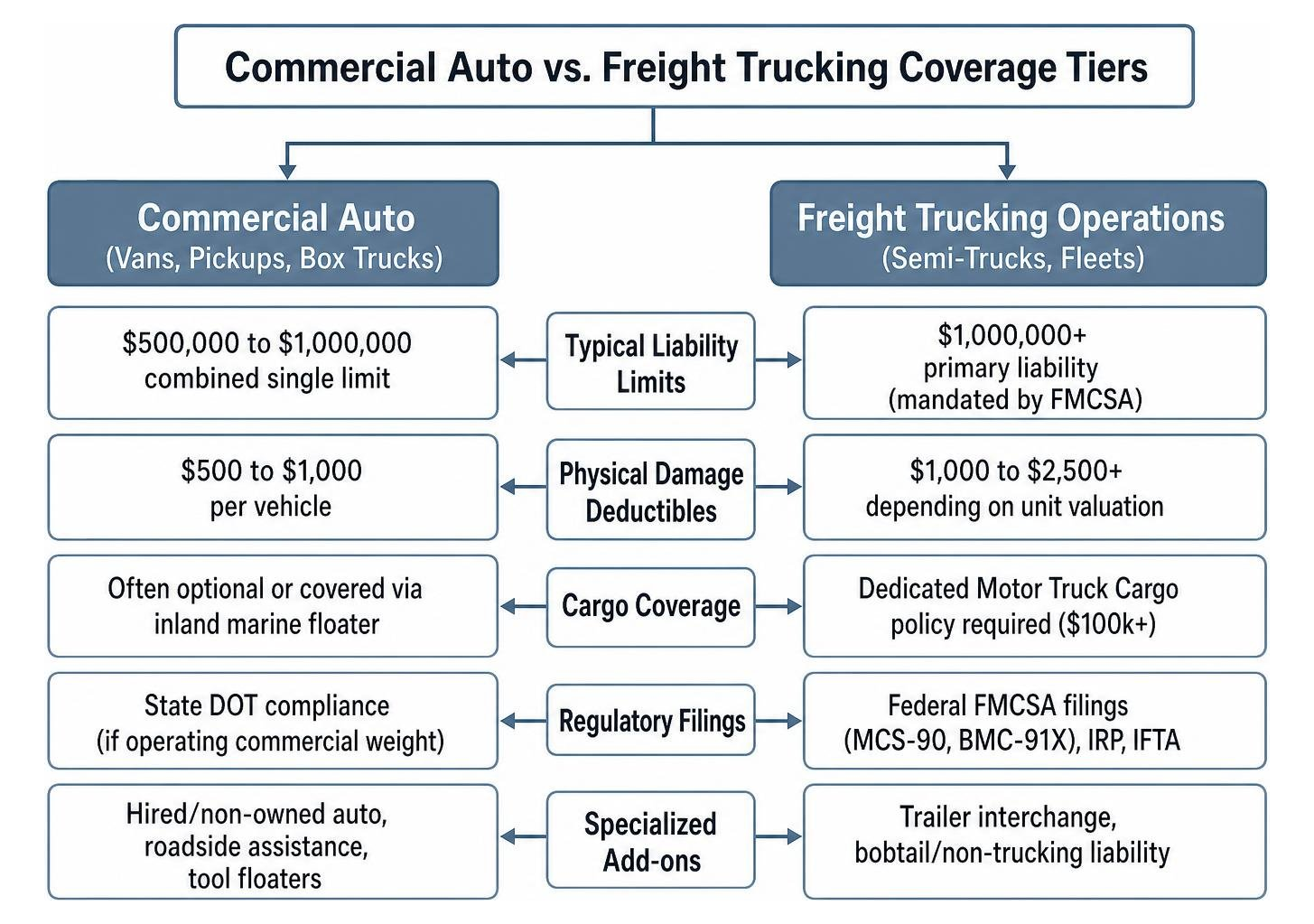
| Typical Liability Limits | $500,000 to $1,000,000 combined single limit | $1,000,000+ primary liability (mandated by FMCSA) |
| Physical Damage Deductibles | $500 to $1,000 per vehicle | $1,000 to $2,500+ depending on unit valuation |
| Cargo Coverage | Often optional or covered via inland marine floater | Dedicated Motor Truck Cargo policy required ($100k+) |
| Regulatory Filings | State DOT compliance (if operating commercial weight) | Federal FMCSA filings (MCS-90, BMC-91X), IRP, IFTA |
| Specialized Add-ons | Hired/non-owned auto, roadside assistance, tool floaters | Trailer interchange, bobtail/non-trucking liability |
Cargo and Specialized Endorsements
For companies transporting freight or client goods, standard auto liability does not cover the freight inside the cargo hold. You need specialized cargo endorsements to bridge this financial exposure.
Key specialized options include:
- Motor Truck Cargo Insurance: Reimburses you for damaged or lost freight caused by collisions, fire, or theft while in transit.
- Inland Marine Floaters: Ideal for service contractors who transport high-value machinery, welders, and equipment from shop to job site.
- Non-Trucking Liability (Bobtail Coverage): Provides liability protection for independent owner-operators when operating the truck cab without a trailer for personal or non-revenue use.
- Trailer Interchange Insurance: Protects non-owned trailers pulled under a formal interchange contract against physical damage.
Be mindful of the 72-hour cargo storage rule. Many standard cargo policies exclude claims for goods stored in an unhitched trailer or warehouse facility for more than 72 hours. If your operations require staging freight over weekends or during supply chain delays, ensure your policy is endorsed for extended terminal storage.
How to Choose the Best Commercial Vehicle Insurance Company for Your Fleet
Selecting an insurer requires looking past marketing claims and evaluating how carrier policies perform when an accident disrupts your workflow.
When reviewing carrier proposals, prioritize these five performance benchmarks:
- A.M. Best Financial Strength Rating: Target carriers rated “A-” (Excellent) or better to ensure long-term stability and claims-paying capacity.
- Claims Resolution Speed: Inquire about dedicated commercial claims units that offer direct repair networks, rapid adjusters, and commercial vehicle rental allowances.
- Driver MVR Monitoring Support: Look for carriers that integrate motor vehicle record (MVR) screening tools to help you identify high-risk driving behavior before it causes an incident.
- Telematics and Loss Control Programs: Modern providers offer discounted rates for fleets that install dashcams or telematics units to track speeding, hard braking, and route adherence.
- Billing and Deductible Flexibility: Investigate first-dollar policies, flexible deductible structures, or seasonal payment plans that match your cash flow cycle.
Working through independent agents gives you the advantage of comparing multiple quotes across multiple carriers at once. This approach helps you secure affordable business insurance without sacrificing critical policy limits or accepting high deductibles.
Evaluating Commercial Vehicle Options for Small Fleets
Small business fleets commonly rely on service utility vans, light-duty pickups, and medium box trucks. For these operations, coverage should focus on multi-driver flexibility.
A sound policy for small fleets should clearly define permissive use and named driver schedules. If multiple technicians rotate driving your service vans, your policy must permit employee operation without triggering unauthorized driver exclusions. We help local enterprises establish comprehensive commercial insurance PA packages that bundle commercial auto with general liability and property coverage to prevent gaps in coverage.
What Insurers Deliver for Heavy Trucking
Heavy trucking operations involve heightened risk profiles, higher vehicle weights, and rigorous regulatory oversight. Carrying an 80,000-pound combination vehicle across state lines demands specialized underwriting.
Leading transportation carriers provide:
- Federal and State Filings: Instant electronic processing of FMCSA filings, DOT registrations, and state-mandated certificates to keep authority active.
- $1,000,000 Minimum Primary Auto Liability: Meeting standard shipper, broker, and regulatory contracts.
- High-Capacity Cargo Coverage: Tailored limits for temperature-controlled reefer freight, dry van goods, or heavy machinery.
- Specialized Radius Management: Coverage options engineered for local, intermediate, or 48-state long-haul routes.
For a deeper dive into regional logistics compliance, consult our Commercial Truck Insurance PA Guide 2026 to understand state-level weight thresholds and filings.
Commercial Auto vs Personal Auto: Managing Costs and Exclusions
A common mistake made by new business owners is relying on personal auto insurance for business operations. While personal auto policies cost less, they almost universally exclude physical damage and liability claims that occur during business activities.

If an employee crashes a personal vehicle while delivering products, hauling construction materials, or driving between paid client jobs, a personal insurer will likely deny the claim. That denial leaves the business owner personally responsible for medical bills, property destruction, and legal judgments.
Personal auto policies also enforce strict gross vehicle weight rating (GVWR) caps, typically excluding any vehicle over 10,000 pounds. Commercial auto policies easily accommodate heavier classifications, including utility bucket trucks, flatbeds, and dump trucks.
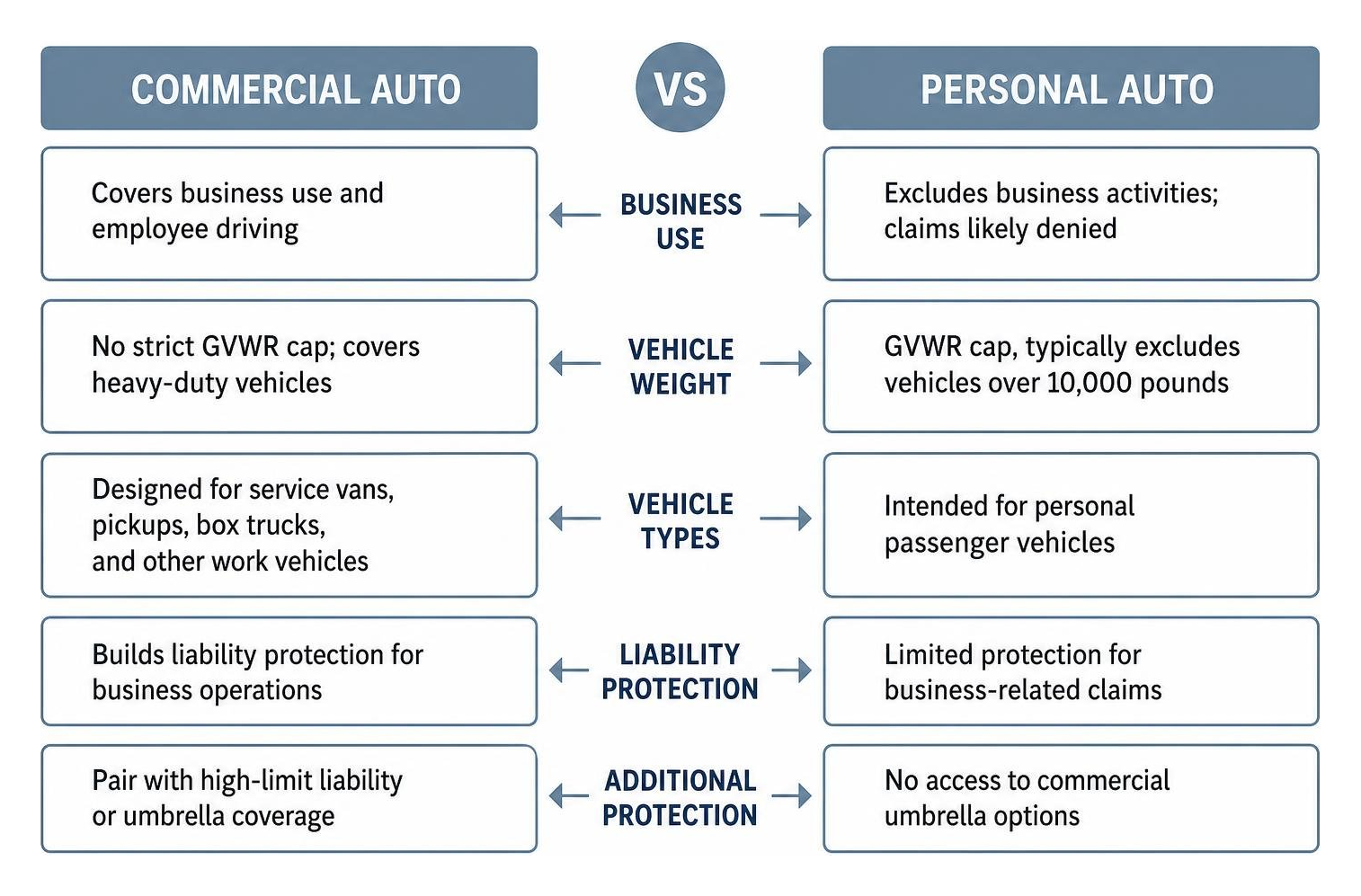
To defend your enterprise against severe liabilities that exceed basic policy limits, consider pairing your primary auto coverage with high-limit liability insurance PA or a commercial umbrella policy. Umbrella coverage provides an extra layer of liability protection—often in increments of $1,000,000—that activates once your primary auto liability limits are exhausted in a major collision.
Frequently Asked Questions About Commercial Vehicle Insurance
Are employees automatically covered when driving company vehicles?
Employees are generally covered if they are listed as named drivers on the policy or if the policy explicitly includes permissive use provisions for company business. However, carriers require regular motor vehicle record (MVR) reviews for all active staff. If an employee with a suspended license or multiple major violations causes an accident, the insurer may investigate or deny the claim. Commercial auto covers auto liability and property damage—any workplace injuries suffered by your employees must be covered through a separate workers’ compensation policy.
What factors have the biggest impact on commercial auto premiums?
Commercial vehicle insurance rates depend on several core operational variables:
- Driver History: Clean MVRs across your entire team significantly reduce premiums.
- Operating Radius: Local delivery routes cost less to insure than regional or long-haul routes due to lower highway exposure.
- Gross Vehicle Weight (GVWR): Heavier vehicles create more impact damage in an accident, requiring higher premiums.
- Cargo Type and Value: Hazardous materials, heavy equipment, or high-theft freight require specialized endorsements.
- Garaging Location: Vehicles parked in congested, high-traffic urban areas carry higher rates than those stationed in secure suburban yards.
What are the most common exclusions in commercial auto and cargo policies?
Standard commercial auto policies do not cover every loss scenario. Common exclusions include:
- Wear, Tear, and Mechanical Failure: Blown transmissions, engine seizures, and worn brakes are regular maintenance issues, not insurable events.
- Unlisted and Unapproved Cargo: Hauling high-risk items (such as explosives, live animals, fine art, or unmanifested cash) without specific endorsements will void cargo claims.
- Intentional Damage or Illegal Acts: Damages caused deliberately by the owner or while committing a criminal offense are strictly excluded.
- Unattended Storage Past 72 Hours: Cargo left unattended in a yard or unhitched trailer past policy time allowances without authorization is typically excluded from theft coverage.
Conclusion
Protecting your fleet requires a careful balance between broad coverage limits and manageable operating overhead. Whether you manage two local service vans or an expanding distribution fleet, selecting the right partner ensures your business remains protected after a loss.
At Newtown Insurance, we provide transparent pricing, tailored policy design, and hands-on risk management advice to protect your business. Explore our commercial protection options today to compare commercial auto terms, secure your fleet, and keep your business moving forward.