Why Full Tort Auto Insurance Can Protect Your Right to Full Compensation
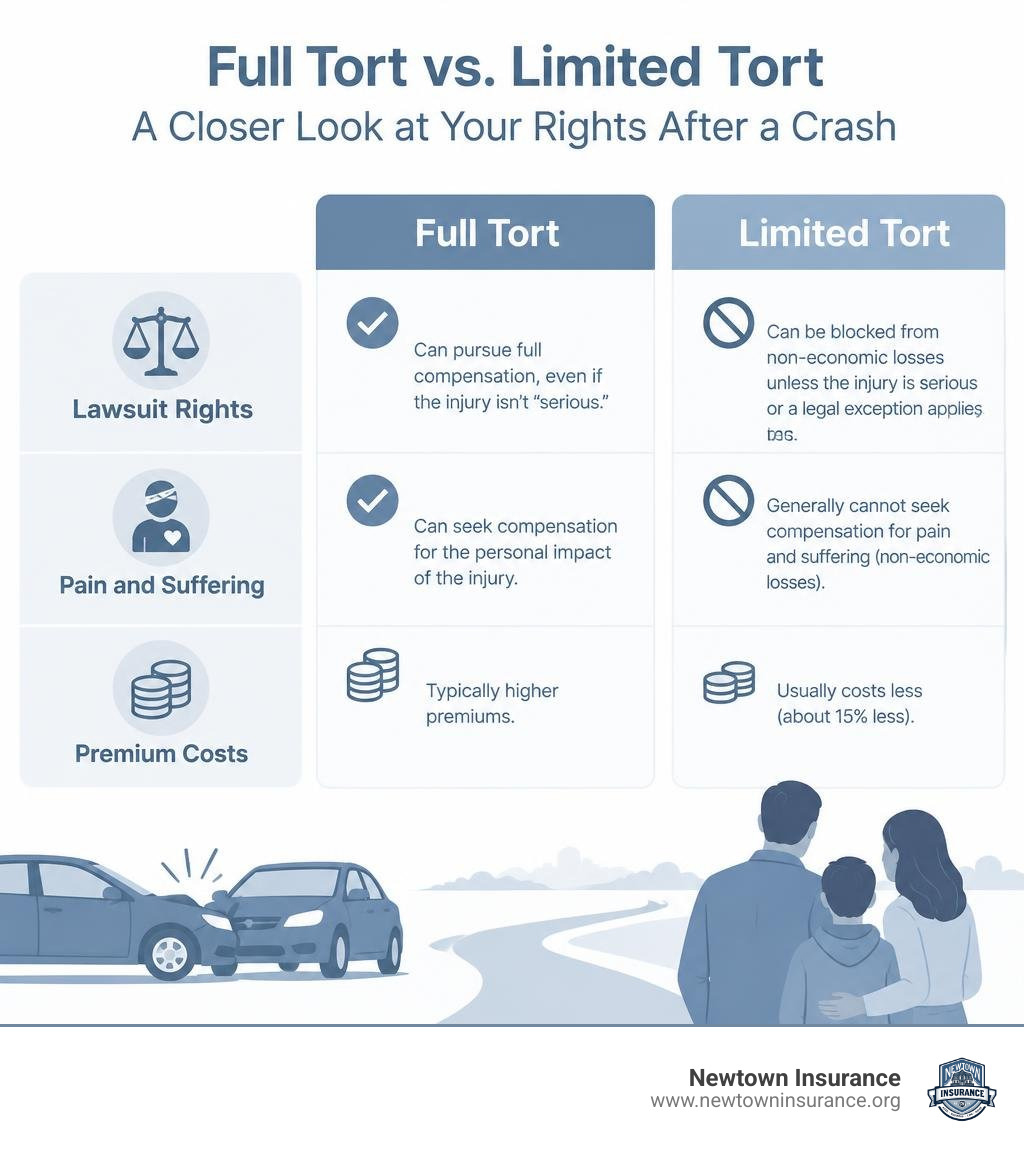
Full tort auto insurance preserves your right to seek pain and suffering compensation from an at-fault driver, even when an injury does not meet a legal “serious injury” threshold. Limited tort usually costs less, but it can block recovery for non-economic losses unless your injury is serious or a legal exception applies.
For Pennsylvania drivers, the choice is a trade-off: limited tort may save roughly 15% on premiums, often about $50 to $200 a year, while full tort keeps more options open after a crash. Both options can allow claims for measurable losses like medical bills, lost wages, and vehicle damage. The major difference is your ability to pursue compensation for the personal impact of an injury.
Full tort is also not the same as “full coverage.” Tort coverage affects your legal rights after an accident; collision, comprehensive, liability, and uninsured motorist coverage affect what your policy may pay.
I’m Shawn Beihl, an insurance professional with more than 15 years of experience across specialty insurance, commercial property and casualty, health, accident, benefits, and disability coverage. I help families evaluate full tort auto insurance and other policy choices based on real risks, clear costs, and long-term financial protection.
Basic full tort auto insurance terms:
Understanding Full Tort Auto Insurance vs. Limited Tort Options

When selecting auto protection, many drivers encounter a check box asking them to choose between “full tort” and “limited tort.” In the legal world, a “tort” is simply a civil wrong that causes someone harm or loss, resulting in legal liability for the person who committed the act. In auto insurance, your tort election determines the scope of your legal rights to pursue compensation from an at-fault driver if you are injured in an accident.
To understand why this choice exists, look at our comprehensive Pennsylvania auto insurance guide 2026. At its core, the distinction lies in the retention of your constitutional and civil rights. Opting for full tort means you give up zero legal rights; you retain the unrestricted ability to hold negligent parties fully accountable for all consequences of a collision, both tangible financial costs and personal, intangible suffering.
Legal Definitions: Tort Systems vs. No-Fault Systems
Across the United States, auto insurance systems fall primarily into two camps:
- Traditional Tort States (38 States): In pure tort states, the driver who caused the crash is legally responsible for paying the damages. Victims can seek recovery from the at-fault driver’s insurance carrier for medical bills, property repair, lost wages, and pain and suffering without needing to meet arbitrary injury thresholds.
- Pure No-Fault States (12 States): In these jurisdictions, every driver turns to their own insurance company—specifically through Personal Injury Protection (PIP)—to cover immediate medical bills and basic economic losses, regardless of who caused the crash. In exchange for prompt medical payment, drivers surrender their right to sue the negligent driver unless their medical bills reach a monetary threshold or their injuries exceed a verbal threshold (such as permanent disfigurement or death).
The Three Choice States: Pennsylvania, New Jersey, and Kentucky
A few states offer a hybrid approach called “choice no-fault.” Pennsylvania, New Jersey, and Kentucky permit motorists to decide whether they want an unrestricted tort system or a modified no-fault threshold system.
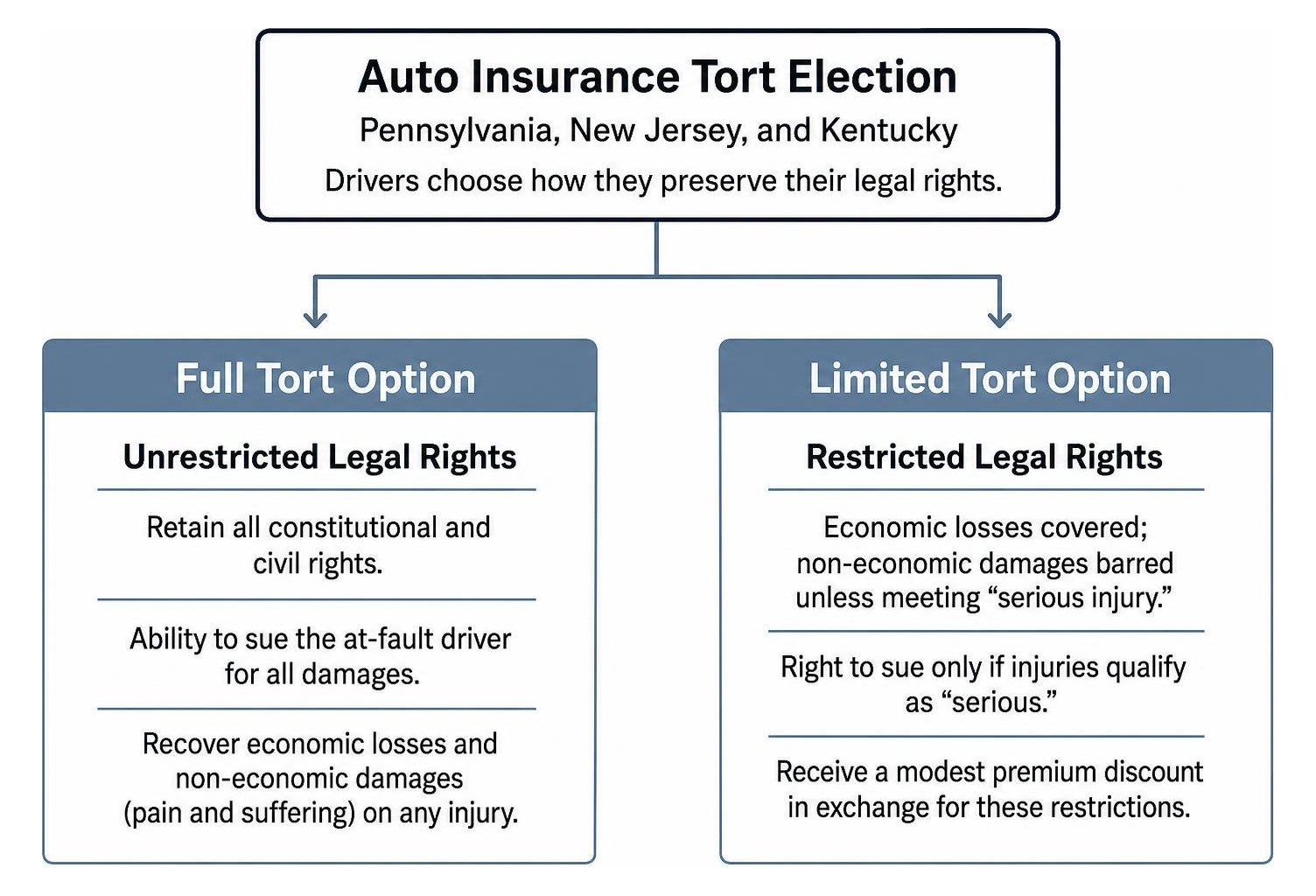
Under the Pennsylvania Title 75 statute (specifically 75 Pa.C.S. § 1705), Pennsylvania drivers must make this election in writing. If you pick limited tort, you secure a modest discount on your premium in exchange for waiving your right to sue for non-economic damages unless your injuries qualify as “serious.” If you choose full tort, you maintain complete legal recourse.
In neighboring New Jersey, the system functions similarly under the “Limitation on Lawsuit” threshold for Standard Policies, where minimum liability limits stand at $35,000 per person and $70,000 per accident as of 2026. Kentucky provides a similar mechanism, allowing motorists to formally opt out of its no-fault system.
Full Tort vs. Limited Tort: Recoverable Damages and the Serious Injury Threshold
The practical consequences of your tort election become apparent after a crash. While both choices provide coverage for financial losses, they diverge when compensating for the personal toll of an accident.
| Feature / Coverage Aspect | Full Tort Coverage | Limited Tort Coverage |
|---|---|---|
| Out-of-Pocket Medical Bills | Covered (100% recoverable) | Covered (100% recoverable) |
| Lost Wages & Earnings | Covered (100% recoverable) | Covered (100% recoverable) |
| Vehicle Repair Costs | Covered (100% recoverable) | Covered (100% recoverable) |
| Pain and Suffering | Unrestricted (any injury level) | Barred (unless “serious injury” or exception) |
| Loss of Life’s Pleasures | Unrestricted recovery | Barred (unless meeting threshold) |
| Annual Premium Impact | Standard baseline premium | Approximately 15% discount ($50–$200 savings) |
| Litigation Hurdles | Must only prove fault & damages | Must prove fault, damages, AND injury threshold |
Non-Economic Damages Recoverable with Full Tort Auto Insurance
When a collision disrupts your life, the expenses you can itemize on paper represent only part of your loss. Non-economic damages compensate for the physical, mental, and lifestyle burdens caused by an accident:
- Physical Pain and Suffering: Enduring chronic back pain, nerve damage, or daily discomfort.
- Loss of Life’s Pleasures: The inability to play with your children, enjoy hobbies, exercise, or garden.
- Emotional Distress and Mental Anguish: Anxiety, depression, sleep disturbances, or post-traumatic stress stemming from the collision.
- Loss of Consortium: The negative impact an injury has on your relationship and intimacy with your spouse.
Under limited tort, if you suffer soft tissue tears, whiplash, or a herniated disc that causes years of pain but doesn’t completely incapacitate you, insurers will reimburse your direct medical bills, but will offer zero compensation for your pain and distress. With full tort protection, you can pursue fair compensation for these life-altering consequences.
The Serious Injury Threshold and Statutory Exceptions for Limited Tort
To recover non-economic damages under a limited tort policy, your injury must satisfy the statutory definition of a “serious injury,” defined under Pennsylvania law as death, serious and permanent disfigurement, or a serious impairment of a body function. Proving a “serious impairment” requires establishing that a vital body function was substantially compromised for a significant duration, a difficult legal standard that insurers frequently dispute in court.
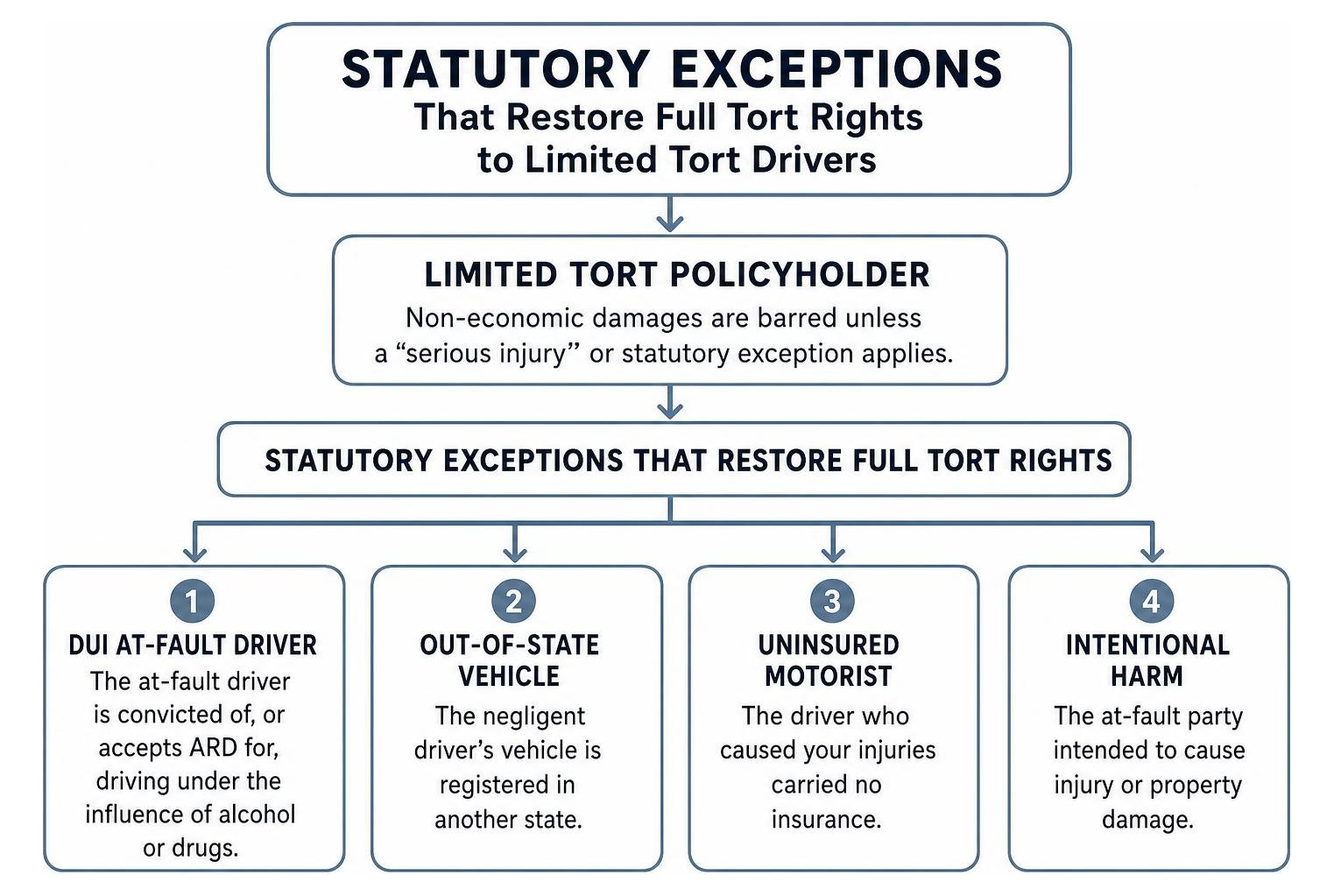
Pennsylvania law includes specific statutory exceptions where a limited tort policyholder is automatically treated as having full tort rights:
- DUI At-Fault Driver: The at-fault driver is convicted of, or accepts Accelerated Rehabilitative Disposition (ARD) for, driving under the influence of alcohol or drugs.
- Out-of-State Vehicle: The negligent driver’s vehicle is registered in another state.
- Uninsured Motorist: The driver who caused your injuries carried no insurance.
- Intentional Harm: The at-fault party intended to cause injury or property damage.
- Non-Passenger Vehicles: You were injured while occupying a motorcycle, commercial vehicle, bus, or taxi, or you were hit as a pedestrian or bicyclist.
- Defective Product Claims: Your injuries resulted from a vehicle manufacturing defect, allowing a third-party product liability claim.
Full Tort vs. Full Coverage: Demystifying Common Auto Policy Misconceptions
A frequent misconception among policyholders is confusing full tort with “full coverage.”
“Full coverage” is an industry marketing term rather than a legal designation. It generally describes a policy package containing:
- Bodily Injury Liability: Pays for injuries you cause to others.
- Property Damage Liability: Pays for damage you cause to others’ property.
- First-Party Medical Benefits: Pays your initial medical bills via PIP.
- Collision Coverage: Pays to repair your vehicle if you hit an object or another vehicle.
- Comprehensive Coverage: Covers non-collision damage like theft, vandalism, storm damage, or hitting an animal.
You can purchase a “full coverage” policy with extensive collision and comprehensive endorsements while still selecting limited tort. If you do, your vehicle will be repaired if damaged, but your personal right to recover pain and suffering compensation remains restricted.
Mandatory Minimum Coverage vs. Optional Physical Protection
To register and operate a vehicle legally, state statutes establish minimum insurance baselines. Reviewing the auto insurance requirements in Pennsylvania shows that drivers must carry:
- $15,000 for bodily injury to one person in an accident.
- $30,000 total bodily injury liability per accident.
- $5,000 for property damage liability.
- $5,000 in mandatory first-party medical benefits.
These baseline minimums have not increased in decades and leave policyholders vulnerable after a major collision. Selecting adequate liability limits alongside collision, comprehensive, and loan payoff endorsements (such as gap insurance) protects your personal finances, while your tort election protects your legal claims if someone else injures you.
How Uninsured Motorist Coverage Interacts with Full Tort Auto Insurance
Your tort choice also influences claims filed under your own policy for Uninsured Motorist (UM) and Underinsured Motorist (UIM) benefits. When an at-fault driver has zero insurance or lacks adequate liability limits to pay for your damages, you turn to your own UM/UIM coverage to cover the remaining costs.
Evaluating underinsured motorist protection is critical because your tort status follows you into UM/UIM claims. If you elected limited tort and the at-fault driver is insured but underinsured, you must still satisfy the “serious injury” threshold to recover non-economic compensation from your own insurance carrier. If you elected full tort, you can recover full non-economic damages directly from your UIM policy up to your purchased limits.
Cost Analysis: Is Full Tort Auto Insurance Worth the Premium Difference?
Premium Breakdown: The 15% Trade-Off
On average, selecting limited tort saves policyholders approximately 15% on their annual bodily injury and first-party premiums. In dollar terms, this discount typically amounts to $50 to $200 per vehicle per year.
While saving $10 to $15 per month can help tight household budgets, it creates substantial financial risk if an accident occurs. A moderate neck or spine injury that does not satisfy the “serious injury” standard might result in a $0 non-economic settlement under limited tort. Under full tort, that same injury could warrant a settlement ranging from $20,000 to $75,000 or more to account for physical pain, missed family activities, and daily discomfort.
To find the right balance between cost and coverage, drivers can use a car insurance calculator and explore savings through auto and home bundle options, good driver incentives, and multi-vehicle policies.
Legal Leverage and Settlement Negotiations After an Accident
Your tort selection significantly affects your leverage during settlement discussions. Insurance claims adjusters immediately verify a claimant’s tort status:
- With Limited Tort: Adjusters understand you face steep litigation hurdles to reach a courtroom jury on non-economic damages. Unless your injury involves a compound fracture, amputation, or clear surgical intervention, adjusters often present minimal settlements that cover only unreimbursed medical bills.
- With Full Tort: Adjusters recognize that your attorney can present the full human story of your injury to a civil jury without clearing arbitrary threshold barriers. This litigation exposure encourages insurers to negotiate fairly and resolve claims more efficiently prior to trial.
Election Rules, Default Selections, and Changing Your Tort Option
The tort election form is a legally binding document with specific statutory requirements:
- The Household Rule: Your election applies to you and all resident relatives in your household who do not own their own insured vehicle. If a parent selects limited tort, their dependent children are bound by limited tort if injured as passengers or pedestrians.
- Signed Waiver Mandate: An insurer must obtain a valid, signed tort selection form from the named insured.
- Unsigned Presumption: If an insurer cannot produce your signed waiver form selecting limited tort, Pennsylvania courts legally presume the policy carries full tort coverage.
Frequently Asked Questions About Tort Auto Insurance
What happens if I do not select a tort option on my application?
If you purchase an auto policy and do not sign a tort election form, or if the insurer misplaces the documentation, state law dictates that your policy automatically defaults to full tort coverage. Insurers cannot apply a limited tort restriction without an executed waiver.
Can I switch between limited tort and full tort at any time?
Yes. You can contact your insurance agent and change your tort option during your policy term or at renewal by signing an updated election form. However, tort changes are never retroactive; the election active on the date and time of an accident governs any claims arising from that collision.
Does my tort election apply to family members and passengers in my vehicle?
Your tort election binds your spouse and resident relatives who do not maintain their own auto insurance policies. Non-relative passengers riding in your vehicle are governed by their own household auto insurance policies. If a passenger does not own a car or reside with an insured relative, they are generally afforded full tort rights under state law.
Conclusion
Choosing between full tort and limited tort comes down to balancing modest short-term savings against your long-term legal protection. While limited tort can reduce your annual insurance bill by roughly 15%, it strips away your right to seek compensation for pain, suffering, and loss of life’s pleasures unless you suffer a catastrophic injury or meet narrow statutory exceptions.
At Newtown Insurance, our team helps drivers assess their coverage to ensure their families are properly protected. Review your policy options and request an auto insurance quote with us today to secure comprehensive protection tailored to your household’s needs. To explore our full suite of personal and commercial coverage, visit our services page or contact our Newtown office to discuss your policy.