Find Teacher Discount Car Insurance and Lower Your Total Rate
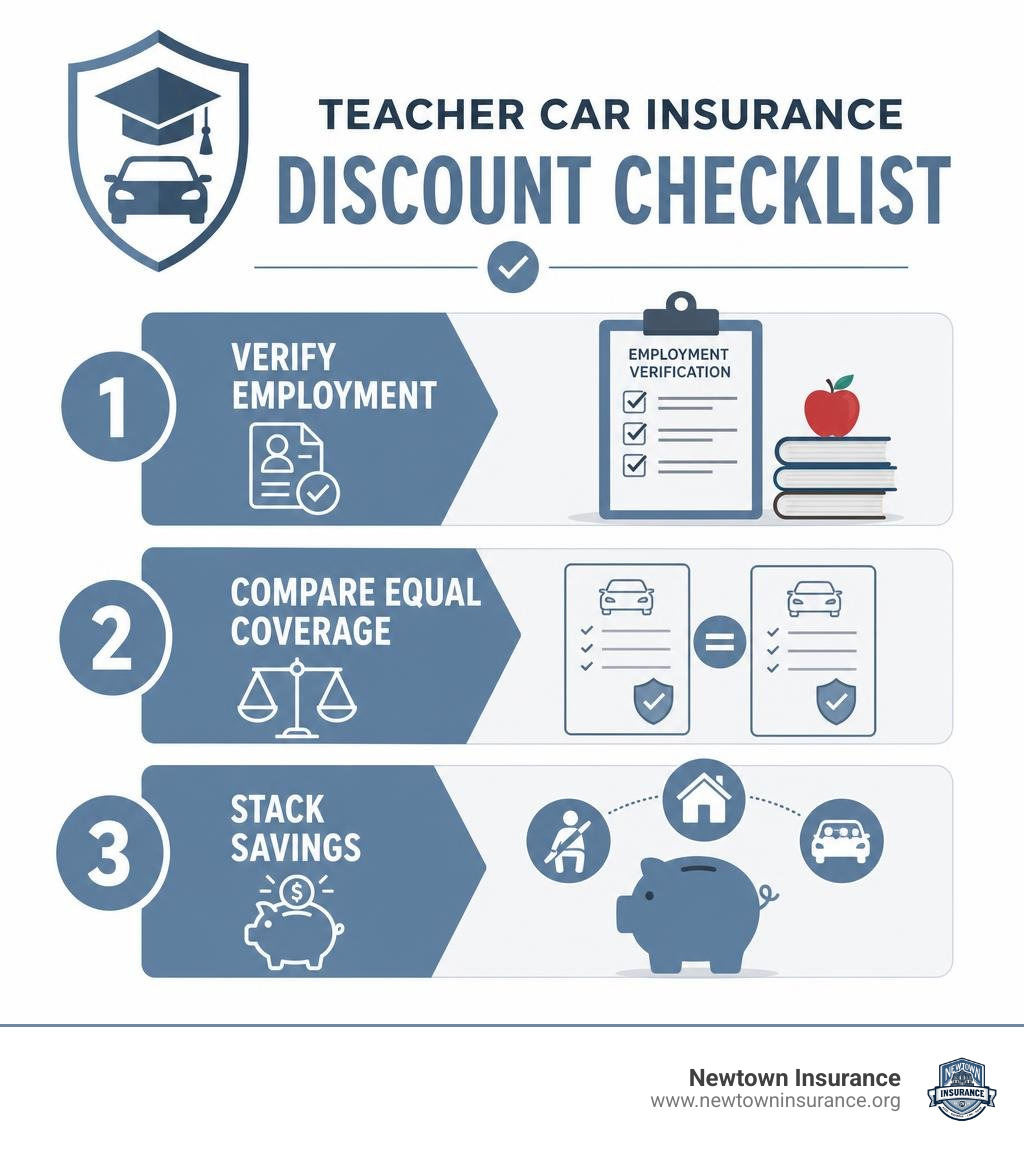
Teachers may qualify for an educator discount, often around 5% to 10%, but the best savings usually come from combining it with safe-driver, low-mileage, multi-car, and home-auto bundle discounts. To find teacher discount car insurance, get comparable quotes with the same coverage limits, ask whether your school or professional association qualifies, and submit a school ID, teaching license, pay stub, or union membership card when requested.
A bigger educator discount does not always mean a lower bill. One insurer may offer 10% off a higher starting premium, while another offers a smaller discount and a better final annual price. Pennsylvania teachers should compare the total premium, deductible, coverage, and service experience – not just the advertised percentage.
Occupation-based discounts are restricted in California, Hawaii, and Massachusetts. In Pennsylvania, educator discounts may be available, but eligibility and savings vary by carrier and policy.
I am Shawn Beihl of Newtown Insurance. With more than 15 years in specialty insurance and risk management, I help people review teacher discount car insurance options, uncover practical savings, and build coverage around real driving risks.
Teacher discount car insurance glossary:
How to Qualify for Teacher Discount Car Insurance
Securing an occupational discount on your auto policy comes down to how underwriting models assess risk. Actuarial data shows that educators statistically file fewer severe claims. Why did the teacher get a lower insurance premium? Because they always follow the rules—on the road, too!
From a mathematical perspective, teachers generally maintain structured, predictable schedules. You drive to school during standard morning hours, leave before late-night peak incident windows, and typically keep up with vehicle maintenance. Underwriters view these stable driving habits as strong risk mitigation, which allows companies to provide targeted rate reductions.
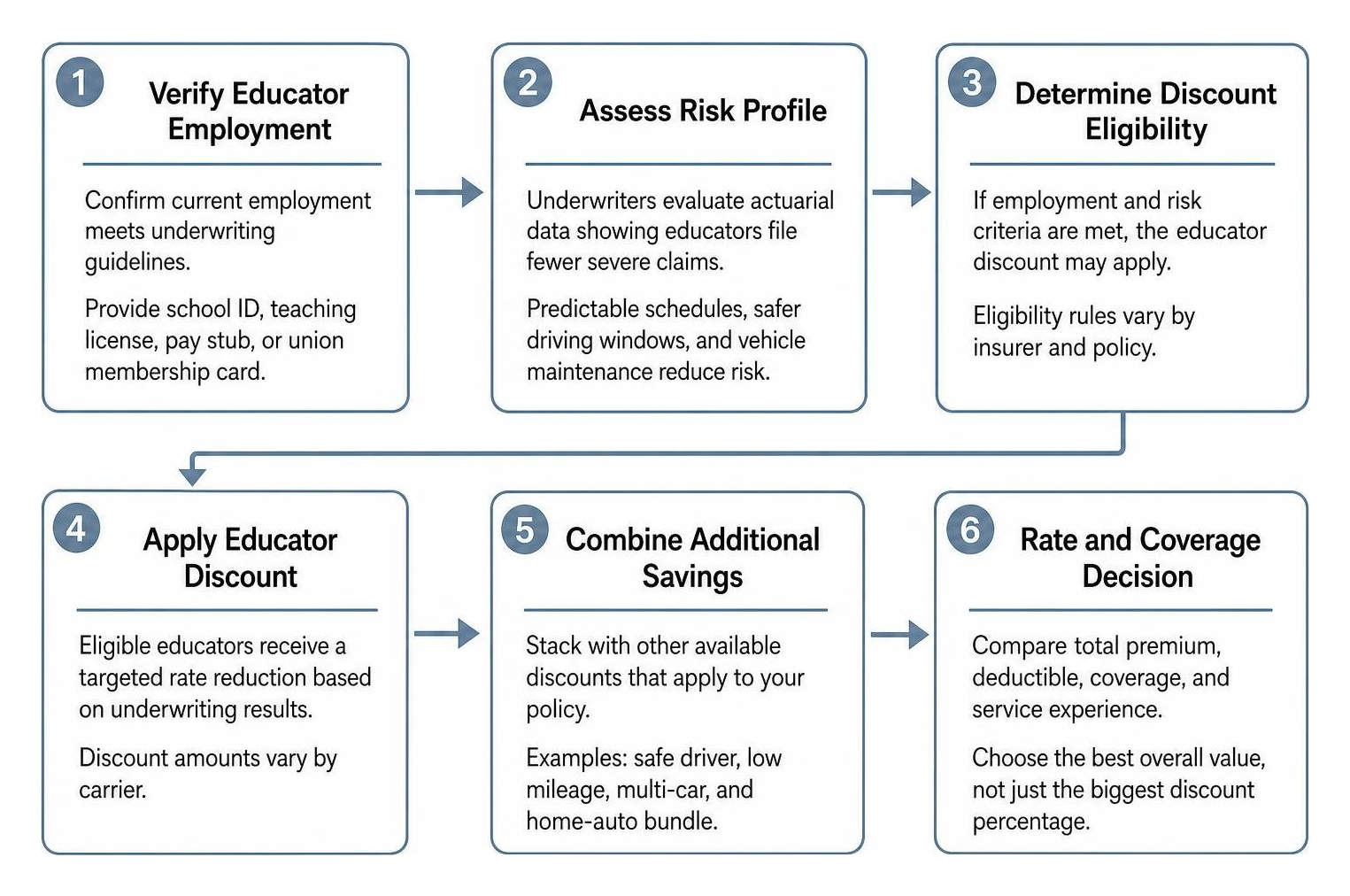
To unlock these savings, you must show that your current employment meets the specific parameters established by the underwriting guidelines.
Who Is Eligible for Teacher Discount Car Insurance?
Eligibility guidelines vary, but coverage programs generally encompass a broad cross-section of the education community. You do not necessarily need to be a tenured classroom instructor in a public school district to qualify.
Common eligible educational roles include:
- Accredited K–12 Teachers: Full-time and certified classroom instructors in public, private, charter, or parochial schools.
- College and University Professors: Faculty members, adjunct instructors, and lecturers at accredited post-secondary institutions.
- Educational Support Staff: School counselors, speech-language pathologists, librarians, school nurses, and instructional aides.
- School Administrators: Principals, vice principals, deans, and district administrative staff.
- Professional Union & Association Members: Members of organizations like the National Education Association (NEA) or the American Federation of Teachers (AFT).
Industry resources like Best Car Insurance Discounts for Teachers | MoneyGeek show that association affiliations often unlock group-level pricing tiers that differ from baseline occupational cuts.
Required Documentation and Verification Process
To claim your occupational discount, insurers require official documentation proving active employment or professional membership. Having these items organized before you request a policy adjustment ensures immediate application of your savings.
The verification process typically accepts:
- School District ID Badge: A current photo ID showing your name, school district, and the active academic year.
- State Teaching License: A valid, active educator credential or certification issued by your state department of education.
- Recent Pay Stub: An earnings statement from the past 30 to 60 days verifying active payroll status with an accredited school or university.
- Union or Professional Membership Card: Proof of good standing in an approved professional association.
Most underwriting departments maintain an annual verification schedule. They typically review policies 30 to 60 days before your annual renewal date to ensure credentials remain current.
State Availability and Regional Restrictions
State-level insurance regulations determine whether carriers can use your occupation as a rating factor. While most states permit professional group discounts, specific consumer protection statutes in states like California (under Proposition 103), Hawaii, and Massachusetts restrict or prohibit occupation-based auto insurance discounts.
In Pennsylvania, occupational rating is fully compliant with state regulations. However, discount structures, eligibility definitions, and savings percentages vary between regional carriers. Understanding these guidelines through our Pennsylvania auto insurance guide 2026 helps you identify how local underwriting rules affect your bottom-line pricing.
Top Stacking Strategies for Educator Auto Coverage

An educator discount on its own typically trims 5% to 10% from your baseline costs. The real savings occur when you stack occupational pricing with other qualifying discounts.
When you apply multiple discounts, insurers generally calculate reductions sequentially against your adjusted base premium. For example, combining a 10% educator discount with a 10% safe driver discount yields roughly 19% in net savings off the starting base rate.
Strategic stacking allows educators to shave 25% to 30% or more off their overall premium.
| Discount Category | Average Savings Percentage | Estimated Annual Dollar Savings | Stackable With Teacher Discount? |
|---|---|---|---|
| Standard Educator Discount | 5% – 10% | $90 – $195 | Baseline |
| Home & Auto Policy Bundle | 10% – 15% | $150 – $280 | Yes |
| Multi-Vehicle Coverage | 10% – 20% | $140 – $300 | Yes |
| Safe Driver / Clean Record | 10% – 26% | $180 – $450 | Yes |
| Low Annual Mileage | 5% – 10% | $75 – $160 | Yes |
| Telematics / Driving App | 10% – 30% | $150 – $400 | Yes |
Bundling and Multi-Vehicle Reductions
One of the easiest ways to expand your savings is pairing auto coverage with property protection. Combining personal auto lines with a homeowners, condo, or renters policy creates dual-policy credits across both accounts.
- Homeowners & Auto Bundling: Combining these coverages regularly adds 10% to 15% in cross-policy savings.
- Multi-Vehicle Accounts: Insuring two or more household vehicles under the same policy delivers tiered multi-car credits of up to 20%.
Our auto insurance savings complete guide outlines how multi-line policies protect household budgets against premium inflation.
Low Mileage and Seasonal Commute Adjustments
Your driving habits change noticeably when school is out of session. During summer vacations, winter breaks, and extended holidays, educators put fewer commuter miles on their vehicles.
If your annual driving drops below standard commuting thresholds (usually under 7,500 to 10,000 miles per year), you should notify your carrier to adjust your policy rating class. Incorporating smart driver discounts and usage-based telematics programs can unlock additional savings of 10% to 30%.
Safe Driving and Clean Record Incentives
Maintaining a spotless driving record remains the most impactful way to keep your auto insurance rates low. Insurers reward long-term clean histories with major premium reductions.
Drivers who complete an approved voluntary defensive driving course or maintain an incident-free record for 3 to 5 consecutive years can earn additional rate credits. Combining clean-record perks with professional educator pricing helps offset mandatory policy costs.
Reviewing our guide on safe driver insurance discounts alongside rankings in Best Car Insurance for Teachers of 2026 will show you how consistent driving habits lead to substantial annual savings.
Comparing Overall Premium Costs Beyond the Advertised Rate

A frequent pitfall for consumers is focusing exclusively on the advertised discount percentage rather than the total out-of-pocket premium. A 12% occupational discount applied to an inflated $2,000 baseline premium results in an annual bill of $1,760. Conversely, an 8% discount applied to a competitive $1,200 base rate results in a final cost of $1,104—saving you $656 more per year.
When evaluating options, look at the complete policy structure:
- Comprehensive & Collision Deductibles: Choosing a $500 versus a $1,000 deductible affects baseline costs before discounts are applied.
- Liability Limits: Ensure bodily injury and property damage limits match your actual financial exposure.
- First-Party Medical Benefits: In Pennsylvania, state law mandates personal injury protection, but limits can be tailored to your health insurance structure.
Educators looking for value can check our cheap auto insurance PA guide 2026 and request comprehensive auto insurance quotes to see how different base premiums influence final price points.
How to Apply for Teacher Discount Car Insurance Policies
Applying for educator discounts is a clear-cut process that takes only a few minutes when you have your documentation ready.
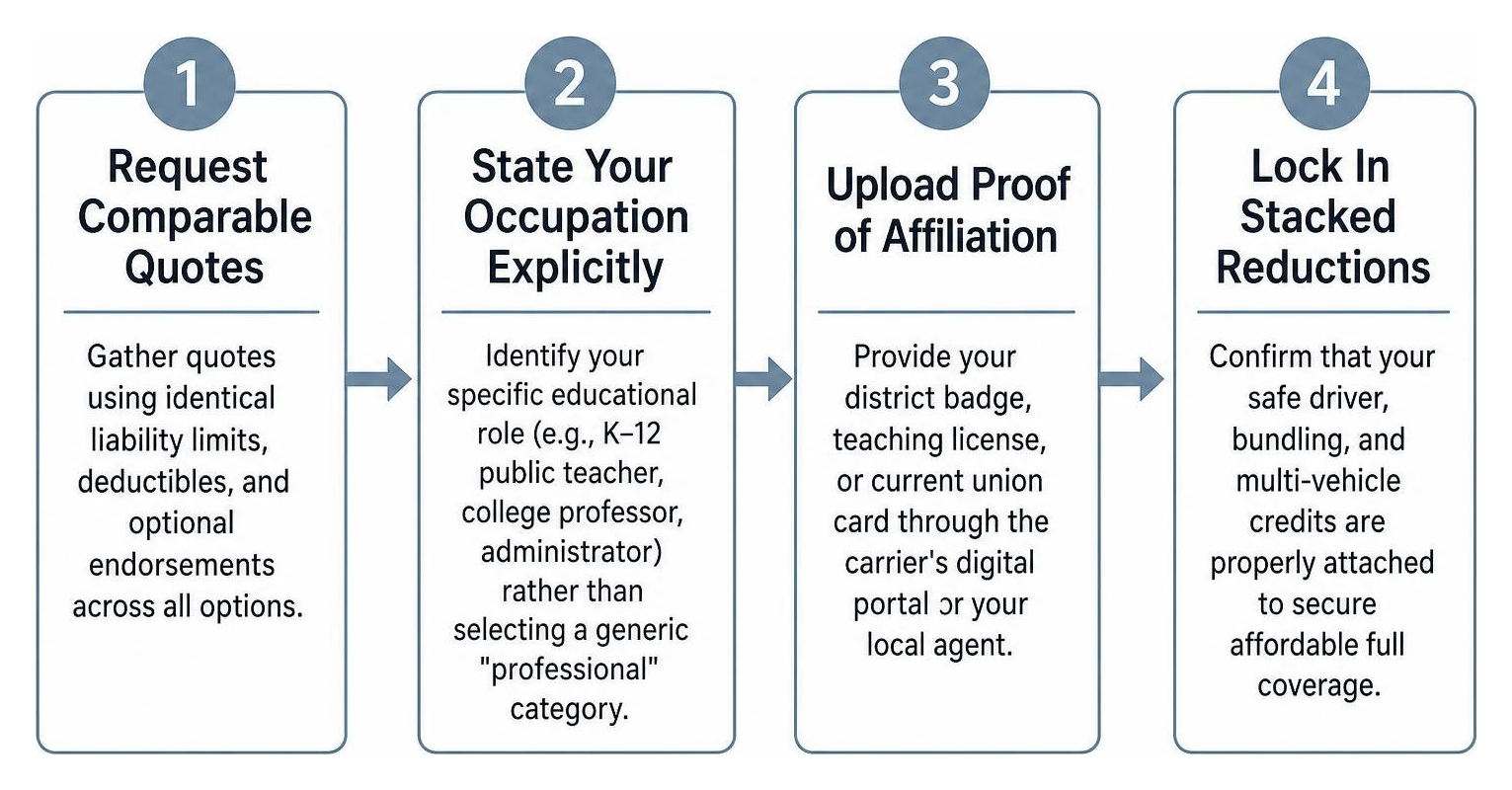
- Request Comparable Quotes: Gather quotes using identical liability limits, deductibles, and optional endorsements across all options.
- State Your Occupation Explicitly: Identify your specific educational role (e.g., K–12 public teacher, college professor, administrator) rather than selecting a generic “professional” category.
- Upload Proof of Affiliation: Provide your district badge, teaching license, or current union card through the carrier’s digital portal or your local agent.
- Lock In Stacked Reductions: Confirm that your safe driver, bundling, and multi-vehicle credits are properly attached to secure affordable auto insurance full coverage.
Frequently Asked Questions About Educator Car Insurance
Do retired and substitute teachers qualify for educator discounts?
Yes, many carriers extend occupational savings to retired educators and substitute teachers, though underwriting requirements differ:
- Retired Teachers: Qualifying usually requires proof of prior service, a state pension statement, or an active membership card with an organization like NEA-Retired.
- Long-Term Substitutes: If you work on an extended contract for an accredited district, a letter from district HR or recent pay stubs verifying continuous classroom hours will generally satisfy requirements.
- Per-Diem Substitutes: Part-time or day-to-day substitutes may face varying carrier rules. If you do not qualify for an occupational discount, you can still lower your bill with other options from our list of 6 car insurance discounts you should ask about.
Do teachers need to re-verify their employment annually to keep the discount?
In most cases, yes. Underwriters periodically audit policy files to confirm drivers remain in their qualifying occupational classes.
You will typically receive an automated notice 30 to 60 days prior to your policy’s annual renewal date asking for updated credentials. Uploading a copy of your current district ID badge or a recent pay stub preserves your discount for the next policy term. If you change school districts or retire, notify your agent to update your policy records without interrupting your coverage.
Is the carrier with the highest teacher discount always the cheapest?
Not necessarily. The final price you pay depends on the carrier’s starting baseline rate, your territory, driving record, credit-based insurance score, and vehicle type.
A carrier advertising a 10% educator discount on a high base rate can easily cost more than an insurer offering an 8% discount on a lower base rate. Review our analysis on the average cost of car insurance in PA to see how baseline carrier pricing impacts your real annual costs.
Conclusion
Maximizing your educator auto insurance savings involves more than looking for a quick occupational credit. True policy value comes from combining occupational discounts with safe driver incentives, multi-policy bundles, and mileage adjustments—all built on top of a competitive baseline rate.
At Newtown Insurance, we are proud to support Pennsylvania’s educators. We help teachers, administrators, and educational support staff evaluate their policies, stack eligible discounts, and secure transparent, reliable protection tailored to their lives.
To explore customized auto coverage options and see how much you can save, contact our team today at our Newtown Insurance Services Portal for a personal policy review.