
How to Save on Auto Insurance Through Policy Adjustments
To save on auto insurance, you can raise your comprehensive and collision deductibles, bundle your auto policy with home or renters insurance, claim eligible vehicle safety and safe-driver discounts, and drop physical damage coverages on older vehicles. Conducting a comprehensive coverage analysis on your policy declarations page helps uncover unnecessary add-ons and ensures you pay only for the protection you actually need.
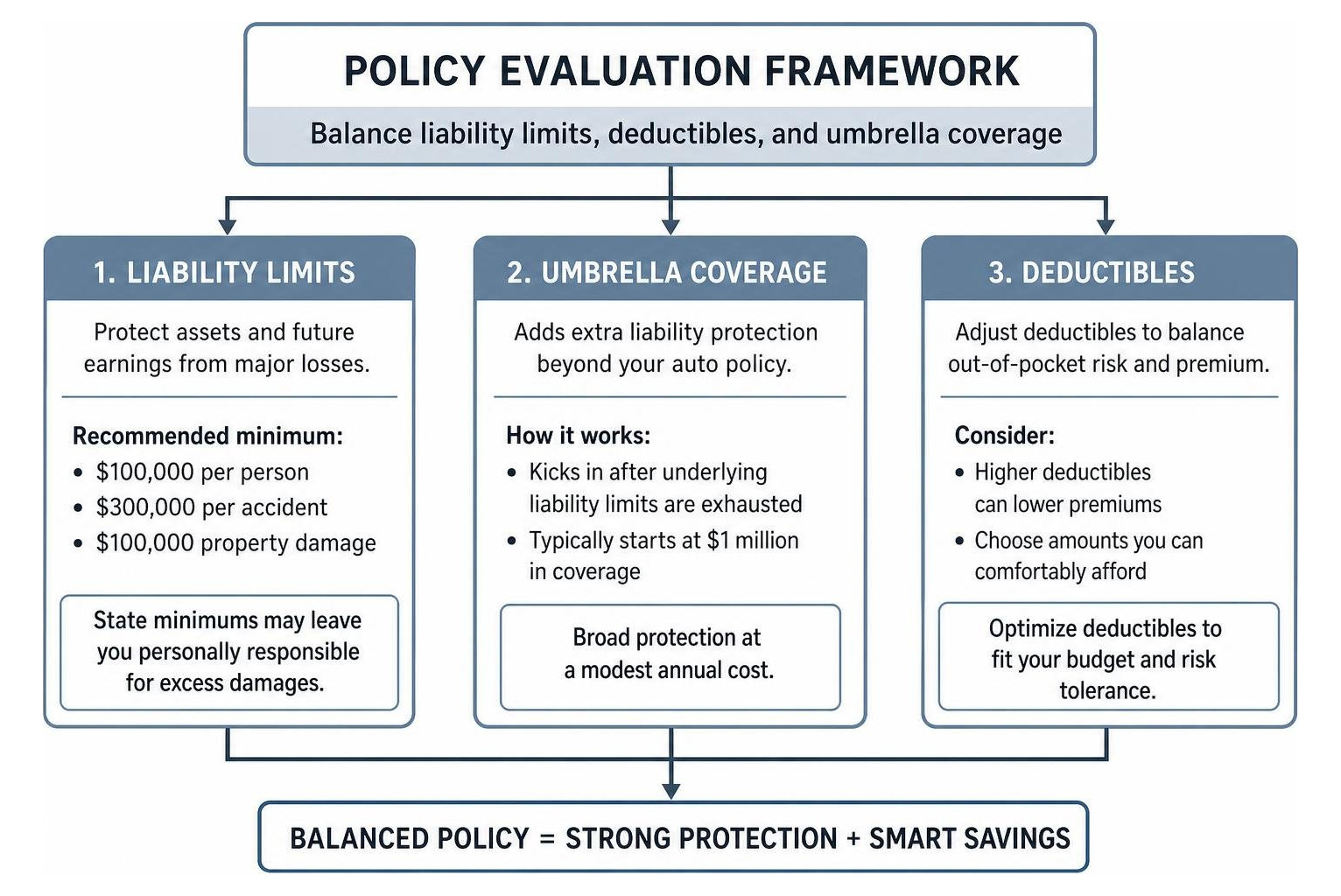
Liability coverage pays for injuries and property damage you cause to others in an at-fault accident. While state minimums exist, carrying only bare-bones limits leaves you personally responsible for any damages that exceed those caps. If you cause a multi-vehicle accident or an incident involving serious bodily injury, hospital bills and repair costs can easily soar past standard limits. To protect your home, savings, and future earnings, we generally recommend liability limits of at least $100,000 per person, $300,000 per accident for bodily injury, and $100,000 for property damage (often abbreviated as 100/300/100).
For households with significant assets, adding a standalone personal umbrella policy provides an extra layer of liability protection—typically starting at $1 million—at a very modest annual cost. Because umbrella policies kick in only after your underlying auto liability limits are exhausted, insurers price them affordably. Structuring your auto liability limits properly allows you to pair your policy with umbrella coverage seamlessly, securing peace of mind without overpaying.
Beyond liability, everyday policy accuracy matters. Small errors—such as a typo in your daily commute distance, an outdated vehicle trim level, or an unassigned primary driver—can skew your risk profile and inflate your premium. Systematically reviewing these details ensures you pay only for your true exposure.
Save on Auto Insurance by Optimizing Deductibles and Coverage
One of the most immediate levers you can pull to lower your ongoing premium is restructuring your physical damage coverages. If you carry affordable auto insurance full coverage, you are paying for comprehensive and collision insurance alongside your liability protections.
Raising your comprehensive and collision deductible is a proven strategy. Moving your deductible from $500 to $1,000 can reduce your annual comprehensive and collision premiums by 20 to 25 percent on average, saving between $464 and $525 every year. However, you should only select a higher deductible if you maintain an emergency fund capable of absorbing that out-of-pocket expense if you file a claim.
| Deductible Level | Typical Annual Premium Impact | Estimated Annual Savings | Recommended Emergency Fund |
|---|---|---|---|
| $250 | Baseline (Highest Premium) | $0 | Low ($250) |
| $500 | ~10% to 15% lower than $250 | $150 – $250 | Moderate ($500) |
| $1,000 | ~20% to 25% lower than $500 | $464 – $525 | Recommended ($1,000+) |
| $1,500+ | ~28% to 35% lower than $500 | $550 – $700 | High ($1,500+) |
As vehicles age, their actual cash value depreciates. Collision coverage pays to repair or replace your vehicle after a crash, while comprehensive covers non-collision events such as theft, vandalism, animal strikes, or storm damage. The maximum payout for either coverage is limited to the vehicle’s market value minus your deductible.
When an older vehicle’s annual comprehensive and collision premium exceeds 10 percent of its market value—or when the car’s replacement value drops below a few thousand dollars—dropping physical damage coverages can save you roughly $1,165 per year. If your car is paid off and you could replace it using savings in the event of a total loss, removing optional physical damage coverage makes sound financial sense.
Save on Auto Insurance with Bundling and Multi-Policy Perks
Combining multiple insurance lines under a single carrier remains one of the most reliable discount mechanisms in the industry. For a detailed breakdown of multi-line structures, explore our auto insurance savings complete guide.
When you bundle your private passenger auto policy with a homeowners, condo, or renters insurance policy, carriers routinely offer multi-policy discounts reaching up to 30 percent across both accounts. Insurers offer these deep discounts because policyholders who bundle multiple products exhibit significantly higher retention rates and represent a lower overall underwriting risk.
Beyond residential bundling, insuring multiple vehicles under the same household auto policy unlocks multi-car credits, reducing the per-vehicle rate significantly compared to carrying separate single-car policies. Additionally, some mutual insurers offer dividend-paying policies, returning a portion of surplus premiums to policyholders during years with low claim frequencies.
Maximizing Vehicle and Driver Discounts
Modern vehicles are equipped with sophisticated technology designed to prevent collisions and deter property crimes. Insurers reward these built-in safeguards with dedicated rate credits. When reviewing your policy, make sure every safety feature on your vehicle identification number (VIN) is recognized by your insurer’s rating system.

Securing an anti theft discount auto insurance credit is straightforward if your vehicle has active or passive disabling devices, GPS tracking, steering column locks, or audible alarm systems. Furthermore, standard factory equipment like four-wheel anti-lock braking systems (ABS), electronic stability control, daytime running lamps, and advanced passive restraint systems (including front and side-curtain airbags) each trigger specific percentage reductions on relevant coverage parts. For a broader look at available opportunities, see our list of 6 car insurance discounts you should ask about.
State-Mandated and Defensive Driving Reductions
Completing an approved driver improvement or accident-prevention course is an effective way to lower rates while refining your driving skills. State regulatory bodies establish clear consumer standards, as detailed by the Auto Insurance | Insurance Department.
In many jurisdictions, completing a certified defensive driving course earns you a mandatory 5 to 10 percent reduction on your liability and collision premiums, often translating to roughly $233 in annual savings. These accredited courses are typically available online or in a classroom setting and take just a few hours to complete. Once earned, the certification discount generally remains active for three years before requiring a brief refresher course to maintain your eligibility.
Driver Demographics and Low-Mileage Savings
Personal driving habits, academic achievements, and life stages also create opportunities for lower premiums. Maintaining an accident-free and violation-free motor vehicle record over a 3- to 5-year rolling window qualifies you for meaningful safe driver insurance discounts.
Common demographic and behavioral savings programs include:
- Good Student Discounts: Full-time high school or college students who maintain a “B” average (3.0 GPA) or make the Dean’s List can earn discounts between 10 and 25 percent, helping offset the cost of insuring a younger driver.
- Mature Driver Programs: Drivers over age 55 or 60 who take voluntary refresher courses can secure specialized mature driver credits.
- Low-Mileage Ratings: The average commuter logs roughly 12,000 to 15,000 miles per year. If you work remotely, carpool, or are retired and drive under 10,000 miles annually, reporting your actual odometer readings can trim your premium by approximately $116 per year.
- Telematics and Usage-Based Insurance (UBI): Enrolling in a smartphone app or plug-in OBD-II device that monitors acceleration, braking, cornering intensity, speed, and late-night driving can lead to significant reductions. Drivers participating in usage-based monitoring programs save a median of $120 annually, with top-tier safe drivers securing discounts of up to $931 per year.
Navigating Credit Scores, Policy Accuracy, and Life Changes
In states where insurance regulations permit, insurance carriers use a credit-based insurance score to help determine underwriting tiers and premium rates. Actuarial data shows a strong correlation between credit stability and claim frequency. Maintaining a strong credit history by paying bills on time, keeping credit card balances low relative to credit limits, and correcting inaccuracies on your credit report helps protect your insurance rating.

If your credit score has improved substantially since you first purchased your policy, you do not have to wait for your insurer to notice. You have the right to request a credit re-rating or mid-term underwriting review from your insurer. If your financial profile has strengthened, this re-scoring can shift you into a lower risk tier, instantly reducing your ongoing costs.
Equally important is continuous policy accuracy. During every renewal cycle, verify that your declared primary garage location, estimated annual mileage, and listed vehicle usage classifications (pleasure, commute, or business) precisely match your day-to-day reality.
Managing Milestones: Moves, Marriages, and Teen Drivers
Major life transitions directly alter your auto insurance profile. Keeping your insurance advisor informed during these milestones ensures your coverage stays up-to-date and fairly priced:
- Relocating and Changing Addresses: Moving to a new neighborhood, even within the same county, alters your territory rating based on local traffic density, vandalism rates, and garage safety. Moving from a dense urban center to a quiet suburban borough often results in lower rates.
- Marriage and Cohabitation: Combining households and updating marital status from single to married statistically reduces claim risk according to carrier actuarial models, lowering baseline premiums.
- Career Transitions: Switching to a remote or hybrid work schedule eliminates daily highway commute miles. Reclassifying your vehicle from “commute” to “pleasure use” provides immediate premium savings.
- Adding a Teen Driver: Adding a newly licensed teenager to your policy can increase your annual premium by $1,000 to $2,000 or more. To manage this increase, assign the teen driver to the oldest, safest vehicle on the policy, apply good student credits, and require completion of a certified driver safety program.
Smart Comparison Shopping and Switching Providers
Because auto insurance underwriting models vary widely across carriers, the price for identical coverage on the same vehicle can differ by hundreds of dollars from one company to another. Shopping your coverage periodically is one of the most reliable ways to secure moneysaving car insurance.
Industry research indicates that roughly 30 percent of policyholders have switched insurance carriers over a five-year span, with those switching realizing a median annual savings of $461. Working with an independent insurance agency gives you a distinct advantage over captive carriers: an independent agent can quote your policy across multiple competitive insurance carriers simultaneously to find the best match of price and coverage.
If you are looking for localized regional pricing and state-specific insights, review our comprehensive cheap auto insurance pa guide 2026.
Follow this structured transition path to ensure continuous, gap-free coverage when switching insurers.
When preparing to switch carriers, always secure your new policy with a firm effective date before canceling your existing plan. Even a one-day lapse in auto coverage can trigger state fines, license suspensions, and higher “high-risk” insurance surcharges on future policies. Once your new policy is active, cancel your old coverage in writing and request a prorated refund for any unearned, prepaid premium.
Frequently Asked Questions About Lowering Car Insurance Rates
How much can I save by raising my deductible from $500 to $1,000?
Raising your comprehensive and collision deductible from $500 to $1,000 typically lowers your annual physical damage premium by 20 to 25 percent. For the average driver, this shift produces an ongoing annual savings between $464 and $525.
Before making this change, make sure you have at least $1,000 readily accessible in an emergency savings account. If an accident occurs, you are responsible for paying this initial amount directly to the repair facility before your insurer covers the remaining balance of the repair or total loss settlement.
Does enrolling in telematics or driver-monitoring apps actually reduce premiums?
Yes, enrolling in a telematics or usage-based insurance (UBI) program can produce tangible savings. Policyholders who participate in driver monitoring save a median of $120 per year on their annual premiums, with exceptional, low-mileage drivers saving up to $931 annually.
These programs track driving metrics such as rapid acceleration, hard braking events, cornering forces, high-speed driving, time of day, and mobile phone usage while moving. If you regularly commute during quiet hours, practice smooth braking, and minimize late-night driving, telematics can yield substantial discounts. If your daily schedule involves heavy rush-hour traffic or late-night driving, review the carrier’s scoring guidelines to confirm you are a good fit before enrolling.
When does it make financial sense to drop collision and comprehensive coverage?
Dropping collision and comprehensive insurance makes financial sense when the annual cost of carrying those coverages approaches or exceeds 10 percent of your vehicle’s actual cash value (ACV), or when the car’s replacement value is low enough that a total loss would not disrupt your household finances.
Removing physical damage coverage on an older, fully paid-off car saves drivers an average of $1,165 per year. If your vehicle is worth $3,000 and your deductible is $1,000, the maximum potential payout you could receive in a total loss is only $2,000. If you are paying $600 to $1,000 annually just to insure against physical damage on that car, setting aside those premium dollars into a private replacement fund is often the smarter financial move.
Conclusion
Managing your auto insurance expenses does not mean you have to settle for substandard coverage or strip away vital liability limits. By methodically evaluating your deductibles, maximizing vehicle safety and driver training discounts, optimizing your policy structure through multi-line bundling, and keeping your driving profile accurate, you can lower your annual costs while maintaining reliable protection.
At Newtown Insurance, our focus is providing clear pricing, customized policy structures, and dedicated local support. If you want to review your current declarations page, identify missed discount opportunities, or explore tailored coverage options for your household, visit our services and personalized coverage portal to speak directly with an advisor today.