Understanding How Underinsured Motorist Protection Operates in Major Crashes
When you share the road, you trust other drivers to carry enough insurance to pay for the harm they might cause. Unfortunately, reality does not always match that expectation. An underinsured motor vehicle is legally defined as a vehicle owned or operated by a person who carries bodily injury liability coverage, but whose policy limits are insufficient to fully pay for the damages, medical bills, and lost earnings sustained by an injured victim.
When a serious crash occurs, the at-fault driver’s policy is tapped first. If your total bodily injury losses exceed their maximum policy ceiling, an underinsurance gap emerges. For a comprehensive overview of how coverages fit together, explore our pennsylvania auto insurance guide 2026.
| Feature | Uninsured Motorist (UM) Coverage | Underinsured Motorist (UIM) Coverage |
|---|---|---|
| Trigger Event | At-fault driver carries zero insurance, insurer denies coverage/is insolvent, or driver flees (hit-and-run). | At-fault driver has insurance, but their liability limits are exhausted before your total damages are paid. |
| Primary Goal | Provides baseline compensation when no third-party liability insurance exists. | Fills the shortfall between third-party liability payouts and your actual medical/wage losses. |
| Exhaustion Requirement | No third-party policy to exhaust; claim begins directly with your carrier. | Requires complete exhaustion of the at-fault driver’s liability limits first. |
| Statutory Relationship | Mutually exclusive with UIM for any single auto accident claim. | Mutually exclusive with UM for any single auto accident claim. |
What Is Underinsured Motorist Protection Versus Uninsured Coverage?
While both coverages protect you against irresponsible motorists, they serve distinct legal functions. Uninsured Motorist (UM) coverage steps in when the responsible party has no auto insurance whatsoever, when their insurance carrier is legally insolvent, or in phantom-vehicle and hit-and-run scenarios where the driver cannot be identified.
In contrast, underinsured motorist protection applies exclusively when the negligent driver carried active insurance at the time of the crash, but their bodily injury liability limits fall short of your true medical expenses, wage losses, and pain and suffering.
Statutory frameworks across various jurisdictions, such as tex.ins.codesection1952.106, outline that underinsured coverage must pay the damages an injured person is legally entitled to recover, reduced by the amounts recovered or recoverable from the at-fault driver’s policy.
The Mathematical Mechanics of Policy Limit Offsets
Underinsured motorist coverage is not designed to create a windfall; it is engineered to place you in the financial position you would have occupied if the at-fault driver carried liability limits matching your own selected UIM limits.
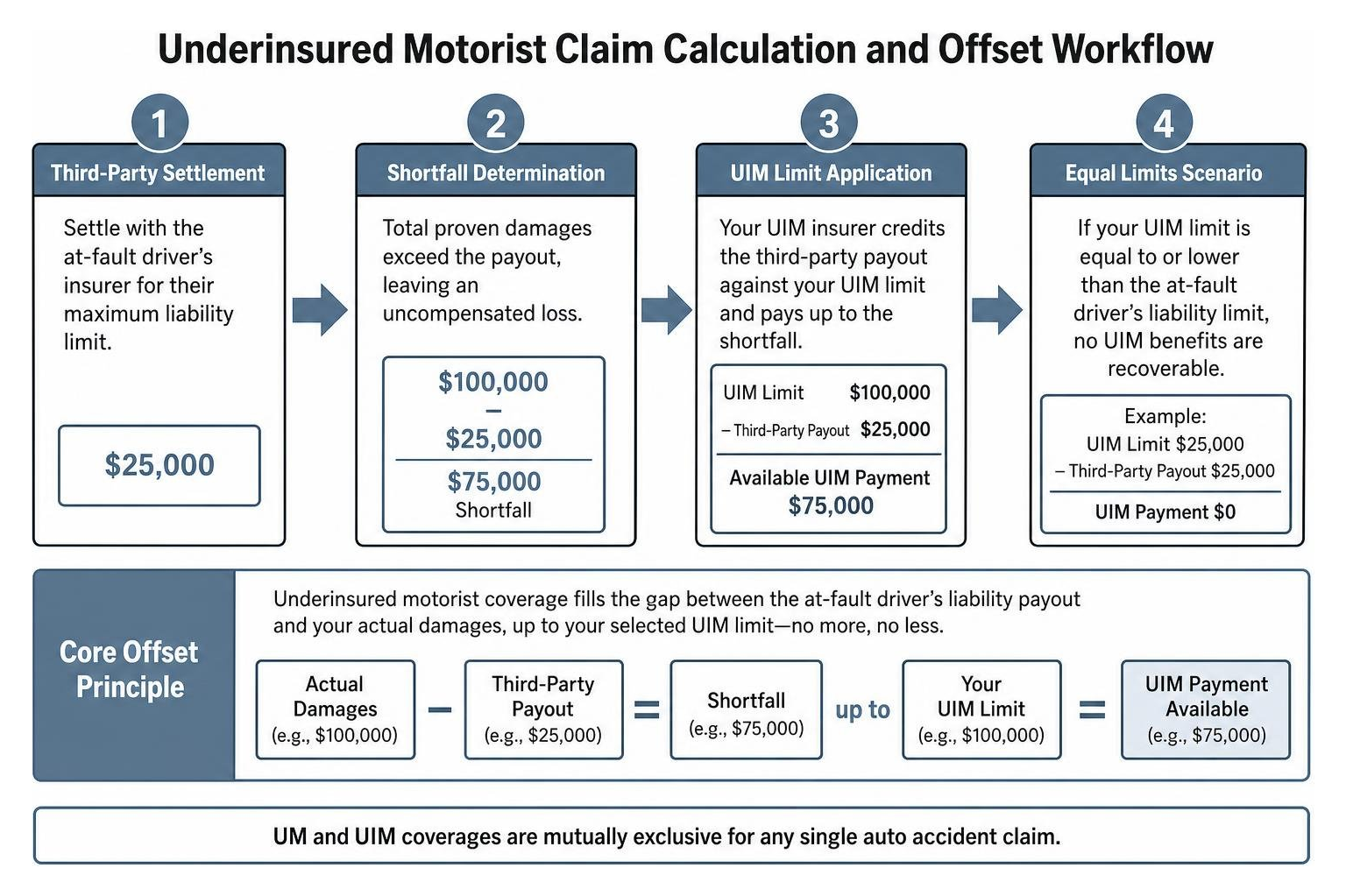
Under standard offset rules:
- Third-Party Settlement: You settle with the at-fault driver’s carrier for their maximum liability limit (e.g., $25,000).
- Shortfall Determination: Your actual proven damages total $100,000, leaving a $75,000 uncompensated loss.
- UIM Limit Application: If you carry a $100,000 UIM limit, your insurer credits the $25,000 third-party payout against your coverage ceiling, making up to $75,000 available to cover the shortfall.
- Equal Limits Scenarios: If your UIM limit is identical to or lower than the at-fault driver’s liability limit (for instance, both are $25,000), no underinsured benefits are recoverable because the credit eliminates the balance.
Statutory Requirements and Coverage Elections Under State Law
State laws establish strict guardrails regarding how insurers must offer and execute underinsured motorist protection. Reviewing the basic auto insurance requirements in pennsylvania helps policyholders understand why these mandatory offering rules exist. Under Pennsylvania law, specifically Section 1731.0 – Title 75 – VEHICLES, no motor vehicle liability insurance policy can be delivered or issued for delivery unless uninsured and underinsured motorist coverages are offered to the named insured.
How Stacking Increases Your Underinsured Motorist Protection Limits
Stacking is one of the most powerful consumer protections available in auto insurance. It allows you to combine the UM/UIM limits across multiple vehicles on a single policy (intra-policy stacking) or across multiple household policies (inter-policy stacking).
For example, if you insure two vehicles on one policy with UIM limits of $100,000/$300,000 and choose stacking, your available single-accident bodily injury protection doubles to $200,000 per person and $600,000 per accident. If you insure three vehicles, it triples to $300,000/$900,000.
Under 75 Pa.C.S. § 1738, stacking is the statutory default in Pennsylvania. To waive it in exchange for a modest premium discount, the insurer must obtain a specific, signed stacking waiver form. When evaluating your overall budget, our car insurance rates pennsylvania guide 2026 breaks down how stacked coverages impact overall premiums.
Strict Waiver Protocols and Default Coverage Rules
The statutory requirements for rejecting UIM protection are exceptionally strict. A valid waiver requires:
- The rejection form must be printed on a separate sheet of paper containing exact statutory wording.
- The form must be signed and dated by the first named insured.
- Renewal documents must continuously show prominent notices if coverage was previously declined.
If an insurance company fails to produce a valid, properly executed statutory waiver form, the policy automatically defaults to providing UIM coverage equal to the policy’s bodily injury liability insurance pa limits.
Navigating the Underinsured Claims Process: Exhaustion, Notice, and Subrogation

Filing a UIM claim involves specific procedural steps that differ significantly from a standard first-party claim. For step-by-step policyholder guidance, review our personal auto insurance guide 2026.
Policy Limits Exhaustion and Consent-to-Settle Rules
Before you can collect UIM benefits from your own carrier, you must satisfy the exhaustion requirement. This means you must formally exhaust the full limits of all applicable third-party bodily injury liability policies covering the at-fault driver.
However, you must never sign a general release or accept a policy-limits settlement check from the at-fault driver’s insurer without first obtaining written consent from your own UIM insurer. Signing an unapproved release extinguishes your insurer’s subrogation rights against the at-fault driver, which can forfeit your right to collect UIM benefits entirely.
Under statutory frameworks like the 2025 Kansas Statutes, when an insured provides written notice of a tentative liability settlement via certified mail, the UIM insurer has a 60-day statutory window to either consent to the settlement or substitute its own payment to the insured, preserving its legal right to subrogate against the negligent driver.
Notice Requirements, Discovery Timelines, and Dispute Resolution
Insurance contracts mandate prompt written notice when an accident occurs or as soon as you discover that the tortfeasor’s liability limits are insufficient. Under discovery rules, the timeline to provide formal claim notice generally runs from the date you knew or reasonably should have known that a policy limit shortfall existed.
If you and your UIM carrier cannot agree on the fair value of your bodily injury claim, most policies require the dispute to be resolved through binding arbitration or formal court litigation. Failing to demand arbitration or commence suit within the applicable statute of limitations relieves the insurer of its obligation to pay benefits.
Coverage Interaction, Exclusions, and Claim Evaluation Strategies

Evaluating a claim requires a thorough analysis of all available insurance layers. If you are comparing your current policy setup against market options, checking our auto insurance quotes page can help you gauge appropriate coverage limits.
Interaction with Health Insurance, Workers’ Compensation, and Liens
Automobile accident injuries trigger a web of overlapping coverages:
- First-Party Medical Benefits (PIP/MedPay): Your primary auto policy pays medical bills first up to its selected limit (e.g., $5,000 or $10,000 in PA).
- Health Insurance: Once auto medical benefits exhaust, your private health insurer pays ongoing medical bills. However, health plans (especially self-funded ERISA plans) typically place subrogation liens against any future third-party liability or UIM recovery.
- Workers’ Compensation: If you were driving for work purposes during the collision, workers’ compensation pays medical costs and wage loss. State statutes frequently credit or offset workers’ compensation recoveries against total UIM damages.
- Tort Election Restrictions: Under 75 Pa.C.S. § 1731(d)(2), individuals subject to the limited tort option who do not suffer a “serious impairment of a body function” are statutorily barred from recovering noneconomic damages (pain and suffering) through their UIM endorsement.
Common Policy Exclusions and Multi-Policy Priority Tiers
Standard auto policies contain enforceable exclusions that bar UIM recovery under specific circumstances:
- Regular Use Exclusion: Operating a non-owned vehicle that is regularly provided for your use (such as an employer’s company car) if that vehicle is not listed on your personal policy.
- Government-Owned Vehicles: Vehicles owned by municipal, state, or federal agencies may be excluded or subject to strict sovereign immunity recovery caps.
- Mutual Exclusivity: You cannot recover under both uninsured motorist coverage and underinsured motorist coverage for the very same accident.
When multiple insurance policies apply to an injured claimant, payment priority follows a strict three-tier hierarchy:
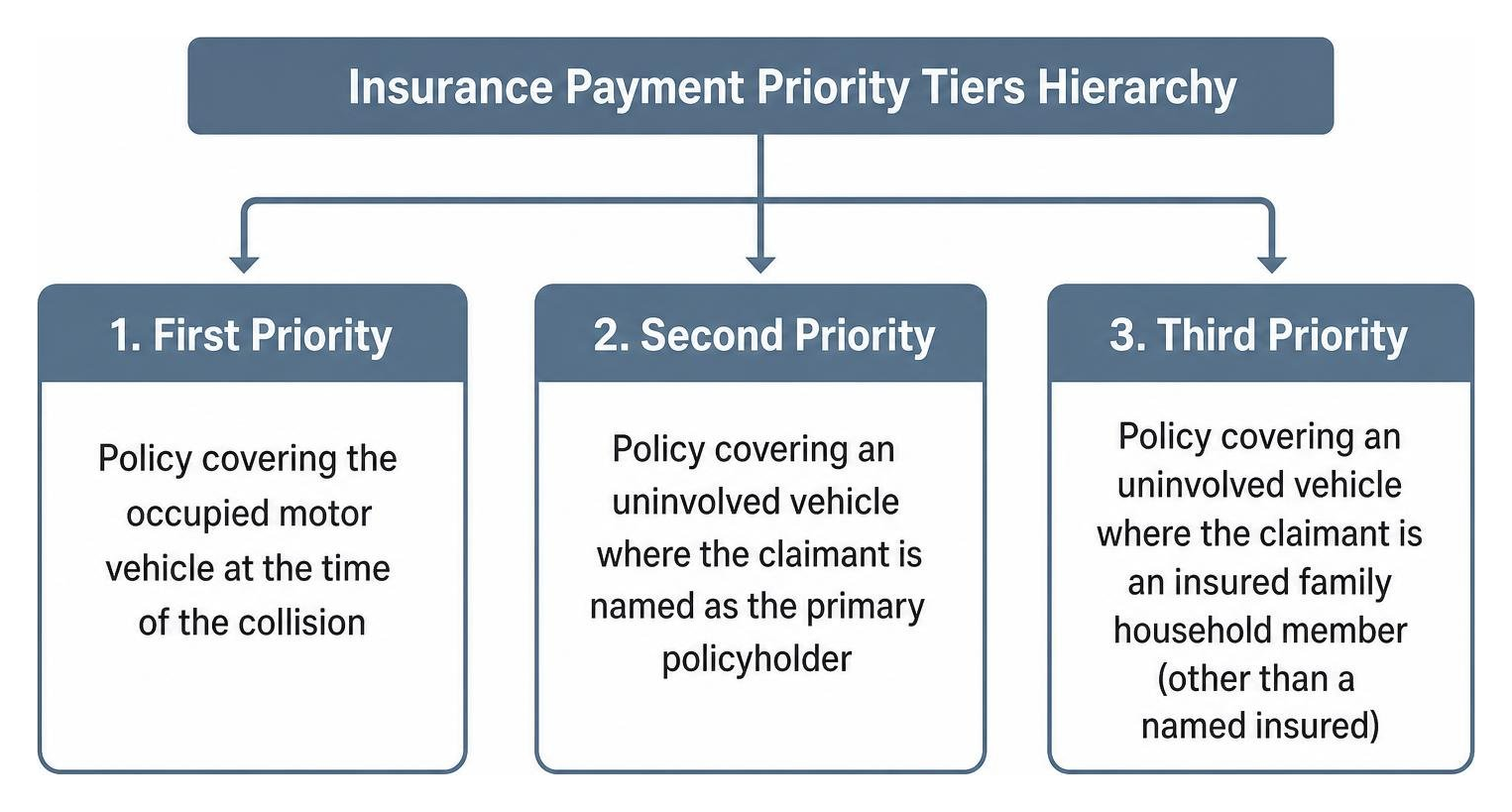
- First Priority: The policy covering the occupied motor vehicle at the time of the collision (host-vehicle policy).
- Second Priority: The policy covering an uninvolved vehicle where the claimant is named as the primary policyholder.
- Third Priority: The policy covering an uninvolved vehicle where the claimant is an insured family household member (other than a named insured).
Step-by-Step Claim Evaluation Protocol for Policyholders and Counsel
To evaluate and preserve an underinsured motorist claim:
- Obtain the complete declarations page and policy contract for all household auto policies.
- Request and inspect signed statutory rejection forms (both for UIM coverage and stacking elections).
- Secure written verification of the at-fault driver’s bodily injury liability limits.
- Perform an asset search on the at-fault driver prior to settlement execution.
- Assemble complete medical records, billing statements, diagnostic imaging, and physician narrative reports.
- Calculate total past and projected wage losses alongside vocational impairment assessments.
- Send formal certified notice to the UIM insurer before executing any third-party liability release.
Frequently Asked Questions About Underinsured Motorist Coverage
What happens if the at-fault driver has state minimum bodily injury limits?
If the at-fault driver carries only state minimum bodily injury liability limits (such as $15,000 per person in Pennsylvania), those funds can be depleted by a single hospital stay or emergency surgery. Once that $15,000 limit is paid out, your underinsured motorist coverage steps in as secondary coverage to pay for the remaining medical expenses, wage losses, and general damages up to your policy limit.
Can you recover from both uninsured and underinsured motorist coverage in one accident?
No. Under Pennsylvania law (75 Pa.C.S. § 1731(d)(1)) and standard auto insurance contract principles nationwide, UM and UIM coverages are mutually exclusive for any single collision. An at-fault driver is either uninsured (triggering UM) or underinsured (triggering UIM); they cannot legally be both at the same time.
How does your Pennsylvania tort option affect your UIM claim?
Your selected tort election directly dictates what damages you can recover under your UIM policy. If you carry Full Tort, you retain the unrestricted right to seek compensation for both economic losses (medical bills, lost wages) and noneconomic damages (pain, suffering, loss of life enjoyment) from your UIM carrier.
If you chose Limited Tort, you can recover all out-of-pocket medical bills and wage losses, but you are legally barred from recovering pain and suffering compensation through your UIM coverage unless your injuries meet the statutory threshold of a “serious impairment of a body function” or qualify for an exception.
Conclusion
Carrying proper underinsured motorist protection is one of the most effective ways to protect your personal assets, future income, and household financial security against minimally insured drivers. Maintaining limit symmetry—ensuring your UIM coverage matches your bodily injury liability limits—and opting for stacked coverage gives your family a vital financial buffer against catastrophic road incidents.
At Newtown Insurance, we are dedicated to providing clear, transparent guidance and tailored auto insurance solutions that fit your budget while keeping your financial safety net intact.
Ready to audit your auto policy and ensure your household is fully protected? Explore our comprehensive insurance solutions through our services content pillar page today.