What a Car Insurance Calculator Can Tell You About Your Pennsylvania Rates
Using a car insurance calculator in Pennsylvania can save you hundreds of dollars a year — but only if you know what inputs matter and how to read the results.
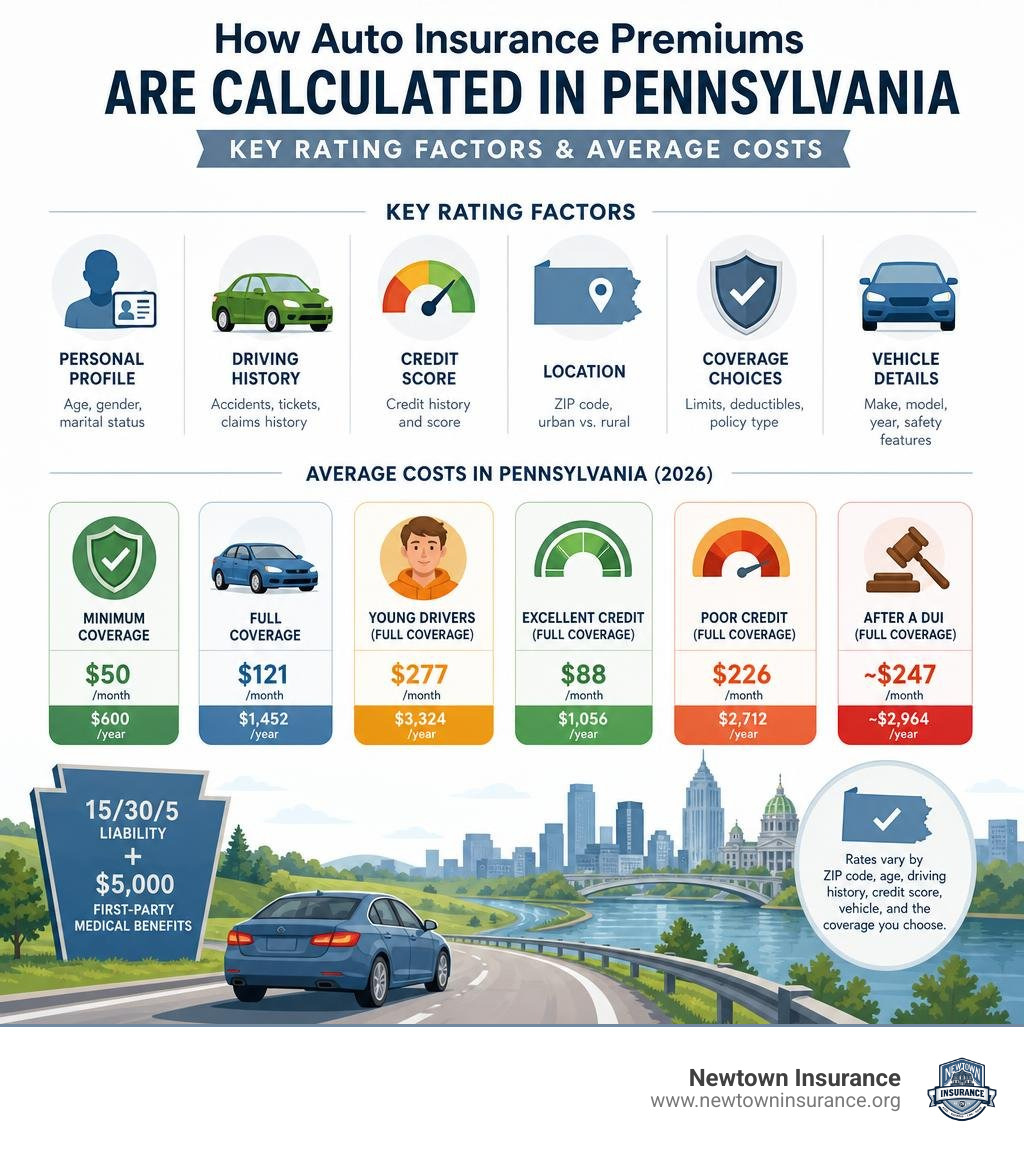
Here’s a quick snapshot of what Pennsylvania drivers typically pay, based on 2026 data:
| Coverage Type | Average Monthly Cost | Average Annual Cost |
|---|---|---|
| Minimum coverage | $50/month | $600/year |
| Full coverage | $121/month | $1,452/year |
| Young drivers (full coverage) | $277/month | $3,324/year |
| Excellent credit (full coverage) | $88/month | $1,056/year |
| Poor credit (full coverage) | $226/month | $2,712/year |
| After a DUI (full coverage) | ~$247/month | ~$2,964/year |
Pennsylvania’s state minimum requires 15/30/5 liability coverage plus $5,000 in first-party medical benefits. But those minimums often aren’t enough to protect your assets in a serious accident.
Rates vary widely by ZIP code, age, driving history, credit score, and the carrier you choose. A 35-year-old with a clean record and good credit insuring a 2023 Toyota Camry can expect to pay roughly $1,400 to $2,000 per year for full coverage — but the same driver in Philadelphia could pay significantly more than one in Pittsburgh or Newtown.
I’m Shawn Beihl, and with over 15 years of specialty insurance experience across commercial P&C, health, and personal lines, I’ve helped countless Pennsylvania families use tools like a car insurance calculator in Pennsylvania to stop overpaying and start getting coverage that actually fits their lives. Let’s walk through exactly how to use one the right way.
How to Use a Car Insurance Calculator in Pennsylvania

Using a digital estimator is the easiest way to plan your household budget before committing to a final policy. When you use a car insurance calculator in Pennsylvania, you are essentially running a mock underwriting process. The calculator takes your specific inputs and runs them against historical statewide risk algorithms to output a close approximation of your monthly premium.
To get the most accurate estimate, you cannot just guess the numbers. You need to understand how each piece of information you input directly impacts the final dollar figure on your screen.
Step-by-Step Guide to a Car Insurance Calculator Pennsylvania
To get started with tools like the 2026 Pennsylvania Car Insurance Calculator: Estimate Your Monthly Rate | How Much To Insure or the Pennsylvania Car Insurance Calculator 2026 | Estimate Rates, you will need to gather a few key details:
- Vehicle Details: The year, make, model, and safety features of your vehicle are primary rating factors. Insuring a brand-new, high-performance sports car will yield a much higher estimated premium than a safety-rated family SUV like a Subaru Outback or Honda CR-V due to replacement costs and structural safety.
- Annual Mileage: How far you drive each year dictates your risk of being involved in an accident. If you commute daily on I-95 or the Pennsylvania Turnpike, your rates will reflect that exposure compared to a remote worker who only drives a few thousand miles annually.
- Driving History: The calculator will ask about traffic violations, speeding tickets, and at-fault accidents over the last three to five years.
- Coverage Levels: You will select whether you want standard state minimum liability, mid-tier protection, or robust full coverage. You can test different variations using a Free Car Insurance Calculator: Instant Cost Estimates – ValuePenguin to see how adjusting your coverage limits moves your monthly price.
Choosing the Right Deductibles for Your Budget
Your deductible is the out-of-pocket amount you agree to pay before your insurance coverage kicks in for physical damage claims. When customizing your calculator inputs, you will have the option to set deductibles for both comprehensive and collision coverages.
Choosing a higher deductible, such as raising it from $100 or $500 to $1,000, is one of the fastest ways to lower your monthly premium. In fact, increasing physical damage deductibles to $1,000 can reduce your annual premium by 15% to 25%—and sometimes up to 40% depending on your risk profile.
However, we always advise Pennsylvania drivers to keep their chosen deductible amount readily accessible in an emergency savings account. If you hit a deer on a rural road—a massive risk in Pennsylvania, where motorists have a 1-in-62 chance of colliding with a deer each year—you must be able to pay that deductible immediately to get your car repaired.
If your vehicle is an older model valued at less than $5,000, you might want to use our guide on the Average Cost of Car Insurance in PA to determine whether it makes financial sense to drop comprehensive and collision coverages entirely.
Pennsylvania Minimum Car Insurance Requirements

Before you start adjusting sliders on a Pennsylvania Car Insurance Calculators: Cost & Coverage tool, you must understand the legal baseline. Pennsylvania law mandates that every driver maintain continuous financial responsibility. Failing to do so can result in severe legal and financial penalties.
To ensure your policy is legally compliant, you should review the Auto Insurance Requirements in Pennsylvania before finalizing any quotes.
Understanding the 15/30/5 Liability Limits
Pennsylvania uses a “15/30/5” split-limit system for bodily injury and property damage liability. If you cause an accident, your minimum policy will cover:
- $15,000 for bodily injury per person: The maximum amount your insurer will pay for medical bills and rehabilitation for a single injured person in another vehicle.
- $30,000 for bodily injury per accident: The total cap your insurer will pay for all injured parties in a single collision, regardless of how many people are hurt.
- $5,000 for property damage liability: The maximum amount your policy covers to repair or replace another person’s vehicle, fence, or storefront.
While these limits keep you legal, they are dangerously low. With the average cost of a brand-new car hovering near $50,000, carrying only $5,000 in property damage liability means that if you total a newer vehicle, you could be held personally liable for tens of thousands of dollars in remaining damages. We strongly recommend upgrading your property damage limits; raising this limit from $25,000 to $100,000 typically costs only a few dollars more per year.
First-Party Medical Benefits and Uninsured Motorist Coverage
Because Pennsylvania operates under a choice no-fault system, you are legally required to carry a minimum of $5,000 in First-Party Benefits (FPB). This medical payments coverage pays for your own medical bills, as well as those of your passengers, regardless of who caused the accident.
Additionally, Pennsylvania has an estimated uninsured driver rate of 12.9%. This means that roughly one in eight drivers on the road is operating without insurance. To protect yourself from these drivers, we highly recommend adding Uninsured and Underinsured Motorist (UM/UIM) coverage.
In Pennsylvania, UM/UIM coverage defaults to “stacked” unless you actively sign a waiver rejecting it. Stacked coverage allows you to combine the policy limits of multiple vehicles in your household, multiplying your protection. For a comprehensive breakdown of these unique local laws, read our Insurance Pennsylvania Complete Guide.
Key Factors That Determine Your Pennsylvania Auto Insurance Rates
When you run your numbers through a car insurance calculator in Pennsylvania, you will notice that even minor adjustments to your personal profile can cause your estimated rate to swing wildly. Insurers evaluate dozens of rating factors to determine your premium.
The table below illustrates how different driving violations and credit tiers can alter your estimated monthly costs for full coverage in Pennsylvania:
| Driver Profile | Clean Record / Good Credit | After an At-Fault Accident | After a DUI Conviction |
|---|---|---|---|
| Excellent Credit | $88/month | $115/month | $214/month |
| Good Credit | $121/month | $148/month | $247/month |
| Poor Credit | $226/month | $253/month | $352/month |
How Location and Credit Score Impact Your Car Insurance Calculator Pennsylvania Estimates
Where you park your car at night has a massive impact on your premium. For instance, drivers in Philadelphia pay an average of $103 per month for minimum coverage due to high population density, heavy litigation, and high vehicle theft rates—Philadelphia recorded a staggering 21,620 vehicle thefts in 2023. Meanwhile, drivers in Pittsburgh pay an average of $51 per month for the exact same minimum coverage.
If you live in Newtown, your average rate sits right around the state average at $217 per month for full coverage. You can explore localized pricing dynamics in our guide to the Average Cost of Car Insurance in Philadelphia or find regional savings with our tips on Affordable Car Insurance Philadelphia.
Your credit score is another dominant factor. Under Pennsylvania law, insurers are permitted to use credit-based insurance scores to calculate rates. Moving from poor credit to excellent credit can save you an average of $138 per month ($1,656 per year). It is important to note that Pennsylvania law does not require insurers to automatically lower your rates when your credit score improves; you must actively request a policy recalculation or shop for new quotes to claim those savings.
The Impact of Your Driving Record and PennDOT Points
Your driving history is a direct reflection of your risk on the road. A single at-fault accident adds an average of $27 per month to a Pennsylvania rate, while a DUI conviction adds an average of $126 per month.
PennDOT uses a point system to track violations. Once a driver accumulates six points, PennDOT initiates corrective actions, which can include mandatory driving exams or license suspensions. For every 12 consecutive months you drive without a violation, PennDOT will remove three points from your record. The moment these points clear, you should recalculate your rates with a Car Insurance Calculator in Pennsylvania: Fast Cost Estimates (2026 Rates) to see how much your premium has dropped.
Understanding Limited Tort vs. Full Tort in Pennsylvania
One of the most unique aspects of insuring a car in the Keystone State is the choice between limited tort and full tort coverage. When you use a Pennsylvania car insurance coverage calculator, this selection will be one of the primary questions asked.
Pennsylvania is a “choice no-fault” state, meaning full tort is the default legal selection unless you actively sign a form opting for limited tort.
What is Limited Tort Coverage?
Choosing limited tort typically saves you about 15% on your monthly liability premiums. In exchange for this discount, you agree to restrict your right to sue an at-fault driver for non-monetary damages, such as “pain and suffering,” after an accident.
Under limited tort, you can still sue for out-of-pocket medical bills and lost wages, but you cannot seek compensation for pain and suffering unless your injuries meet a strict “serious injury” threshold, such as permanent severe impairment of a body function, permanent disfigurement, or death.
What is Full Tort Coverage?
Full tort coverage is more expensive, but it preserves your unrestricted right to sue an at-fault driver for all damages, including pain and suffering, regardless of the severity of your injuries.
If you want the maximum level of asset protection and legal freedom, full tort is highly recommended. To see how these selections impact statewide averages, take a look at our Car Insurance Rates Pennsylvania Guide 2026.
Smart Strategies to Lower Your Pennsylvania Car Insurance Premium
Even if a car insurance calculator in Pennsylvania outputs a higher estimate than you’d like, you aren’t stuck paying that price. There are several highly effective, actionable strategies you can use to drive down your costs.
For a deeper dive into saving money locally, check out our Cheap Auto Insurance Pennsylvania Tips 2026 and our Cheap Auto Insurance Pennsylvania Guide 2026.
Maximizing Discounts and Bundling Policies
The easiest way to lower your premium is to take advantage of insurers’ built-in discount programs:
- Policy Bundling: Combining your auto insurance with home, renters, or condo insurance can save you up to 25% on your total premiums.
- Defensive Driving Course: Under Pennsylvania law (75 Pa.C.S. § 1799.2), drivers aged 55 and older who complete an approved driver improvement course are legally entitled to a mandatory premium reduction of at least 5% for three consecutive years.
- Anti-Theft Devices: Installing active GPS tracking or alarm systems can secure a discount, which is especially valuable in high-theft urban areas.
To ensure you aren’t leaving money on the table, review the 6 Car Insurance Discounts You Should Ask About before finalizing your policy.
Act 3 of 2026 and Avoiding Registration Suspensions
Maintaining continuous coverage is not just smart—it is the law. If you let your car insurance lapse for more than 30 days, PennDOT will issue a mandatory three-month suspension of your vehicle’s registration.
However, under Act 3 of 2026, Pennsylvania drivers who experience a lapse can opt to pay a $500 civil penalty in lieu of the three-month registration suspension. This civil penalty option can only be used once every 12 months. While Act 3 provides a helpful safety net to keep your plates active, avoiding lapses altogether remains the most cost-effective strategy.
Frequently Asked Questions About Pennsylvania Car Insurance
Does Pennsylvania require an SR-22 filing after a DUI?
No. Unlike many other states, Pennsylvania does not require SR-22 or FR-44 financial responsibility filings after a DUI conviction. Instead, PennDOT handles DUI penalties through license suspensions, restoration fees, and mandatory ignition interlock requirements under 75 Pa.C.S. § 3805. To restore your driving privileges, you only need to pay your restoration fees and present your standard, valid Pennsylvania insurance card.
Why is car insurance so much more expensive in Philadelphia?
Philadelphia’s high premiums are driven by several urban risk factors. The city features high population density, which leads to a higher frequency of accidents. Additionally, Philadelphia’s high litigation rates drive up claim payouts, and severe vehicle theft rates (over 21,000 thefts annually) increase comprehensive insurance claims, causing localized premiums to spike.
How often should I recalculate my Pennsylvania car insurance rates?
We recommend recalculating your rates at least once a year, or whenever you hit major life milestones. You should run your numbers through a calculator when your credit score improves, when a traffic violation or point clears from your PennDOT record, when you turn 25, 55, or 65, or if you move to a new ZIP code.
Conclusion
A car insurance calculator in Pennsylvania is an incredibly powerful tool to help you estimate your costs, but it only provides a baseline. To get the absolute best rate, you need a policy that is tailored to your unique driving habits, assets, and lifestyle.
At Newtown Insurance, we specialize in providing Pennsylvania drivers with tailored protection, smart savings, and fully transparent pricing with no hidden fees. We take a customer-first approach to ensure you never pay for coverage you don’t need, while protecting what matters most.
Ready to see how much you can save? Skip the generic estimators and Get a Tailored Pennsylvania Car Insurance Quote from our local Newtown, Pennsylvania team today.