Buying Health Insurance in PA: Start With the Right Path
Buying health insurance in PA usually starts with one question: Which coverage path fits your household, budget, and enrollment timing?
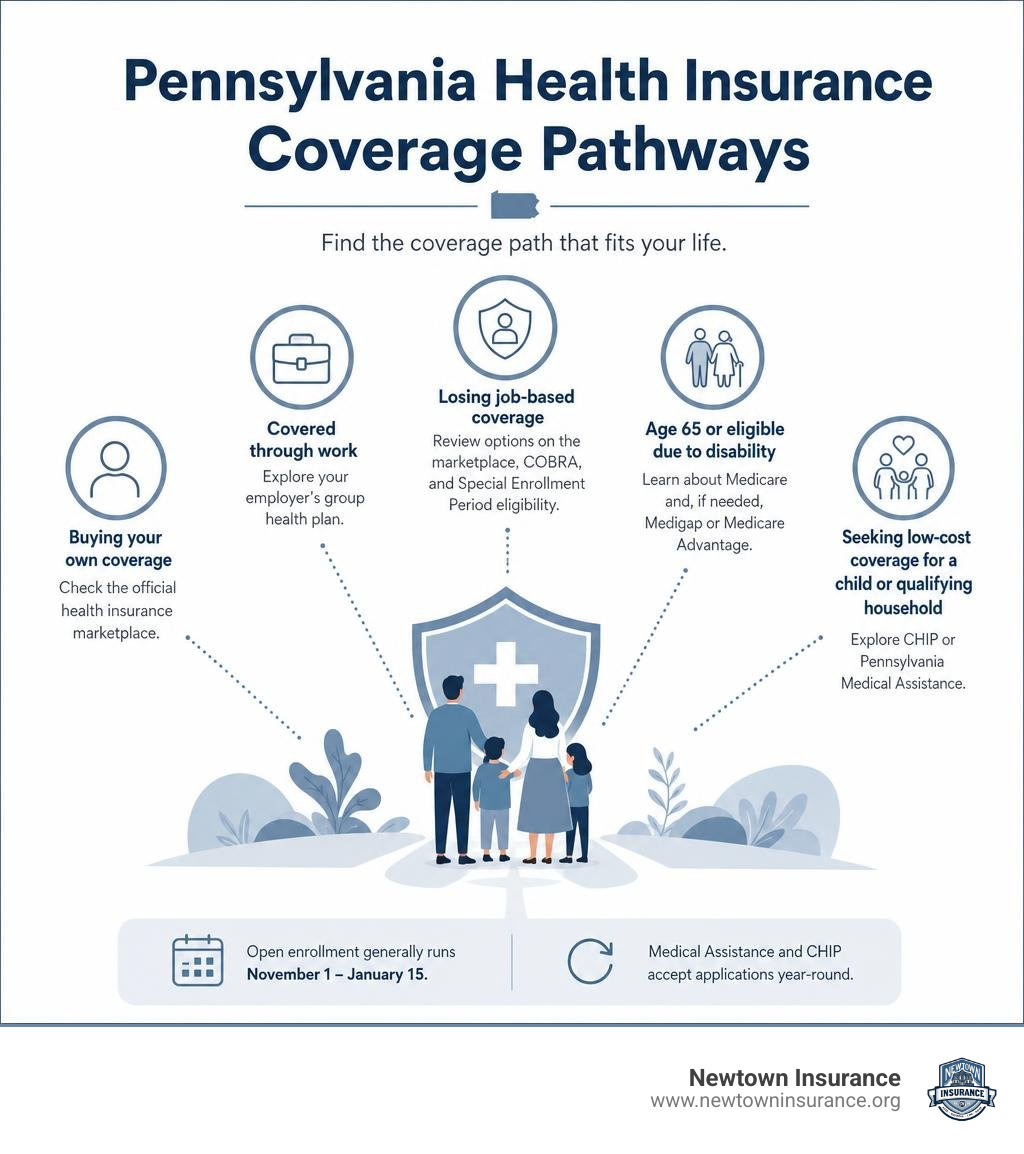
| If you are… | Start by checking… |
|---|---|
| Buying your own coverage | Pennie, Pennsylvania’s official health insurance marketplace |
| Covered through work | Your employer’s group health plan |
| Losing job-based coverage | Pennie plans, COBRA, and whether you qualify for a Special Enrollment Period |
| Age 65 or eligible due to disability | Medicare and, if needed, Medigap or Medicare Advantage |
| Seeking low-cost coverage for a child or qualifying household | CHIP or Pennsylvania Medical Assistance |
Pennie is the main place to compare ACA-compliant individual and family plans and find out whether you qualify for financial help. Open enrollment generally runs from November 1 through January 15, while Medical Assistance and CHIP accept applications year-round. With premiums and federal tax-credit rules changing, comparing total costs – not just the monthly premium – matters more than ever.
I am Shawn Beihl, with more than 15 years of experience in health, benefits, disability, life, and commercial insurance. My background in buying health insurance in PA helps families look past generic plan labels and focus on coverage that supports their real financial risks and healthcare needs.
Main Options for Getting Coverage in Pennsylvania

When you start shopping for health coverage in the Keystone State, it helps to understand that there isn’t just one single path. Pennsylvania residents access health care through several distinct channels, each designed for different financial situations, employment statuses, and age brackets.
At Newtown Insurance, we regularly work with individuals across Bucks County and the rest of Pennsylvania to demystify these options. The main pathways for health coverage in PA include:
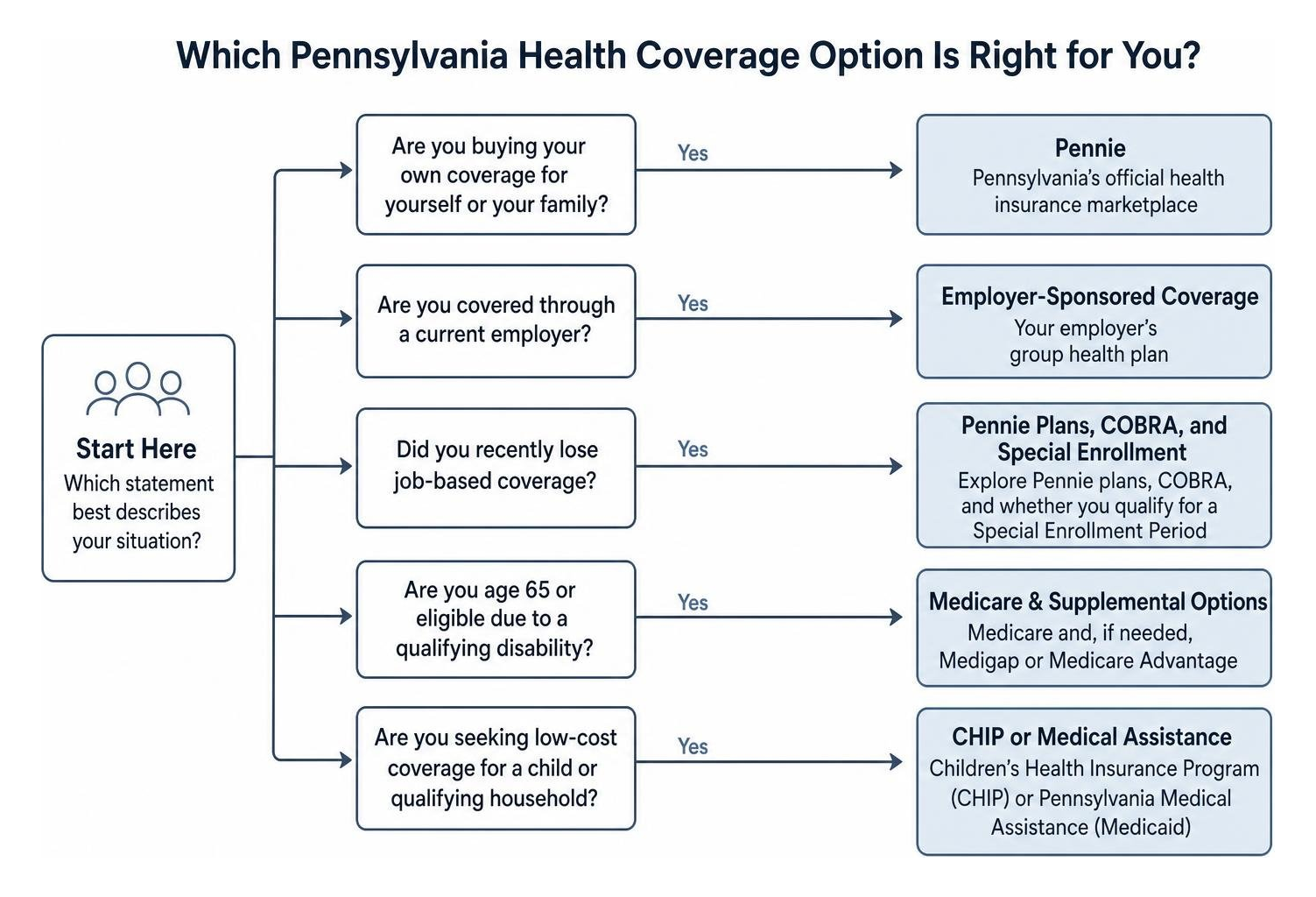
- Pennie (Pennsylvania’s State-Based Exchange): Created by state law to serve as the official health marketplace, Pennie is the only portal where Pennsylvanians can access federal premium tax credits and cost-sharing reductions under the Affordable Care Act (ACA). Every plan sold on Pennie provides mandatory minimum essential coverage, including prescription drugs, maternity care, and mental health services.
- Employer-Sponsored Group Coverage: Most working Pennsylvanians get health coverage through their jobs. If you own or run a company, setting up Pennsylvania Small Business Health Insurance is one of the best ways to recruit and retain talent while taking advantage of tax credits.
- Public Assistance Programs: Low-income individuals, children, pregnant women, and people with disabilities may qualify for zero-cost or low-cost state coverage through Medicaid (known in PA as Medical Assistance) or the Children’s Health Insurance Program (CHIP).
- Commercial Off-Exchange Coverage: You can purchase ACA-compliant coverage directly from private insurance carriers. While off-exchange plans meet all federal standards, you cannot apply government subsidies toward them.
- Medicare & Supplemental Options: Designed for seniors aged 65 and older or individuals with certain qualifying disabilities.
To see how these options connect, here is a quick visual guide:
Understanding Public Assistance: Medicaid, CHIP, and Medicare Options
Navigating state and federal assistance programs can feel overwhelming, but these programs form a crucial safety net for hundreds of thousands of Pennsylvanians.
Medical Assistance (Medicaid)
Pennsylvania’s Medical Assistance program provides comprehensive health care coverage to eligible residents with low incomes. Qualification is determined primarily by your Modified Adjusted Gross Income (MAGI) relative to the Federal Poverty Level (FPL). For example, eligible adults generally qualify if household income is at or below 138% of the FPL. Medical Assistance offers doctor visits, hospital stays, emergency services, and prescription drug benefits with little to no out-of-pocket costs. Unlike commercial plans, you can apply for Medical Assistance at any time during the year.
Children’s Health Insurance Program (CHIP)
Pennsylvania’s CHIP program ensures that every child in the Commonwealth has access to comprehensive healthcare. CHIP covers uninsured kids and teens up to age 19 who do not qualify for Medical Assistance. What makes CHIP special is that no family makes too much money for CHIP. Depending on your household income, coverage is either completely free or offered at low-cost monthly premiums with minimal copays. CHIP enrollment remains open 365 days a year.
Medicare and Medicare Supplement (Medigap)
When turning 65 (or qualifying earlier due to a disability), Pennsylvanians transition into Medicare:
- Part A: Covers inpatient hospital stays and skilled nursing facility care.
- Part B: Covers outpatient services, doctor visits, and preventive care.
- Part C (Medicare Advantage): Bundles Parts A, B, and usually D into a private plan.
- Part D: Covers outpatient prescription drugs.
Because Original Medicare (Parts A & B) leaves gap expenses like deductibles and 20% coinsurance without an out-of-pocket maximum, many seniors pair it with a Medigap policy. For example, enrolling in a policy like Medigap Plan G Pennsylvania covers virtually all remaining out-of-pocket medical costs once you meet the small annual Part B deductible.
Navigating Pennie: Open Enrollment, Subsidies, and Special Circumstances
If you aren’t covered by an employer or a public assistance program, Home | Pennie – PA’s Official Health Insurance Marketplace is your primary hub for buying health insurance in pa.
Pennie was created specifically for Pennsylvanians, replacing the federal HealthCare.gov portal. It streamlines the shopping experience and automatically calculates your financial assistance eligibility based on your estimated annual household income and household size.
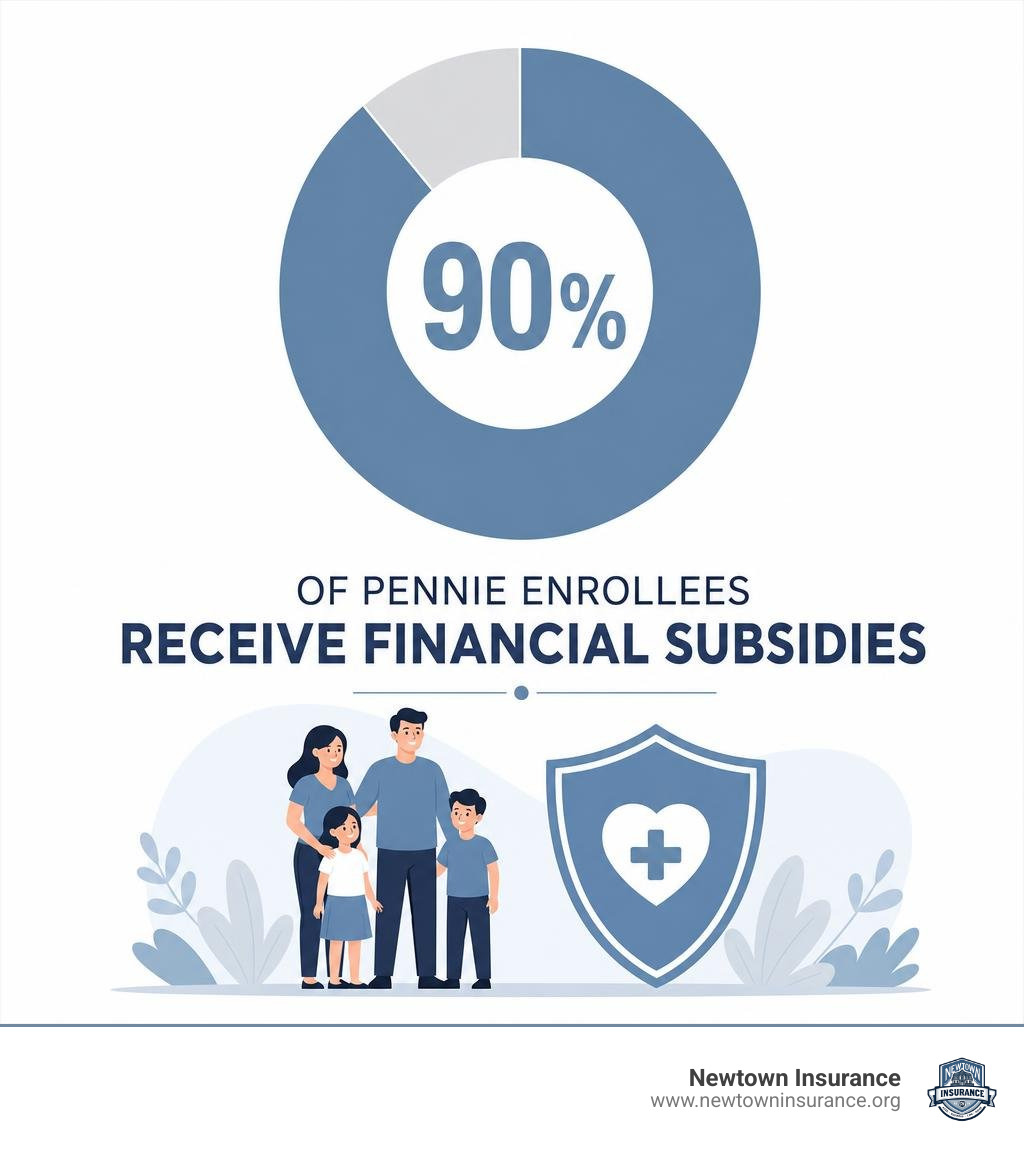
Financial assistance on Pennie comes in two main forms:
- Advance Premium Tax Credits (APTC): These reduce your monthly premium payment upfront. In recent enrollment cycles, approximately 90% of Pennie enrollees qualified for premium tax credits, saving hundreds of dollars per month on average.
- Cost-Sharing Reductions (CSR): If your income falls within specific ranges (typically between 100% and 250% of the FPL) and you choose a plan in the Silver metal tier, CSRs lower your deductibles, copayments, and coinsurance amounts when you receive care.
Timing Your Purchase: When Is Open Enrollment for Buying Health Insurance in PA?
Timing is critical when purchasing individual health insurance. You cannot simply buy ACA marketplace coverage whenever you feel like it; you must act within designated enrollment windows.
The annual Pennie Open Enrollment Period runs from November 1 through January 15.
- If you enroll between November 1 and December 15, your health coverage takes effect on January 1.
- If you enroll between December 16 and January 15, your coverage starts on February 1.
Missing the January 15 deadline means you may be locked out of buying coverage for the remainder of the calendar year, as detailed in recent updates regarding how the Enrollment deadline approaching for Pennsylvania’s health insurance marketplace impacts residents.
Qualifying Life Events and Special Enrollment Periods (SEPs)
If you miss the main open enrollment window, you can still buy coverage if you experience a Qualifying Life Event (QLE). A QLE unlocks a 60-day Special Enrollment Period, allowing you to enroll outside the standard window. Common qualifying events include:
- Involuntary loss of job-based health coverage or Medicaid
- Marriage, divorce, or legal separation
- Birth, adoption, or placing a child in foster care
- Permanent relocation to a new county or area in PA with different plan options
- Gaining citizenship or lawful presence in the U.S.
Essential Steps for Buying Health Insurance in PA

Shopping for coverage shouldn’t feel like a high-stakes guessing game. By breaking down plans into their core components, you can find a policy that balances fixed monthly costs against variable out-of-pocket risks.
When evaluating policies, review our comprehensive Health Insurance Quotes Guide 2026 to understand pricing mechanics. Plans sold on Pennie are categorized into four standard “metal tiers” reflecting how you and the plan share healthcare costs:
| Metal Tier | Monthly Premium Level | Expected Plan Pays | Expected You Pay | Best Suited For |
|---|---|---|---|---|
| Bronze | Lowest | ~60% | ~40% | Healthy individuals wanting protection against catastrophic bills |
| Silver | Moderate | ~70%* | ~30%* | Anyone qualifying for Cost-Sharing Reductions; balanced coverage |
| Gold | Higher | ~80% | ~20% | Frequent doctors’ visits or ongoing medical condition management |
| Platinum | Highest | ~90% | ~10% | High healthcare utilization needing predictable out-of-pocket costs |
*Note: Silver plans pay significantly more (80%–94%) if you qualify for Cost-Sharing Reductions based on income.
Key Factors to Consider When Buying Health Insurance in PA
Selecting a plan involves much more than just picking a metal tier. Before committing, consider these four vital factors:
1. County Coverage Footprints for 2027
Health insurance in Pennsylvania is hyper-local. Insurance companies submit regional footprints to the Pennsylvania Insurance Department every year. To buy a specific plan, you must live within its official county coverage area. Check the official Coverage Areas Individual Market | Insurance Department | Commonwealth of Pennsylvania listings to confirm which carriers offer individual policies in your home county for 2027.
2. Network Types (HMO vs. PPO vs. EPO)
- HMO (Health Maintenance Organization): Requires you to select a Primary Care Physician (PCP) and obtain referrals for specialists. Out-of-network care is generally not covered except in emergencies.
- PPO (Preferred Provider Organization): Offers the most flexibility. You can see specialists without referrals and visit out-of-network doctors (though at higher copays/coinsurance).
- EPO (Exclusive Provider Network): Combines features of both. You do not need specialist referrals, but you must stay strictly in-network for non-emergency care.
3. Formularies and Prescription Costs
If you take regular medications, always verify that your specific drugs are listed on the plan’s formulary (drug list). Pay attention to which tier your medication falls under—tier 1 preferred generic drugs cost pennies compared to tier 4 specialty medications.
4. Out-of-Pocket Maximums
Your deductible is the amount you pay before insurance kicks in. However, your out-of-pocket maximum is the absolute most you will pay in a plan year for covered essential services. Once you hit that cap, the insurance company pays 100% of covered medical costs for the rest of the year.
Understanding Rates, COBRA, and Consumer Protections in 2026
Keeping up with health insurance costs requires paying close attention to market filings. In recent rate filings for 2026, Pennsylvania health insurers proposed significant overall rate increases: an average 19% increase in individual market premiums and a 13% increase for small business group plans.
These requested rate increases stem from rising medical costs, increased utilization of outpatient care and specialty prescription drugs, and shifts in federal subsidy funding. You can read a complete breakdown of these market adjustments in our article on Navigating The 2026 Pa Health Insurance Rate Rollercoaster.
Market rate adjustments vary substantially by carrier across Pennsylvania:
- Ambetter Health of PA: Requested an average rate increase of 30.1%
- Capital Advantage Assurance Company: Requested an average increase of 26%
- Keystone Health Plan East: Requested an average increase of 23.5%
- Partners Insurance Company (Southeastern PA/Lehigh Valley): Bucked the trend by requesting an average rate decrease of 10.1%
Without boosted federal tax credits, total out-of-pocket insurance expenses could spike dramatically for many households, as reported by news outlets covering how Pennsylvania health insurers propose 2026 premium increases – WHYY.
COBRA vs. Short-Term Health Insurance Options
When transitioning between jobs or facing sudden loss of employer coverage, two alternative temporary pathways frequently come up: COBRA and short-term health plans.
COBRA and Mini-COBRA
COBRA allows you to keep your former employer’s exact health plan after leaving a job. Under federal COBRA (for companies with 20+ workers) or Pennsylvania Mini-COBRA (for small businesses with 2-19 employees), you can extend coverage for up to 18 months.
However, COBRA is usually very expensive. You are required to pay 100% of the total monthly premium (including the portion your employer used to pay) plus a 2% administrative fee. Before electing COBRA, compare it against Pennie plans—loss of job coverage triggers a Special Enrollment Period where you may qualify for substantial financial subsidies.
Short-Term, Limited-Duration Health Insurance
Short-term health insurance offers temporary coverage for gaps in insurance. While monthly premiums appear cheap, these plans do not comply with the Affordable Care Act.
Key limitations of short-term health insurance in PA include:
- They can deny coverage or charge higher rates for pre-existing conditions.
- They do not have to cover ACA essential health benefits like prescription drugs, mental health care, or maternity care.
- They frequently impose cap limits on total benefits paid out.
Pennsylvania Consumer Rights and Protections
Pennsylvania law provides robust safeguards to protect patients:
- No Surprises Act Protections: Restricts unexpected balance billing from out-of-network providers during emergency care or covered visits to in-network hospitals.
- Mental Health Parity Laws: Requires insurers to offer mental health and substance abuse disorder benefits equal to medical and surgical benefits.
- Pharmacy Benefit Reform (Act 77): Increases transparency in pharmacy management and helps lower out-of-pocket drug costs for consumers.
Frequently Asked Questions About Pennsylvania Health Insurance
What should I do if I receive a surprise medical bill or claim denial in PA?
If you receive an unexpected out-of-network medical bill from an emergency room visit or an in-network facility treatment, do not panic or pay it immediately. Under the Federal No Surprises Act and Pennsylvania state guidelines, you are protected against balance billing in these situations.
First, contact your health plan and the billing provider to request a billing review. If the carrier denies coverage for a treatment, procedure, or drug recommended by your doctor, you have the legal right to file an internal appeal with the insurer. If they uphold the denial, you can request an External Review through the Pennsylvania Insurance Department Consumer Services Bureau. Independent medical experts will review your case, and their decision is legally binding on the insurance company.
What happens if I miss the Pennie open enrollment deadline?
If you miss the January 15 deadline and do not qualify for a Special Enrollment Period (SEP) through a qualifying life event (like losing a job, moving, or getting married), you generally cannot purchase an ACA marketplace plan until the next open enrollment cycle begins in November.
However, you still have immediate options:
- Check Medical Assistance & CHIP: Eligibility for Medicaid and CHIP is evaluated year-round without enrollment window limits.
- Short-Term Policies: These provide temporary emergency gap protection, though they lack full ACA protections.
- Job-Based Coverage: If you get a new job offering group benefits, you can enroll during the employer’s onboarding window regardless of the time of year.
Can I get a health insurance quote in PA without sharing personal information?
Yes! Pennie features an anonymous plan browsing tool that allows you to preview available individual policies, estimated monthly rates, and projected tax credits without entering your name, social security number, or contact info.
You only need to supply basic, non-identifying demographic inputs like your zip code, county, age, household size, and an estimated annual income figure. To learn more about anonymous rate shopping, check out our guide on whether Can You Get Health Insurance Quote Without Giving Personal Information.
Conclusion
Navigating the healthcare market in Pennsylvania does not have to feel overwhelming. Whether you are exploring options on Pennie, transitioning off an employer policy, or looking for ways to protect your family from rising 2026 rates, taking the time to compare total out-of-pocket risks against monthly premiums ensures you land on the right coverage.
At Newtown Insurance, our team believes in complete pricing transparency, smart health plan strategies, and placing our clients first. We take pride in helping individuals, families, and business owners throughout Bucks County and across the Commonwealth find quality coverage that guards their health without draining their budget.
Ready to simplify your search for health insurance? Visit our Pennsylvania Health Insurance Directory or reach out to our Newtown office today to get personalized assistance from a trusted local advisor!