Why PA Uninsured Motorist Coverage Matters
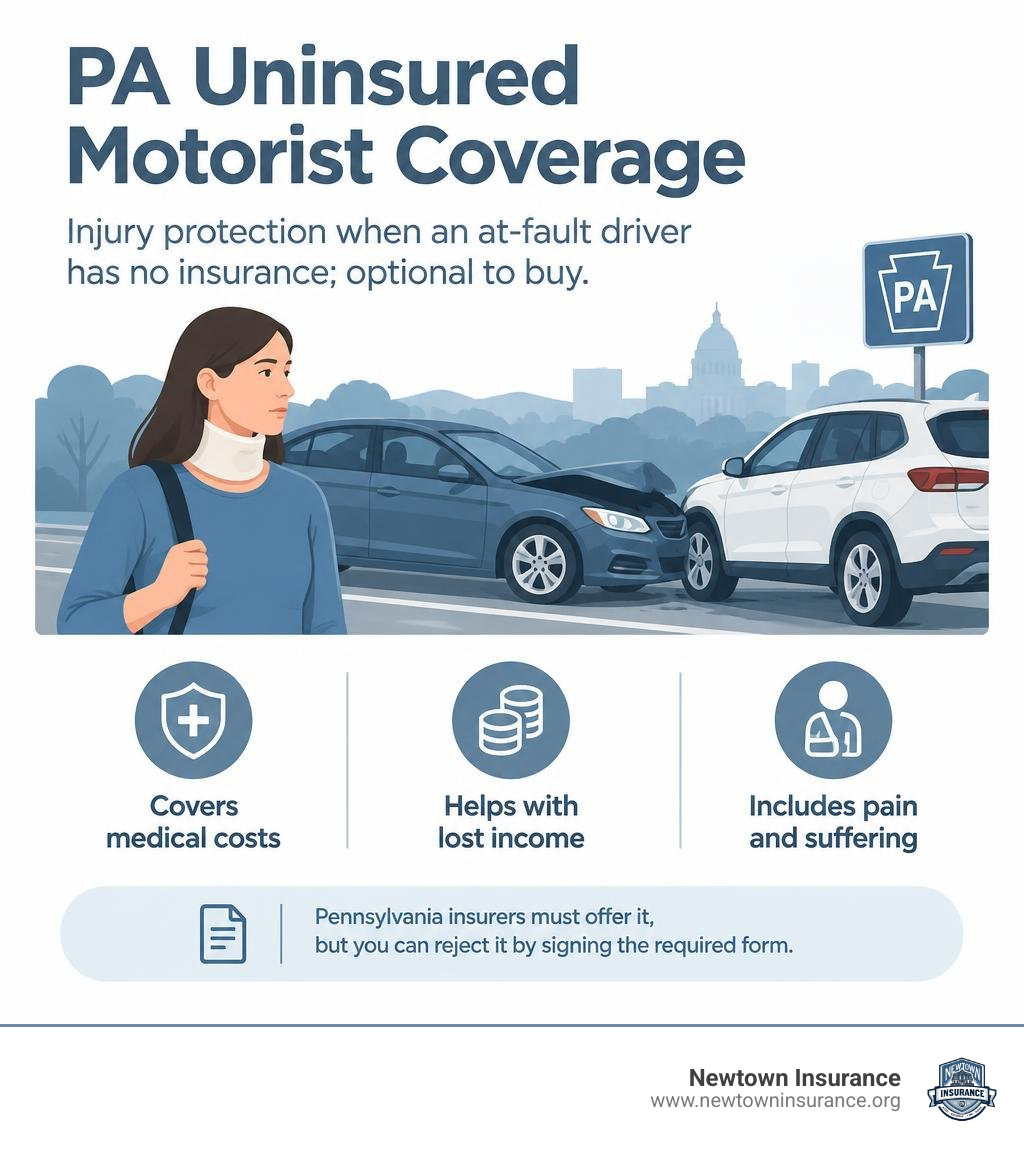
PA uninsured motorist coverage helps pay for your injuries when an at-fault driver has no auto insurance. It can cover medical costs, lost income, and pain and suffering, up to your policy limits. Pennsylvania insurers must offer it, but you can reject it by signing the required form.
That choice matters if the other driver cannot pay for the harm they caused. Coverage may also apply after a hit-and-run, depending on the facts and your policy. Before deciding what to buy, check your coverage limits and what you would pay without this protection.
With more than 15 years of experience in specialty insurance, including accident and commercial coverage, Newtown Insurance helps Pennsylvania drivers weigh the cost and value of PA uninsured motorist coverage.
PA uninsured motorist coverage word list:
- auto insurance pennsylvania quote
- cheap auto insurance quotes pa
- car insurance calculator pennsylvania
What Is PA Uninsured Motorist Coverage and How Does It Work?
Uninsured Motorist (UM) protection serves as your personal financial safety net when an irresponsible motorist causes a crash and carries zero auto liability insurance. Under the Pennsylvania Motor Vehicle Financial Responsibility Law (MVFRL), specifically codified under Section 1731.0 – Title 75 – VEHICLES , UM coverage functions as first-party protection. This means your own insurer steps into the shoes of the at-fault driver to pay for the bodily harm inflicted upon you and your passengers.
Beyond crashes with drivers who simply ignore state insurance laws, UM coverage in Pennsylvania steps up in two other critical scenarios:
- Hit-and-Run or “Phantom” Vehicles: If an unidentified vehicle strikes your car or causes an accident and flees the scene, Pennsylvania law treats that unknown motorist as an uninsured driver.
- Insurer Insolvency: If the at-fault motorist held a valid insurance policy at the time of the collision, but their carrier subsequently goes bankrupt or becomes legally insolvent before paying your claim, your UM policy takes over.
Navigating these rules starts with understanding Pennsylvania uninsured motorist coverage and state requirements, ensuring you do not leave your family’s physical and financial recovery to chance.
Who and What Does PA Uninsured Motorist Coverage Protect?
When you maintain UM coverage on your policy, the blanket of protection extends far beyond just the primary driver behind the wheel. In Pennsylvania, UM insurance typically protects:
- The Named Insured: You, as the policyholder listed on the declarations page.
- Resident Relatives: Family members related by blood, marriage, or adoption who reside in your household.
- Vehicle Passengers: Anyone legally occupying your insured vehicle at the time of the collision.
- Pedestrians and Cyclists: You and your resident family members if struck by an uninsured or hit-and-run driver while walking, jogging, or riding a bicycle.
UM coverage is specifically structured to cover non-property damages related to physical injuries. While Personal Injury Protection (PIP) handles immediate, baseline medical expenses regardless of who caused the crash, UM covers extensive losses that exceed baseline PIP limits.
| Loss Category | Personal Injury Protection (PIP) | Uninsured Motorist Coverage (UM) |
|---|---|---|
| Fault Requirement | No-fault (applies regardless of who caused the crash) | Requires another driver to be at fault |
| Baseline Medical Bills | Yes (subject to selected policy limits, min. $5,000) | Yes (covers medical costs exceeding PIP) |
| Lost Income | Optional add-on (subject to monthly statutory caps) | Yes (covers actual proven future and past wage loss) |
| Pain and Suffering | Never covered | Yes (non-economic damages, subject to tort choice) |
| Loss of Life / Quality | Not covered | Yes |
| Vehicle Damage | Never covered | Not covered (handled via Collision or Mini-Tort) |
UM vs. UIM: Key Differences in Pennsylvania
A frequent point of confusion for Keystone State motorists is the distinction between Uninsured Motorist (UM) and Underinsured Motorist (UIM) insurance.
- Uninsured Motorist (UM): Applies when the at-fault driver has no insurance at all, flees the scene (hit-and-run), or is insured by an insolvent company.
- Underinsured Motorist (UIM): Applies when the at-fault driver carries valid auto insurance, but their policy limits are too low to pay for the severe injuries and losses they caused.
For instance, consider a scenario where an at-fault driver carries Pennsylvania’s minimum bodily injury liability limit of $15,000. If you suffer catastrophic injuries resulting in $100,000 in combined medical bills, surgery costs, and lost earnings, the other driver’s carrier will pay their maximum policy limit of $15,000 and walk away. That leaves an unpaid gap of $85,000. If you carry UIM coverage, your own insurer covers that remaining $85,000 gap up to your chosen policy maximum. This is precisely why underinsured motorist protection is your best road safety net on Pennsylvania roads.
Pennsylvania Legal Requirements, Statutory Minimums, and Stacking Rules
Every auto insurance policy issued for vehicles registered or garaged within Pennsylvania must comply with the MVFRL and 31 Pa. Code § 63.1. Policies to which coverage shall be attached. .
According to the official state Auto Insurance Guide , the baseline mandatory liability limits required to operate a vehicle legally are $15,000 per person for bodily injury, $30,000 per accident for bodily injury, and $5,000 for property damage (commonly written as 15/30/5), or a $35,000 combined single limit. To stay fully compliant, drivers should carefully review basic auto insurance requirements in Pennsylvania.
Mandatory Offering and Waiver Requirements Under Section 1731
In Pennsylvania, insurance companies are legally mandated under 75 Pa.C.S. § 1731 to offer UM and UIM coverage on every motor vehicle liability policy in amounts equal to the policy’s bodily injury liability limits. However, purchasing UM/UIM coverage is optional for the consumer.
To decline this protection, the policyholder must sign and date a specific, statutorily prescribed written rejection form. Pennsylvania courts enforce strict procedural compliance regarding these forms:
- Strict Statutory Language: The waiver must use the exact wording provided in Section 1731. Insurers cannot alter, rephrase, or abbreviate the text.
- Separate Sheets: UM and UIM rejections must appear on separate, dedicated sheets of paper, printed in prominent typeface.
- The Default Rule: If an insurance company fails to secure a properly executed, fully compliant waiver form, the rejection is legally void. Under landmark rulings such as National Union Fire Insurance v. Irex Corp. (1998), an improper waiver results in the policy automatically defaulting to UM/UIM limits equal to the bodily injury liability coverage.
These strict waiver rules also extend to commercial leasing and rental agreements. Under 75 Pa.C.S. § 1731(b.1) and established case law in Smith v. Enterprise Leasing Co. (2003), self-insured car rental companies must provide UM coverage unless the renter signs an explicit statutory rejection within the rental agreement.
Stacking vs. Non-Stacking for PA Uninsured Motorist Coverage
Stacking is one of the most powerful consumer protections available under Pennsylvania auto insurance law. Stacking allows you to combine the UM coverage limits across multiple vehicles on a single policy (intra-policy stacking) or across separate policies within the same household (inter-policy stacking).

Here is how stacking works in practice:
- Non-Stacked Coverage: If you insure three vehicles on your policy and carry $100,000 in UM coverage per person, your maximum available UM payout for an accident remains $100,000.
- Stacked Coverage: If you choose stacked coverage with three vehicles and carry $100,000 in UM limits, your total available protection multiplies by the number of vehicles: 3 vehicles × $100,000 = $300,000 in available coverage.
Selecting non-stacked coverage reduces your annual insurance premium, but it permanently caps your total recovery to a single vehicle limit. Pennsylvania legislative proposals, such as SENATE BILL – Pennsylvania General Assembly , continue to evaluate how stacking forms are administered to balance driver affordability with robust accident recovery.
Policy Interactions, Exclusions, and Tort Options
Understanding how your UM coverage works with other components of your insurance policy prevents surprises during a claim. For a complete overview of state policy structures, consult our insurance Pennsylvania complete guide.
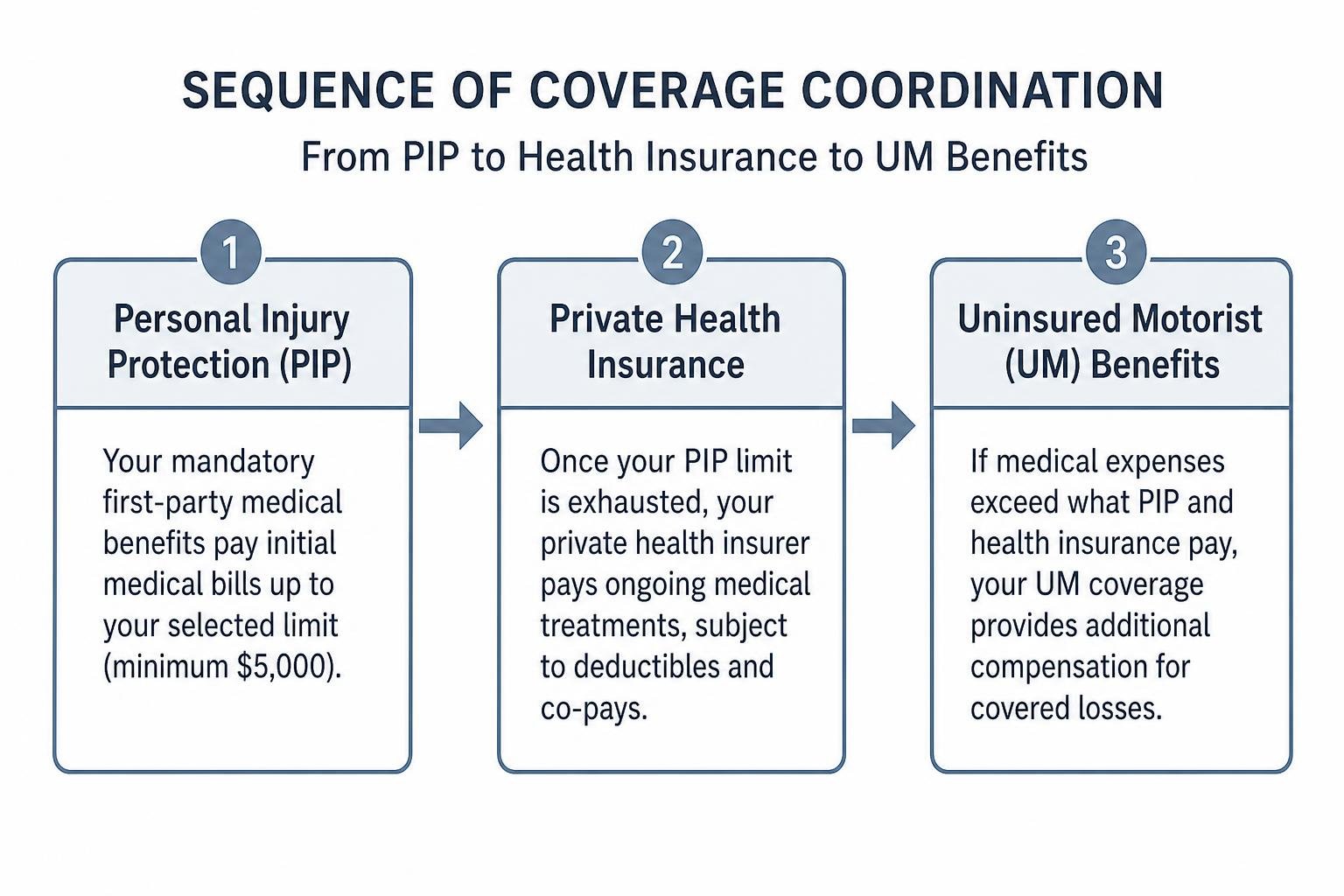
How UM Coordinates with PIP, Health Insurance, and Tort Thresholds
When an uninsured driver injures you, your insurance benefits pay out in a specific hierarchy:
- Personal Injury Protection (PIP): Your mandatory first-party medical benefits pay initial medical bills up to your selected limit (minimum $5,000).
- Private Health Insurance: Once your PIP limit is exhausted, your private health insurer pays ongoing medical treatments, subject to deductibles and co-pays.
- Uninsured Motorist (UM) Coverage: Your UM coverage steps in to pay for past and future medical bills exceeding your PIP/health limits, past and future wage loss, and general non-economic damages (pain and suffering).
Your choice between Full Tort and Limited Tort significantly influences what you can recover through a UM claim. If you select Limited Tort to save money on your premium, you waive the right to recover non-economic damages (pain and suffering) unless your injuries meet the statutory threshold of a “serious impairment of a body function” or qualify for specific exceptions (such as being hit by an out-of-state registered vehicle or a drunk driver). Drivers wanting unrestricted recovery for physical suffering should explore full tort auto insurance explained without the legal headaches.
Common Exclusions and Coverage Limitations
Insurers include specific policy exclusions that can bar or limit UM payouts:
- The Household-Vehicle Exclusion: This exclusion attempts to deny UM coverage if you are injured while occupying a household-owned vehicle that is not insured under the specific policy from which you are seeking benefits.
- The Regular Use Exclusion: If you are injured while operating a non-owned vehicle that is furnished or available for your regular use (such as an employer-provided work vehicle or police cruiser) that lacks UM coverage, your personal auto insurer may deny benefits, as litigated in Robert Henderson v. Charter Oak Fire Insurance.
- Uninsured Vehicle Owners: Under the Supreme Court of Pennsylvania ruling in Brown v. Travelers Insurance (1986), owners of registered vehicles who fail to maintain compulsory liability coverage cannot recover UM benefits from assigned claims plans or other policies if they are injured while operating their uninsured vehicles.
What to Do After an Accident and How to File a UM Claim in PA
The steps you take immediately following an accident with an uninsured driver will directly determine the success of your insurance claim. Reviewing the Pennsylvania auto insurance guide 2026 helps you understand the required timelines and documentation.
Immediate Steps at the Accident Scene
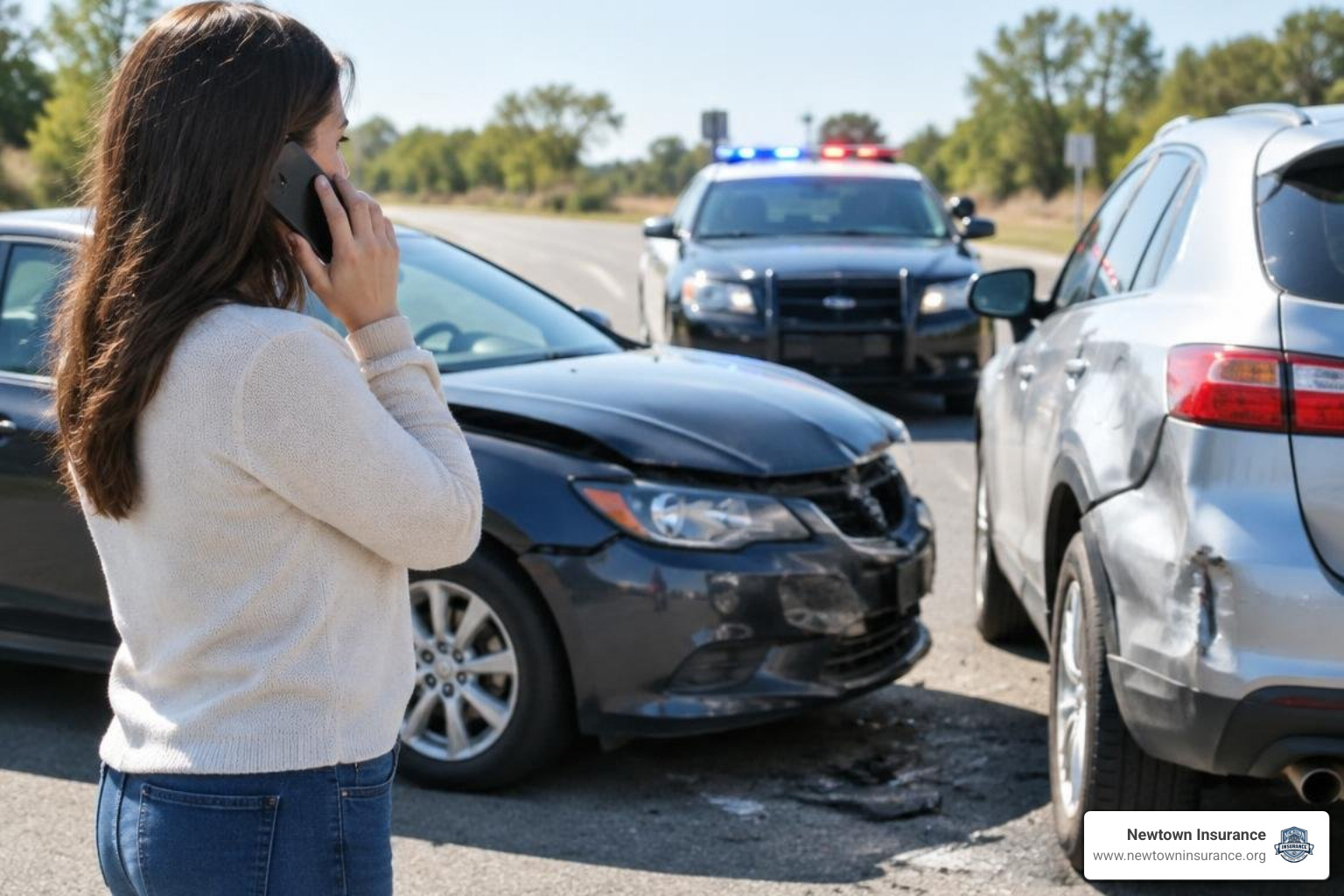
If you are involved in a collision with an uninsured or hit-and-run driver, take these immediate actions:
- Call 911 Immediately: Ensure police arrive and file an official incident report. An official police report is vital for hit-and-run claims, as policies often require law enforcement notification within 24 to 48 hours.
- Gather Identifying Details: Collect the other driver’s name, contact details, driver’s license number, and vehicle registration. If they admit they have no insurance, note that statement.
- Photograph Everything: Capture extensive photos and videos of vehicle damage, license plates, skid marks, road conditions, traffic signs, and visible physical injuries.
- Identify Witnesses: Obtain names and phone numbers of any independent bystanders who saw the crash.
- Seek Immediate Medical Care: Visit an emergency room, urgent care, or your primary doctor right away. Gaps in medical treatment allow insurers to argue that your injuries were not caused by the collision.
Navigating the UM Claims and Settlement Process
Filing a UM claim requires dealing directly with your own insurance company as a first-party claimant:
- Provide Prompt Written Notice: Notify your insurer about the collision and indicate that you are opening a potential Uninsured Motorist claim.
- Submit Comprehensive Documentation: Provide the claims adjuster with the official police report, complete medical treatment records, itemized medical billing statements, and employment records proving lost income.
- Respect Consent-to-Settle Clauses: If an underinsured or partially covered driver is involved, never sign a release or finalize a settlement without written consent from your own insurer. Failing to obtain consent can destroy your insurer’s subrogation rights and void your coverage.
- Demand Arbitration if Necessary: If you and your insurer cannot agree on a fair settlement for your pain and suffering, most Pennsylvania UM endorsements contain arbitration clauses allowing an impartial panel to decide the claim value.
- Protection Against Bad Faith: Under 42 Pa.C.S. § 8371, Pennsylvania law protects consumers against insurers who handle claims in bad faith. If your carrier unreasonably delays, undervalues, or denies your valid UM claim without an objective basis, you may be entitled to interest, court costs, attorney fees, and punitive damages.
Frequently Asked Questions About Pennsylvania UM Coverage
Is uninsured motorist coverage legally required in Pennsylvania?
No. While Pennsylvania law requires insurance companies to offer UM and UIM coverage on every policy, consumers have the legal right to reject it by signing a written waiver form under 75 Pa.C.S. § 1731. However, if an insurer fails to obtain a valid, properly formatted rejection form, the policy automatically includes UM coverage equal to your bodily injury liability limits.
Does PA uninsured motorist coverage pay for property damage?
No. In Pennsylvania, standard Uninsured Motorist coverage applies strictly to bodily injury losses (medical bills, wage loss, pain and suffering). To protect your physical vehicle against damage caused by an uninsured driver, you must carry Collision Coverage on your policy.
Will filing a UM claim increase my auto insurance rates in PA?
Generally, no. Under Pennsylvania insurance regulations, insurers are prohibited from raising your premium rates or applying surcharges for claims resulting from accidents where you were not at fault and were hit by an uninsured motorist.
Conclusion
Carrying proper Uninsured Motorist protection ensures that an irresponsible driver who refuses to buy insurance cannot wipe out your personal savings or derail your family’s financial security. Reviewing your policy declarations page, verifying your stacking status, and choosing adequate coverage limits provides essential peace of mind on Pennsylvania roads.
At Newtown Insurance, we provide tailored protection, transparent pricing, and customer-first support to help you avoid overpaying while staying fully protected. Take control of your coverage today—compare auto insurance quotes with our local team and discover our complete range of customized insurance solutions.