Compare Pennsylvania Auto Insurance Quotes Before You Buy
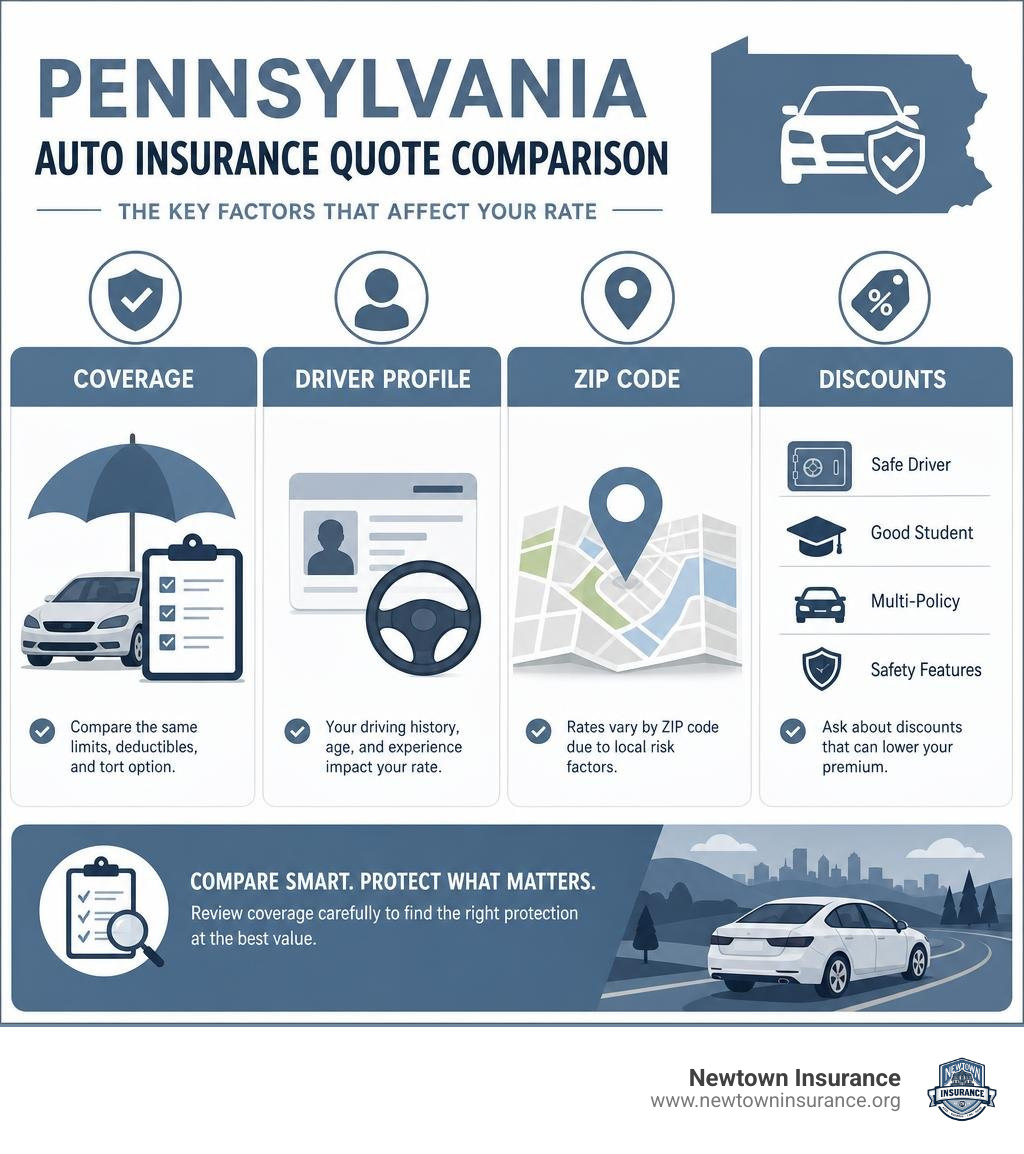
For an auto insurance Pennsylvania quote, compare the same coverage limits, deductibles, and tort option across several insurers. Pennsylvania drivers average about $121 per month for full coverage and $50 per month for minimum coverage, but the carrier and your ZIP code can change that price dramatically.
- Full coverage can better protect your vehicle after a crash, theft, or storm damage.
- Pennsylvania’s legal minimum of $15,000/$30,000 for bodily injury and $5,000 for property damage may fall short after a serious accident.
- Do not compare price alone. Check liability limits, uninsured/underinsured motorist coverage, deductibles, and whether you selected limited or full tort.
A smart quote review looks for real savings without quietly removing protection you may need. For example, rates can vary by hundreds of dollars per month between insurers for the same driver profile, making comparison shopping more valuable than simply cutting coverage.
I am Shawn Beihl, an insurance professional with more than 15 years of experience across specialty insurance and property and casualty risk. I use that background to help Pennsylvania drivers understand an auto insurance Pennsylvania quote, spot coverage gaps, and make clearer cost decisions.
Auto insurance pennsylvania quote terms you need:
Understanding Your Auto Insurance Pennsylvania Quote: Average Costs and Legal Minimums

Navigating the insurance market in the Keystone State requires balancing legal requirements against real-world risk. As outlined in our Pennsylvania Auto Insurance Guide 2026, the statewide baseline average for full coverage sits at $121 per month ($1,452 annually), which comes in $3 below the national average of $124. For state minimum liability coverage, Pennsylvania drivers pay an average of $50 per month.
While saving $71 per month with minimum coverage may sound tempting, state minimums expose your personal assets to immense financial danger. Understanding the mandatory Auto Insurance Requirements in Pennsylvania reveals why basic coverage rarely suffices:
- Bodily Injury Liability: $15,000 per person / $30,000 per accident.
- Property Damage Liability: $5,000 per accident.
- First-Party Benefits (Medical Payments): $5,000 mandatory minimum.
Consider the reality of these numbers. If you cause a collision involving a modern vehicle, a $5,000 property damage limit will not even replace a damaged bumper and sensor array, let alone cover a total loss. Any remaining repair balance comes straight out of your pocket. Similarly, an emergency room visit and surgical care can surpass $15,000 in a matter of hours.
| Coverage Type | State Minimum Policy | Recommended Full Coverage Policy |
|---|---|---|
| Monthly Average Cost | $50 / month | $121 / month |
| Bodily Injury Liability | $15,000 / $30,000 | $100,000 / $300,000 |
| Property Damage Liability | $5,000 | $100,000 |
| Medical Benefits | $5,000 | $10,000+ |
| Collision & Comprehensive | Not included | Included ($500–$1,000 deductible) |
| Asset Protection | Minimal (High personal risk) | Comprehensive |
Limited Tort vs. Full Tort Elections
When requesting an insurance estimate, one of the most critical decisions you will make is choosing between limited tort and full tort coverage.
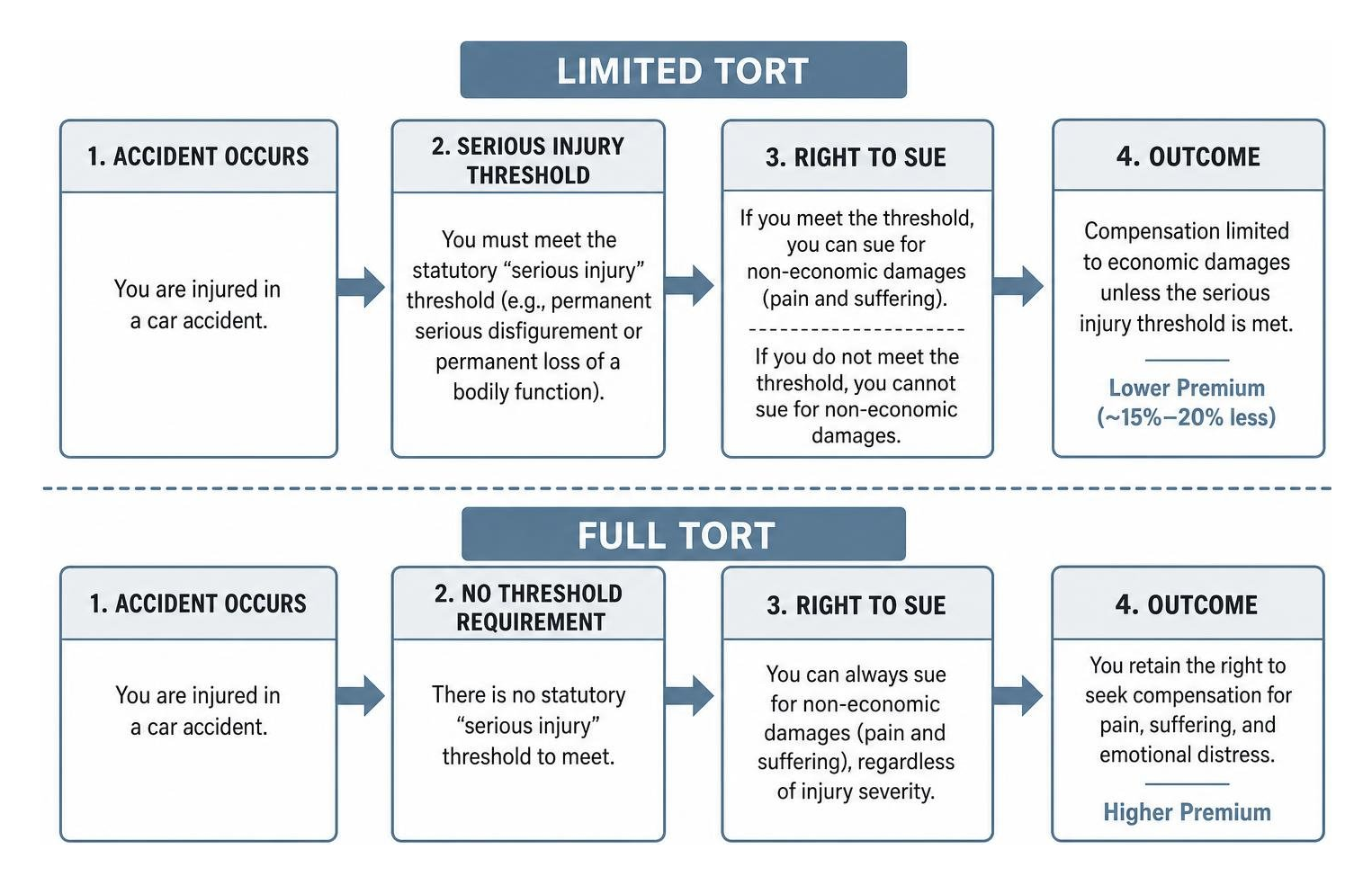
- Limited Tort: Choosing limited tort reduces your annual premium by approximately 15% to 20%. However, in exchange for these savings, you waive your legal right to seek compensation for non-economic damages—commonly referred to as “pain and suffering”—unless your injuries meet a specific statutory threshold defined as “serious injury” (such as permanent serious disfigurement or permanent loss of a bodily function).
- Full Tort: Opting for full tort costs slightly more each month, but it retains your unrestricted legal right to pursue financial compensation for pain, suffering, and emotional distress caused by an at-fault driver, regardless of the severity of the injury.
Stacked vs. Unstacked Uninsured and Underinsured Motorist Coverage
Pennsylvania roads present unique hazards. The state’s uninsured driver rate is estimated at 12.9%, meaning nearly one in eight motorists carries no liability coverage whatsoever. Understanding Why Underinsured Motorist Protection Is Your Best Road Safety Net helps prevent devastating out-of-pocket medical bills if an uninsured driver hits you.
Under Pennsylvania law, Uninsured Motorist (UM) and Underinsured Motorist (UIM) coverage are stacked by default across your vehicles unless you sign an explicit waiver.
- Stacked UM/UIM: Multiplies your coverage limits by the number of vehicles insured on your policy (or across multiple policies in the same household). For example, if you carry $100,000/$300,000 in coverage across two vehicles, stacked coverage allows you to access up to $200,000/$600,000 in injury protection.
- Unstacked UM/UIM: Restricts your protection to the single limit stated on the policy, regardless of how many cars you insure, offering a modest premium discount.
Location and Risk: Why Rates Fluctuate Across Pennsylvania

Where you park your vehicle overnight plays a massive role in what you pay. Geography dictates risk density, traffic congestion, repair costs, and regional crime rates. The Average Cost of Car Insurance in Philadelphia highlights this divide: Philadelphia drivers pay an average of $103 per month for minimum coverage alone. In contrast, drivers navigating Western Pennsylvania—as detailed in The Steel City Guide to Car Insurance—pay an average of just $51 per month in Pittsburgh for the same level of coverage.
Philadelphia recorded 21,620 vehicle thefts in 2023, representing the highest total in nearly two decades according to Philadelphia Police Department data. High rates of vandalism, litigation, and dense traffic explain why urban premiums surge.
Beyond urban crime, environmental factors affect statewide pricing. Pennsylvania averaged 8.2 billion-dollar weather disasters per year from 2020 through 2024, with severe convective storms driving 56% of all such events since 1980. Comprehensive coverage protects against falling trees, flash floods, hail damage, and collision with deer, making it an essential buffer across suburban and rural counties alike.
Key Factors That Shift Your Auto Insurance Pennsylvania Quote
Insurance underwriters evaluate a wide range of pricing variables to determine your personalized rate:
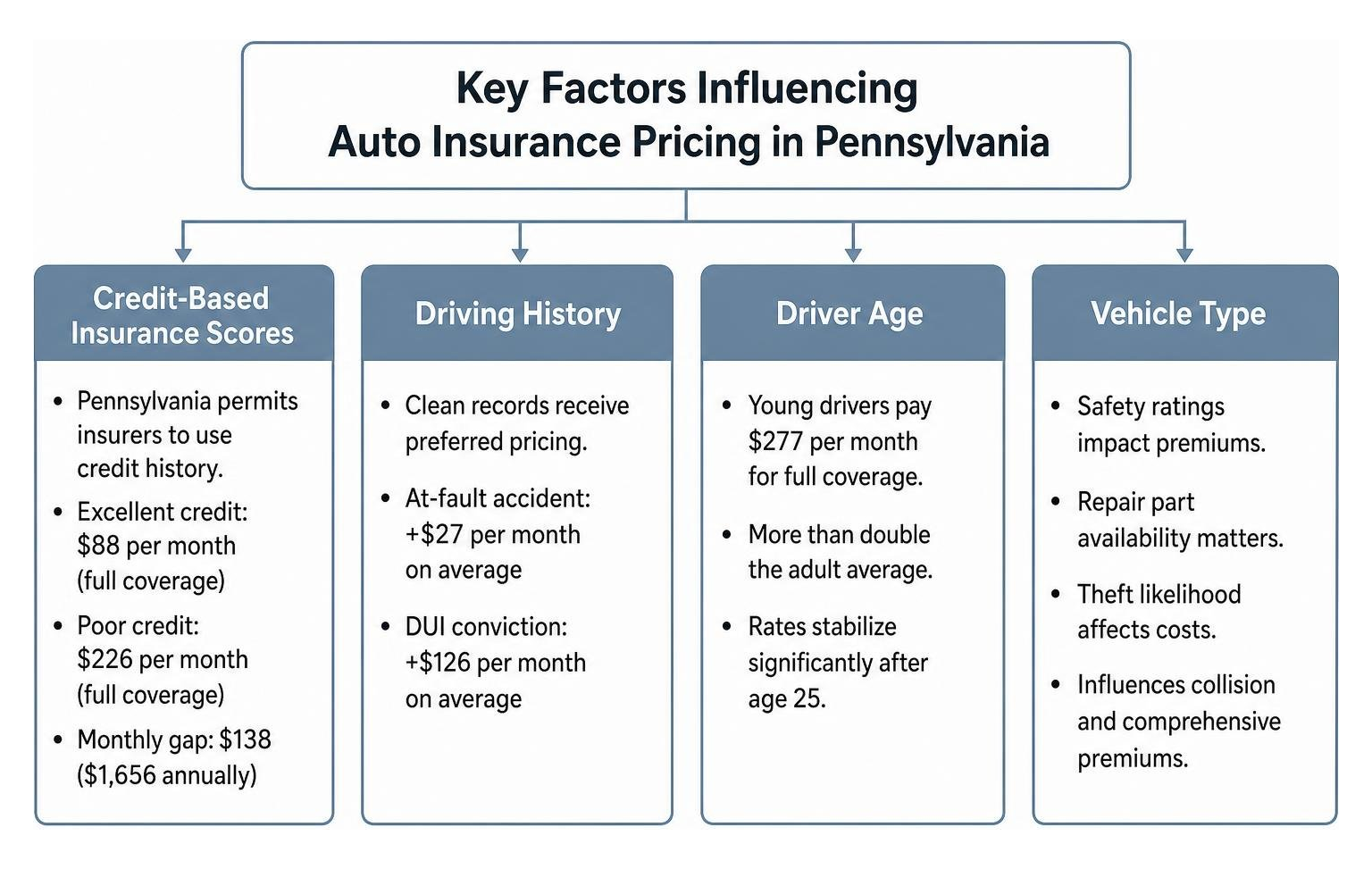
- Credit-Based Insurance Scores: Pennsylvania permits insurers to use credit history. Drivers with excellent credit pay an average of $88 per month for full coverage, while those with poor credit pay $226 per month—a stark $138 monthly gap ($1,656 annually). You can learn more about how rating tiers work in our Car Insurance Rates Pennsylvania Guide 2026.
- Driving History: Clean records receive preferred pricing. An at-fault accident adds an average surcharge of $27 per month, while a DUI conviction adds $126 per month.
- Driver Age: Young drivers in Pennsylvania pay an average of $277 per month for full coverage—more than double the adult average. Rates stabilize significantly once drivers turn 25.
- Vehicle Type: Safety ratings, repair part availability, and theft likelihood influence collision and comprehensive premiums directly. To see how these variables interact with your vehicle type, you can test scenarios using Pennsylvania Car Insurance Calculators: Cost & Coverage .
How to Maximize Discounts and Lower Your Premium
You do not have to settle for high baseline premiums. Leveraging targeted discounts can reduce your out-of-pocket costs without sacrificing coverage quality. Reviewing our Auto Insurance Discounts Guide 2026 gives you a clear roadmap for cutting costs.
- Multi-Policy Bundling: Pairing your auto policy with a homeowners or renters policy is one of the most effective ways to lower rates. An Auto and Home Bundle frequently generates double-digit percentage savings across both policies.
- Vehicle Safety Devices: Equipping your car with alarm systems, GPS tracking, or ignition disablement devices qualifies you for an Anti Theft Discount Auto Insurance reduction.
- Deductible Management: Increasing your collision and comprehensive deductibles from $250 or $500 up to $1,000 immediately reduces your monthly payment.
Mandatory Defensive Driving Discounts for Seniors 55 and Older
Pennsylvania state law offers a valuable, mandatory savings opportunity for mature motorists. Under state statute, drivers aged 55 and older who complete an approved mature driver improvement course are legally entitled to a minimum 5% discount on their auto insurance premiums.
- The course can be completed in a classroom or via certified online providers.
- The discount remains valid for three consecutive years.
- To maintain the discount indefinitely, drivers simply take an approved refresher course every three years without incurring moving violations or at-fault accidents.
When to Refresh Your Auto Insurance Pennsylvania Quote for Maximum Savings
Insurance pricing models fluctuate constantly. Rather than letting your policy auto-renew indefinitely, use strategic life milestones to shop for rates:
- Turning 25: Young drivers typically see an immediate drop in baseline risk pricing upon reaching age 25.
- Improving Your Credit Score: Moving from a fair credit tier to good or excellent credit can save over $100 per month.
- Violation Aging: Moving violations and minor accidents typically fall off your chargeable driving record after 36 months.
- DUI Milestones: Surcharges associated with past DUIs diminish significantly after three to five years.
- Annual Review: Taking time to Compare Insurance Quotes Complete Guide ensures your current carrier remains competitive as regional rates shift.
Frequently Asked Questions About Pennsylvania Car Insurance
How much does car insurance cost in Pennsylvania per month?
Pennsylvania drivers pay an average of $121 per month for full coverage auto insurance, which is slightly below the national monthly average of $124. Minimum coverage in Pennsylvania costs an average of $50 per month, though exact rates depend heavily on your driving record, age, credit tier, and home ZIP code.
Does Pennsylvania require an SR-22 or FR-44 filing after a DUI?
No. Unlike many other states, Pennsylvania does not use SR-22 or FR-44 certificate filings to verify financial responsibility after a DUI conviction or license suspension. Instead, restoration of driving privileges is managed directly through PennDOT restoration fees, court-mandated ignition interlock programs, and proof of standard valid insurance coverage.
Why is car insurance more expensive in Philadelphia than Pittsburgh?
Philadelphia drivers pay an average of $103 per month for minimum coverage compared to $51 per month in Pittsburgh. This gap is driven by higher traffic density, elevated litigation and medical claim costs, and significantly higher vehicle theft rates (with Philadelphia recording 21,620 vehicle thefts in 2023).
Conclusion
Finding the right auto insurance in Pennsylvania is not about hunting for the absolute bare minimum—it is about finding the right balance between robust financial protection and an affordable monthly rate. By evaluating tort choices, selecting adequate liability limits, stacking uninsured motorist coverage, and claiming every available discount, you can secure dependable protection for your household.
At Newtown Insurance, our team is dedicated to helping Pennsylvania drivers navigate the state’s distinct insurance regulations. We take the time to evaluate your unique driving profile, explore multi-policy discounts, and build a customized coverage plan that keeps you protected on every road. To explore your options, connect with us today through our services overview and let us help you secure your ideal coverage.