
Affordable Auto Insurance for Students Starts With the Right Policy Setup
Auto insurance for students is usually cheapest when the student stays on a parent’s policy, claims every eligible discount, and accurately reports where the car is kept. College students often pay about $120 to $250 per month, but costs can be much higher for a standalone policy, especially at age 18.
Start with these three steps:
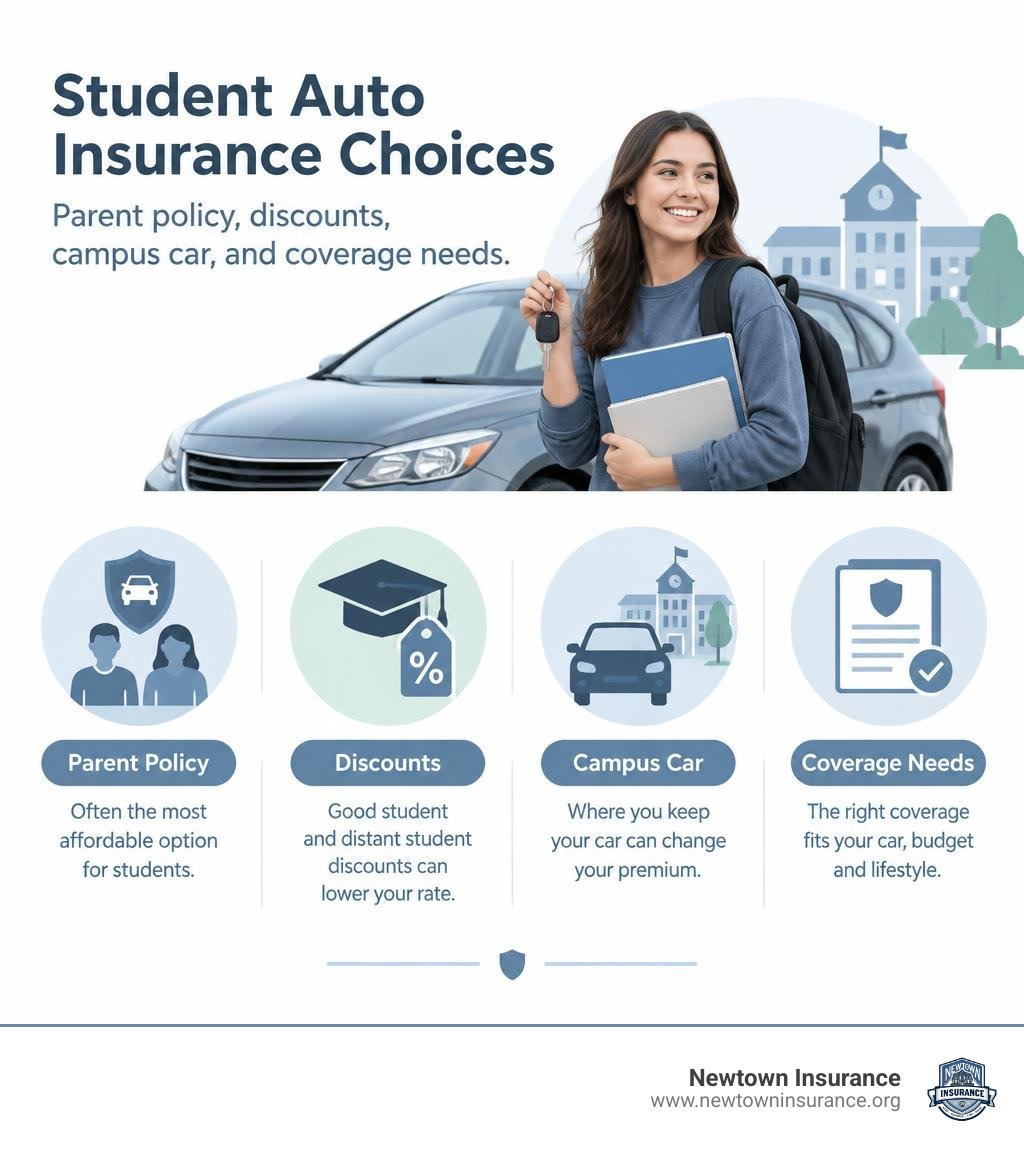
- Compare family-policy and standalone quotes. Staying on a parent’s policy can save thousands each year.
- Ask about good-student and distant-student discounts. A GPA of 3.0 or higher may reduce premiums, and leaving a car at home while attending school 100+ miles away can unlock further savings.
- Update the car’s garaging address. Taking a car to a campus in a higher-risk ZIP code may raise the rate. Leaving it at home may lower it.
Young drivers pay more because they have less driving experience and, statistically, a higher crash risk. But high prices are not a reason to accept a generic plan, hidden fees, or coverage that does not fit your budget. The right choice depends on who owns the car, whether it is financed, how often it is driven, and whether it lives on campus or at home.
I am Shawn Beihl, with more than 15 years of experience in specialty insurance, including commercial property and casualty coverage and risk management. In this guide to Auto insurance for students, I will help you understand the practical choices that can protect your budget without leaving important gaps.
Auto insurance for students basics:
- Auto insurance Pennsylvania quote
- Cheap auto insurance quotes pa
- Car insurance calculator pennsylvania
Parent Policy vs. Standalone Policy: Finding the Biggest Savings

When college begins, the first major financial crossroad is deciding whether to remain listed on a family policy or venture out onto an independent, standalone policy. For young drivers between 18 and 22, the financial gap between these two approaches is dramatic.
According to industry data from the Insurance Information Institute, drivers under age 25 pay roughly 60% to 80% more for identical coverage than experienced drivers aged 30 to 50. For an 18-year-old striking out on an independent full-coverage policy, annual premiums can reach an average of $7,146 per year (or nearly $600 per month). In contrast, keeping that same 18-year-old on a parent’s multi-vehicle policy brings the average annual premium down to approximately $4,079—an immediate out-of-pocket savings of over $3,000 per year.
Across the wider college demographic (ages 18 to 22), independent policies typically range from $2,400 to $4,800 annually, whereas remaining on a parent’s plan usually results in a manageable $1,000 to $1,800 per year added to the household premium.
To see how these costs stack up for your exact situation, it pays to compare insurance quotes across multiple policy structures. You can also explore options for an auto and home bundle with the household’s current carrier to unlock multi-policy rate reductions.
When Staying on a Family Plan Makes Sense
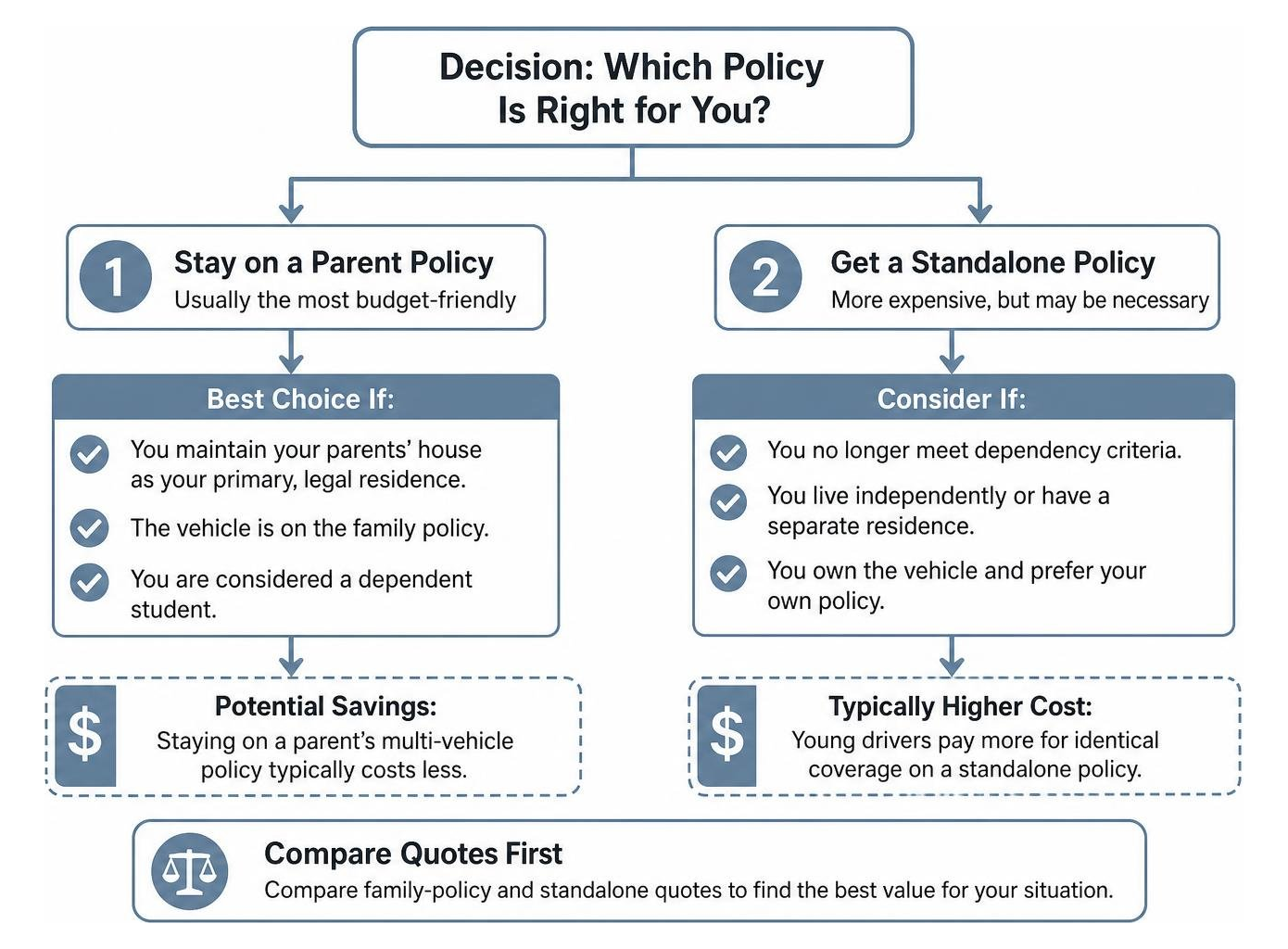
Staying on a family insurance policy is almost always the most budget-friendly move if you meet standard dependency criteria. To remain on your parents’ plan, you generally must:
- Maintain your parents’ house as your primary, legal residence.
- Attend school full-time or return home during academic breaks and summer vacations.
- Drive a vehicle titled in your parents’ names or co-titled jointly with them.
By sharing a policy, students immediately tap into accumulated household benefits, such as multi-car discounts, longevity credits, and superior coverage tiers that would otherwise be cost-prohibitive. For an extensive look at how household policies reduce long-term spending, see our auto insurance savings complete guide.
When a Separate Policy Becomes Necessary
While staying on a family policy saves money, life transitions sometimes require establishing your own policy. A standalone policy is typically mandatory when:
- The vehicle is titled solely in the student’s name: Most insurance regulations require the policyholder to have a direct financial, insurable interest in the vehicle.
- You establish permanent residency elsewhere: Moving into an off-campus apartment year-round, changing voter registration, or filing taxes as a fully independent adult often severs family policy eligibility.
- You get married: Tying the knot establishes a new legal household, where combining coverage with a spouse often yields married-driver discounts that lower rates.
If you must purchase an independent policy, review our personal auto insurance guide 2026 to structure your coverage limits effectively without overpaying.
Key Discounts in Auto Insurance for Students

Auto insurers recognize that college budgets are tight, which is why almost every major carrier offers specialized student discounts. Stacking these discounts together can cut your overall premium by 20% to 40%.
To make sure you are capturing every possible dollar of savings, consult our comprehensive auto insurance discounts guide 2026.
The Good Student Discount and Academic Requirements
The Good Student Discount is the single most valuable rate reduction available to young drivers. Insurers have found a statistical correlation between academic diligence and conscientious, lower-risk driving habits.
- Eligibility Criteria: Full-time high school or undergraduate students under age 25 who maintain a cumulative Grade Point Average (GPA) of 3.0 or higher (a “B” average).
- Alternative Qualifications: Making the Dean’s List, ranking in the top 20% of your class, or scoring in the top national percentiles on standardized tests (SAT/ACT).
- Savings Impact: Reduces comprehensive, collision, and liability premiums by 8% to 25%, with most carriers averaging around 12% to 15% in gross savings.
- Verification: You will need to provide an official transcript, report card, or registrar letter at the start of each academic semester or policy term.
To maximize driver-profile savings alongside academic performance, explore our guide on smart driver discounts.
Distant Student and Low-Mileage Savings
If you attend a college or university located more than 100 miles away from your parents’ residence and leave the vehicle parked at home, you likely qualify for the Distant Student (Away-at-School) Discount.
Because the insurer assumes you will only drive the car occasionally during holiday breaks, weekend visits, or summer vacation, your daily accident exposure plummets. This adjustment can trim 15% to 30% off your policy costs.
For students who bring a car to school but commute infrequently, enrolling in a usage-based telematics program or low-mileage tier can offer comparable savings. Learn more about low-mileage structures in our guide to low cost auto insurance options.
Managing Coverage, Locations, and Driving Records
Maintaining an affordable premium requires balancing your coverage levels with a clean driving record. Because young drivers already face elevated base rates, any minor moving violation or collision can trigger severe surcharges.
- Speeding Tickets: A single speeding conviction typically increases a student’s insurance premium by 25%.
- At-Fault Accidents: A collision where you are deemed at fault can trigger a premium surge of 45% or more, which lingers on your driving record for three to five years.
- Coverage Lapses: Allowing your policy to lapse for even 30 days can raise your future rates by an average of 9%.
If you have a recent citation on your record, you can offset some rate increases by completing an approved driver education program, tapping into safe driver insurance discounts, or reviewing our practical guide on lowering car insurance after a ticket.
| Coverage Option | Typical Annual Cost (Solo Policy) | Typical Annual Cost (Parent Policy) | Best Suited For |
|---|---|---|---|
| State Minimum Liability | $1,800 – $2,600 | $800 – $1,200 | Older vehicles (sub-$4,000 value), owned outright, tightest budgets |
| Standard Liability (50/100/50) | $2,400 – $3,400 | $1,000 – $1,500 | Commuter students, moderate asset protection, balanced approach |
| Full Coverage ($500 Deductible) | $4,200 – $7,100 | $1,800 – $3,800 | Financed or leased vehicles, newer cars, complete asset protection |
| Full Coverage ($1,000 Deductible) | $3,400 – $5,600 | $1,400 – $2,900 | Newer vehicles with an emergency savings buffer to handle deductible |
Choosing the Right Coverage in Auto Insurance for Students
Choosing policy limits is a balancing act between affordable monthly premiums and realistic out-of-pocket exposure.
- Liability Coverage: Always carry enough Bodily Injury and Property Damage liability to protect your family’s assets. While state minimum limits keep premiums low, standard limits (such as $50,000/$100,000/$500,000) offer significantly better protection against catastrophic legal claims.
- Collision & Comprehensive: Collision pays for damage to your vehicle resulting from an accident, while comprehensive covers theft, vandalism, glass damage, and weather events. If you drive a newer or financed vehicle, full protection is essential. To understand how physical damage coverage works without breaking the bank, explore our breakdown of affordable auto insurance full coverage.
- The 10% Rule for Older Cars: If the annual cost of comprehensive and collision coverage exceeds 10% of your vehicle’s total market value, consider dropping them and relying on liability coverage only.
- Deductible Strategies: Increasing your comprehensive and collision deductible from $500 to $1,000 can lower your physical damage premiums by 15% to 25%. Only choose this option if you have an emergency fund ready to cover that out-of-pocket expense if an accident occurs.
How Moving to Campus Affects Auto Insurance for Students
Where your car is parked at night directly impacts your insurance premium. When you pack your bags for campus, your vehicle’s physical location (its “garaging address”) changes:
- Urban vs. Suburban Risks: Moving a car from a quiet suburban driveway to an on-campus lot in a dense city often increases rates. High traffic congestion, elevated rates of vehicle break-ins, and tight street parking all raise risk factors.
- Garaging Integrity: Always inform your insurer of the vehicle’s true location. Failing to report where the car is kept can result in denied claims if an accident or vandalism occurs on campus.
- State Requirements: If you are attending an out-of-state college or university, review regional liability thresholds. For students attending school within the Commonwealth, review our Pennsylvania auto insurance guide 2026 and auto insurance requirements in Pennsylvania.
Coverage Options When You Leave the Car at Home
If you choose not to bring a vehicle to campus, you do not necessarily want to be stripped from all auto coverage. Maintaining continuous coverage is vital for preserving preferred-tier insurance pricing over time.
- Staying on the Policy as an Occasional Driver: Keeping your name on the family policy while applying a distant-student discount keeps your driving history active and protects you when driving during school breaks.
- Non-Owner Auto Insurance: If you do not own a vehicle but frequently borrow friends’ cars, use car-sharing services, or rent vehicles, a non-owner liability policy is an affordable solution. Costing between $200 and $500 per year, it provides liability protection and prevents a coverage gap. Discover more budget strategies in our guide to moneysaving car insurance.
Frequently Asked Questions About Student Auto Coverage
How much does car insurance cost for a college student in 2026?
Nationwide, college students (ages 18 to 22) pay an average of $120 to $250 per month when added to a parent’s policy. Independent, standalone policies cost significantly more, ranging between $200 and $600 per month ($2,400 to $7,146 annually), depending on the student’s age, vehicle type, driving history, credit profile (where permitted), and coverage levels.
Do I need auto insurance if I do not have a car at college?
While insurance is not legally mandated if you do not own a vehicle, carrying coverage is often wise. A non-owner insurance policy or staying listed as an occasional driver on your parents’ plan provides personal liability coverage when you drive borrowed vehicles or rent cars. It also maintains your continuous insurance history, helping you avoid higher premiums after graduation.
Can my college roommate drive my car under my policy?
Occasional, rare borrowing is generally covered under the permissive use clause of your auto insurance policy. However, if your roommate drives your vehicle on a regular, weekly basis, insurers expect them to be explicitly listed on the policy. If an unlisted regular driver causes an accident, the insurance carrier may deny the claim.
Conclusion
Navigating auto insurance as a student does not have to drain your college budget. By staying on a family policy whenever possible, maintaining a GPA of 3.0 or higher to capture good student discounts, and selecting coverage deductibles that match your vehicle’s value, you can save thousands of dollars throughout your academic career.
At Newtown Insurance, we provide personalized protection, smart savings strategies, and transparent pricing tailored to students and families throughout Pennsylvania. Whether you are bringing your car to campus or leaving it safely in the driveway at home, we are here to help you build the right coverage plan.
Ready to see how much you can save this school year? Explore our full range of student-focused coverage solutions at Newtown Insurance Services today.