What a Health Insurance Discount Really Means
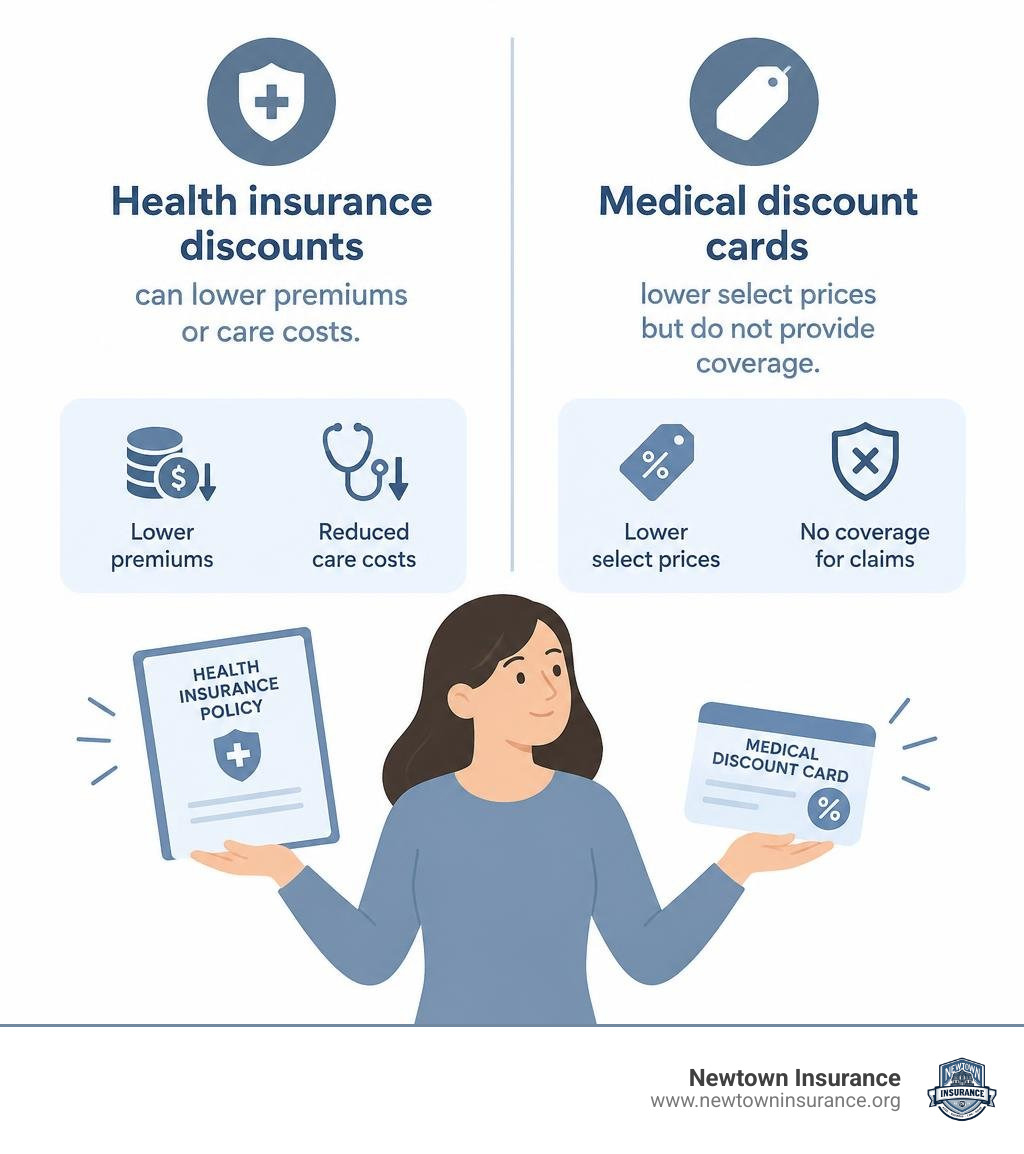
A health insurance discount can mean a lower premium or a reduced price for care through your insurance plan. A medical discount plan is different: you may pay a fee to access lower prices from participating providers, but the plan does not pay medical claims or protect you from a large hospital bill.
That difference matters when you compare costs. A low monthly fee may look appealing, but check what you would pay for care, whether your providers take the card, and whether any savings outweigh the fee.
I’m Shawn Beihl, and I’ve spent over 15 years working in health insurance, benefits management, and other specialty coverage. When someone asks me “what is a health insurance discount,” I start by separating lower prices from actual coverage.
Relevant articles related to what is a health insurance discount:
What Is a Health Insurance Discount vs. a Medical Discount Plan?
Understanding the healthcare marketplace starts with recognizing the fundamental difference between an insurance policy and a discount program. While both promise to lower what you spend on medical care, they operate under entirely different legal frameworks, financial structures, and risk models.
Understanding What Is a Health Insurance Discount on Premiums and Services
When examining what is a health insurance discount, it generally refers to two distinct savings mechanisms built into legitimate insurance policies:
- Contracted In-Network Rates: Health insurance companies negotiate discounted rates directly with doctors, hospitals, and pharmacies. When you visit an in-network provider, you do not pay standard retail charges. Instead, you pay the insurer’s negotiated rate, which is often 10% to 30% below retail pricing.
- Premium Reductions and Wellness Subsidies: Insurers provide discounts directly on your monthly premium based on specific health choices or coverage selections. These include non-smoker discounts, wellness incentives for completing annual checkups, or premium tax credits applied under federal guidelines.
By comparing 2026 health insurance quotes, you can evaluate how these negotiated rates and premium adjustments lower your overall annual medical spending while maintaining a legal safety net.
How Medical Discount Cards Work
A medical discount plan—often marketed as a discount card—is a membership program rather than insurance. In this arrangement, you pay a monthly or annual membership fee to a company that has negotiated cash discounts with participating healthcare providers.
As explained in this guide on what is a medical discount plan?, the discount company assumes zero financial risk. When you receive treatment:
- The discount plan pays nothing to the physician.
- You must pay the provider directly at the time of service.
- The provider applies an agreed-upon percentage discount (e.g., 20% off an office visit).
If a medical bill amounts to $5,000, a discount card might lower the total to $4,000, but you remain personally responsible for paying every single dollar of that remaining $4,000 balance out of your own pocket.
Key Differences Between Coverage and Price Reductions
The primary distinction between genuine health insurance and a medical discount plan lies in risk assumption and financial protection. Health insurance creates a legal obligation for the insurer to cover your qualified medical bills once you meet your deductible and copayments, up to your annual out-of-pocket maximum. A discount plan offers price cuts at the checkout counter, but leaves 100% of the financial burden on your shoulders.
| Feature / Criteria | Major Medical Health Insurance | Medical Discount Plan |
|---|---|---|
| Primary Function | Transfuses and pools financial risk | Provides percentage discounts on cash prices |
| Claim Payments | Insurer pays covered claims to doctors/hospitals | Company pays zero claims; you pay the entire bill |
| Regulatory Oversight | State Insurance Departments & Federal ACA Rules | State consumer protection or model discount laws |
| Pre-Existing Conditions | Covered fully without exclusions (ACA-compliant) | Not insurance; providers may restrict discounted rates |
| Out-of-Pocket Maximum | Mandated annual limit to protect from catastrophic debt | No maximum limit; unlimited personal financial liability |
| Preventive Care | Mandated 100% free coverage for in-network care | Discounted cash fee charged at each visit |
Types of Legitimate Insurance Discounts and Extra Benefits
When you purchase true health insurance, there are multiple avenues to legitimately lower your premiums and take advantage of plan-embedded savings without exposing yourself to financial hazards.
Lifestyle and Policy Adjustments to Lower Premiums
Under the Affordable Care Act (ACA), insurance companies are strictly limited in how they can adjust your premium rates. However, policyholders can use several lifestyle and plan adjustments to secure substantial premium discounts:
- Non-Tobacco Usage: Under federal rules, insurers are permitted to charge tobacco users up to 50% more in premiums than non-smokers. Quitting smoking or remaining tobacco-free instantly secures a massive baseline discount on coverage.
- Choosing High-Deductible Health Plans (HDHPs): Opting for a higher annual deductible lowers your monthly premium obligations.
- Health Savings Account (HSA) Pairing: HDHPs allow you to contribute pre-tax dollars into an HSA, reducing your overall taxable income and creating tax-free savings for future medical expenses.
- Selecting In-Network Care Providers: Staying strictly within your insurer’s designated provider network guarantees that you pay negotiated, heavily discounted rates on all eligible services.
Exploring budget-friendly Pennsylvania health insurance options allows policyholders to structure their deductibles and copayments to fit their monthly household finances.
Extra Benefits vs Direct Price Reductions

Many modern insurance plans include “extra benefits” designed to promote wellness and lower routine care costs. While not direct discounts on your insurance premium, these value-added perks function as built-in financial savings:
- Telehealth Services: Many policies include zero-dollar or low-copay virtual consultations, allowing you to bypass costly urgent care visits.
- Over-the-Counter (OTC) Allowances: Select policies offer quarterly or monthly stipends to purchase everyday health supplies, such as vitamins, pain relievers, and first-aid items.
- Gym Memberships and Fitness Incentives: Free access to fitness centers or fitness-tracker reimbursements help policyholders stay active and reduce long-term medical costs.
- Ancillary Dental and Vision Allowances: Routine preventive cleanings, annual eye exams, or hardware allowances packaged into standard coverage.
Risks, Limitations, and the Math Behind Medical Discount Cards
While medical discount cards are advertised with promises of dramatic savings, the underlying mathematics often reveals a different story for average consumers.
Calculating the True Cost-Benefit Ratio
Discount health programs rely on monthly membership fees that chip away at any advertised savings. Consider the real-world math of a typical discount plan:
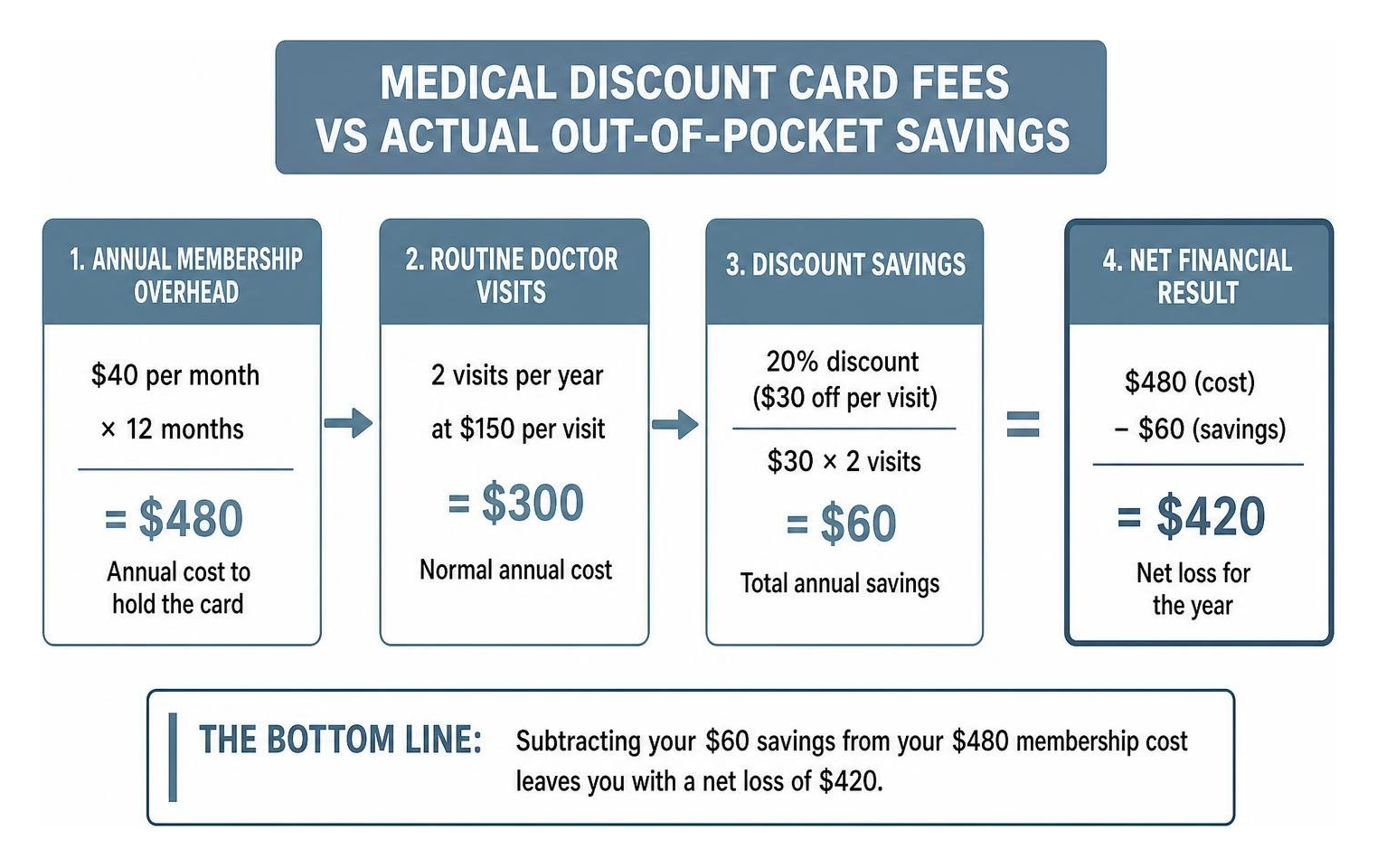
- Annual Membership Overhead: If a discount plan charges $40 per month, your fixed annual cost just to hold the card is $480.
- Routine Doctor Visit Math: If you visit a primary care doctor twice a year at a normal rate of $150 per visit, and the card provides a 20% discount ($30 off per visit), your total savings for the year equals $60.
- Net Financial Result: Subtracting your $60 savings from your $480 membership cost leaves you with a net loss of $420.
By contrast, standalone dental discount plans often cost around $150 annually and can provide useful 15% to 50% discounts on cleanings and fillings if you lack employer dental benefits. However, when applied to general medical care, discount programs rarely generate net positive value unless you require frequent, high-cost non-covered services.
ACA Compliance and Shared Responsibility Gaps
Medical discount plans are not health insurance and do not meet the definition of minimum essential coverage under the Affordable Care Act.
According to state regulatory resources such as the Discount Health Care Plans Guide, relying solely on a discount card leaves you vulnerable to several critical gaps:
- No Hospital Protection: If you experience an emergency, surgery, or major illness requiring hospitalization, a discount card will not pay your bills. A $100,000 hospital stay discounted by 20% still leaves you with an unpayable $80,000 bill.
- Pre-Existing Condition Exposure: Discount cards do not provide comprehensive coverage standards, meaning you pay out of pocket for all chronic disease management.
- Mandate and Penalty Risks: In jurisdictions with individual healthcare coverage mandates, holding only a discount card does not satisfy legal requirements and may expose you to state-level tax penalties.
How to Spot Scams and Verify Legitimate Health Discount Programs
Because medical discount cards sound similar to health insurance, deceptive marketers frequently target consumers shopping online for affordable coverage.

Red Flags and Deceptive Marketing Tactics
Regulatory agencies, including the Federal Trade Commission (FTC), actively penalize companies that misrepresent discount programs as comprehensive insurance. In one major enforcement action, the FTC returned nearly $7 million in refunds to over 47,000 consumers misled by deceptive discount health operations. In 2025, major lead-generation firms paid $145 million in combined settlements for deceptively marketing discount plans as ACA-compliant health coverage.
Watch for these primary warning signs when evaluating any healthcare plan offer:
- High-Pressure Enrollment Demands: The salesperson insists that a “special discounted rate” is only available if you give your credit card number immediately over the phone.
- Refusal to Provide Written Terms: The seller will not provide a detailed summary of benefits, network lists, or plan documents before you make a payment.
- Misleading Terminology: The representative uses terms like “copays,” “deductibles,” or “comprehensive coverage,” but the fine print states: “This is not health insurance.”
- Vague Provider Networks: You are told “all major doctors accept this card,” but individual clinics in your area state they have never heard of the program.
What Is a Health Insurance Discount Verification Process?
Before enrolling in any discount program or purchasing non-standard coverage, follow this straightforward verification process:
- Check for Mandatory Disclosures: The National Association of Insurance Commissioners (NAIC) model legislation requires legitimate discount cards to state clearly and conspicuously on all materials: “This is a discount plan, not health insurance.”
- Consult State Insurance Regulators: Review state licensing databases to ensure the organization is registered to operate as a discount medical plan organization.
- Contact Your Doctors Directly: Call your personal physician, dentist, and local hospital billing office. Provide the exact name of the discount program and confirm they currently accept their fee schedule.
- Demand 30-Day Cancellation Language: As outlined in NAIC consumer insights on how to be careful when purchasing a discount health card, legitimate discount programs must provide a 30-day “free look” period with a full refund of membership fees upon cancellation.
Frequently Asked Questions About Medical Discounts
Do medical discount plans satisfy Affordable Care Act requirements?
No. Medical discount plans do not qualify as minimum essential coverage under the ACA. They do not cover essential health benefits, provide free preventive care, or place annual caps on your out-of-pocket medical liabilities.
Can I use a medical discount card alongside my health insurance?
Yes. Many consumers hold a discount card specifically for services excluded from their primary insurance, such as cosmetic dentistry, adult vision hardware, hearing aids, or alternative therapies like acupuncture. However, you cannot combine both discounts simultaneously on the same service; providers will process either your insurance contracted rate or the discount card rate.
How can I legitimately reduce my monthly health insurance costs?
You can lower your insurance expenses without sacrificing catastrophic coverage by applying for federal premium tax credits through official exchanges, selecting a plan with an appropriate deductible, quitting tobacco use, and exploring community programs. Review our guide on finding low cost health coverage when money is tight for actionable steps to secure affordable, fully regulated coverage.
Conclusion
A legitimate health insurance discount helps you lower your monthly premiums and pay contracted, predictable rates for clinical care, all while shielding your household from severe financial catastrophe. Medical discount cards, while sometimes useful as low-cost supplements for non-covered dental or vision care, are never a replacement for comprehensive medical coverage.
At Newtown Insurance, we believe every individual and family deserves transparent pricing, tailored protection, and customer-first support without overpaying or falling into marketing traps. Explore our tailored healthcare solutions and request a transparent quote today to protect your health and your financial future.