Find the Best Cheap Full Coverage Car Insurance in Pennsylvania
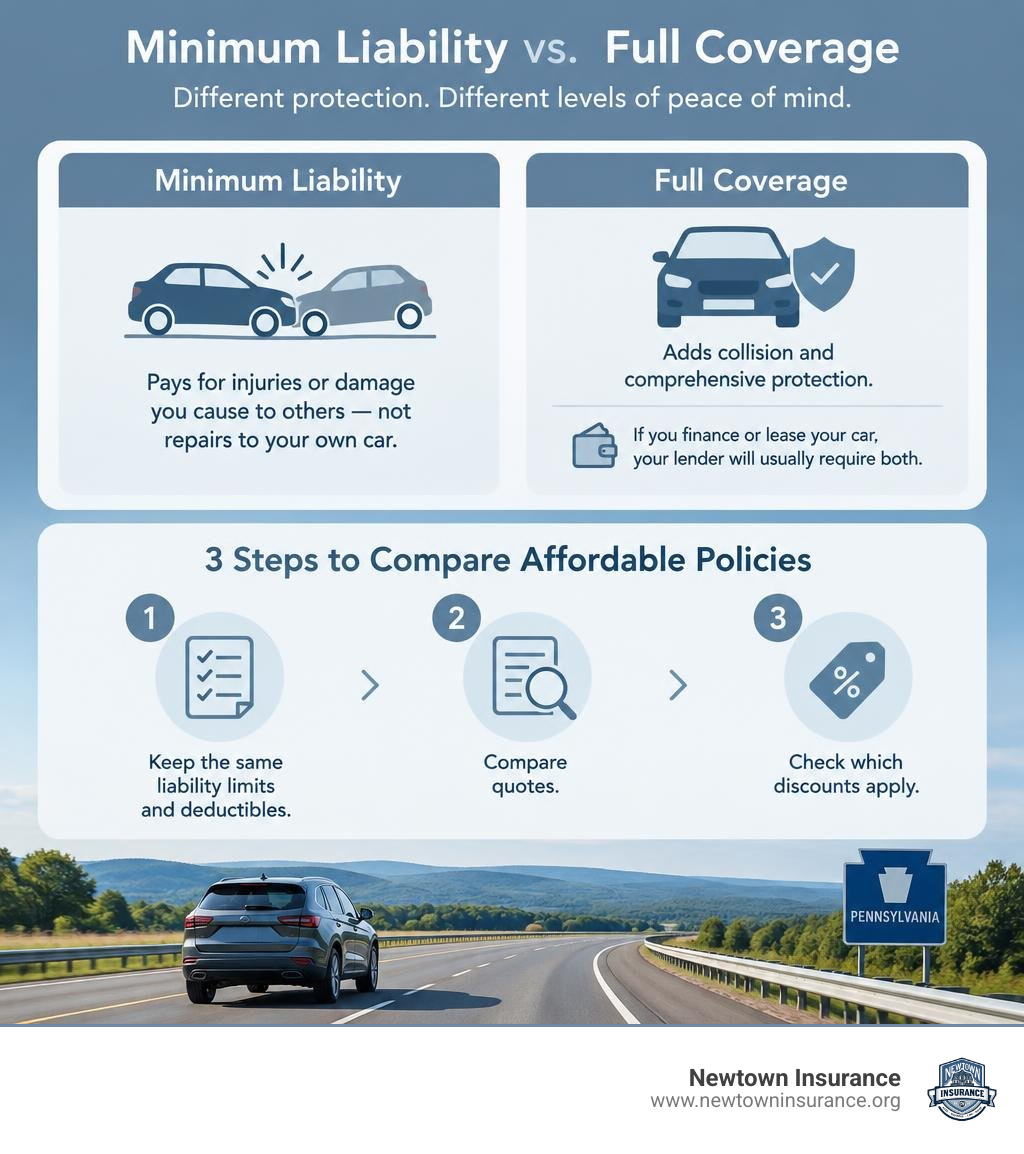
For Pennsylvania drivers, the best cheap full coverage car insurance is a policy that protects your car at a price you can manage. Compare quotes with the same liability limits and deductibles, then check which discounts apply. The lowest quote is only a good deal if the coverage meets your needs.
Minimum liability coverage pays for injuries or damage you cause to others, not repairs to your own car. Full coverage typically adds collision and comprehensive protection. If you finance or lease your car, your lender will usually require both.
I’m Shawn Beihl of Newtown Insurance. I bring more than 15 years of specialty insurance and risk-advising experience to helping people find the best cheap full coverage car insurance without overlooking the protection they need.
Know your best cheap full coverage car insurance terms:
- auto insurance cheapest full coverage
- auto insurance glass coverage
- average cost of commercial vehicle insurance
Understanding Full Coverage vs. Minimum Liability Protection
When you shop for car insurance, the gap between what is legally required and what genuinely protects your wallet can be eye-opening. Every state sets basic legal baselines for drivers. However, standard state-minimum policies are built primarily to cover third-party losses—meaning they pay for the bodily injury and property damage you cause to other people in an accident. They offer zero financial protection for repairs or replacement of your own vehicle.
Relying solely on minimum liability means that if you hit a guardrail on an icy winter morning or a deer darts in front of your sedan, you are entirely on the hook for the repair bills. Opting for affordable auto insurance full coverage bridges this financial exposure by adding physical damage safeguards directly to your policy package. The Pennsylvania Insurance Department auto insurance guide emphasizes how crucial it is to evaluate policy limits carefully rather than simply settling for the bare legal minimums.
What Full Coverage Policy Packages Include
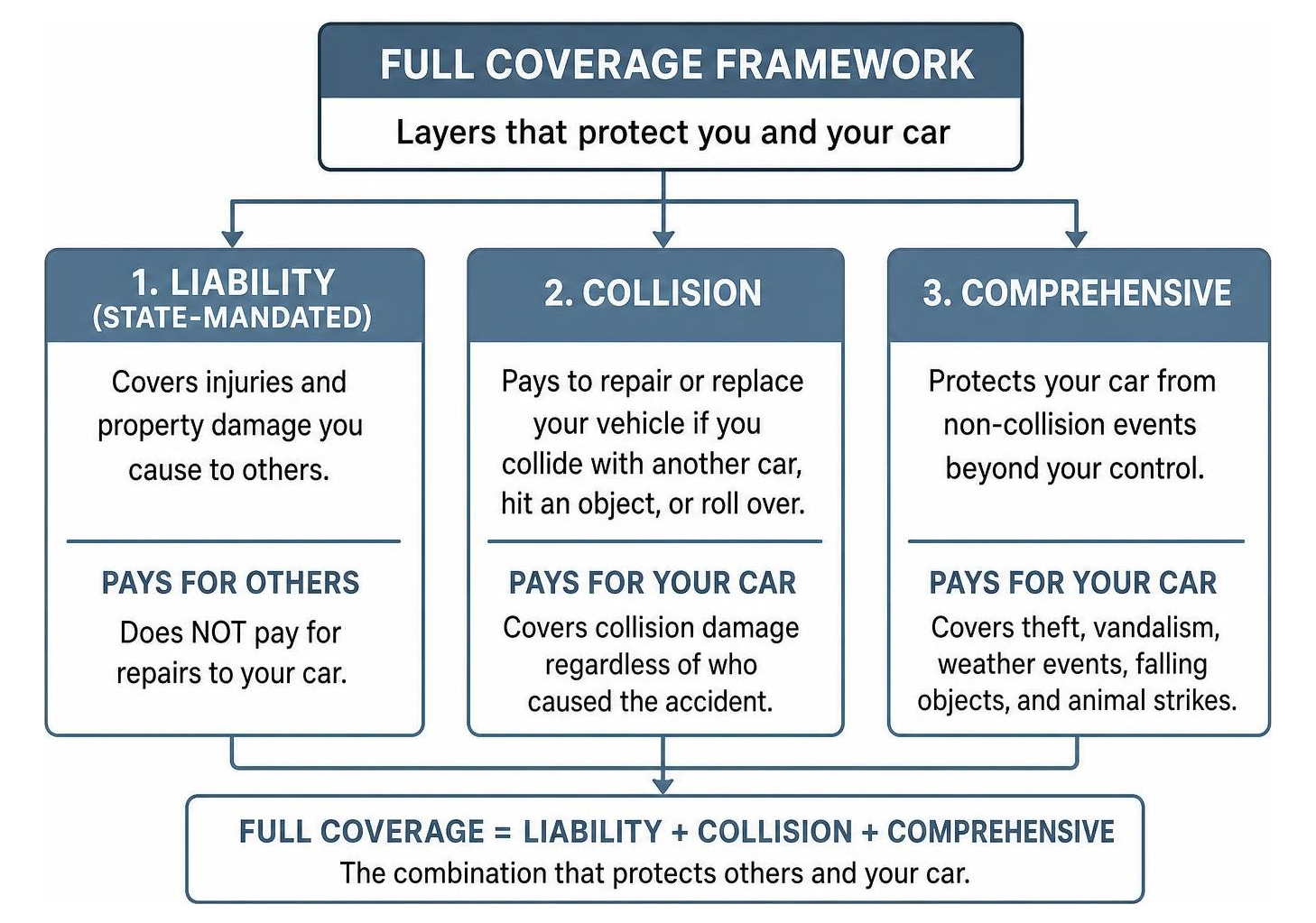
There is technically no single state-mandated legal definition for “full coverage.” Instead, the insurance industry uses this term to describe a well-rounded policy package combining several core protection types:
- State-Mandated Liability Insurance: Covers bodily injuries, medical expenses, and property damage sustained by other drivers, passengers, or pedestrians when you are at fault in a collision.
- Collision Protection: Pays to repair or replace your vehicle if you collide with another car, hit a stationary object like a fence or utility pole, or experience a rollover accident, regardless of who caused the crash.
- Comprehensive Insurance: Shields your car from non-collision perils beyond your immediate control. This covers vehicle theft, vandalism, windshield cracks, fallen tree limbs, hail storms, flood damage, and animal strikes.
- First-Party Benefits & Medical Protection: Pays for immediate medical expenses for you and your passengers following a crash.
- Uninsured and Underinsured Motorist Coverage: Steps in if you are hit by a driver who carries no insurance or whose liability limits cannot cover your total medical or repair expenses.
- Optional Policy Endorsements: Add-ons such as roadside assistance, towing reimbursement, and rental car coverage during extensive repairs.
When Is Full Coverage Worth the Investment?
State-minimum liability costs an average of $716 per year (about $56 per month), while full coverage averages $1,997 annually (around $166 per month). In some higher-density areas, rates can climb significantly higher. So when does paying the difference make sense?
First, if you finance or lease your vehicle, full coverage is not optional—your lienholder or leasing company will require active comprehensive and collision coverages until the balance is completely paid off. Second, if your car holds substantial market equity, a single severe incident without physical damage coverage could wipe out thousands of dollars in personal savings.
A reliable guideline is the “10% rule.” If the combined annual cost of your comprehensive and collision coverages plus your deductible exceeds the total actual cash value (ACV) of your vehicle, dropping full coverage in favor of liability-only protection may be financially sensible.
| Coverage Type | What It Covers | Who Is Protected | Required by Law? | Average Annual Cost Benchmark |
|---|---|---|---|---|
| State Minimum Liability | Third-party bodily injury & property damage you cause | Other drivers, pedestrians, property owners | Yes (Mandatory in PA) | ~$716 / year (~$56 / month) |
| Full Coverage (Liability + Comp + Collision) | Third-party damages PLUS repairs/replacement for your vehicle | You, your passengers, and third parties | Contractual (if financed/leased) | ~$1,997 / year (~$166 / month) |
How to Find the Best Cheap Full Coverage Car Insurance
Finding affordable full coverage does not require stripping away essential protections. Instead, it comes down to comparing personalized quotes from providers that calculate risk favorably for your unique driving profile.

Because insurers rely on proprietary algorithms that weigh driving history, vehicle make and model, territory data, and credit history differently, premiums can vary substantially between carriers for the exact same coverage limits.
Finding the Best Cheap Full Coverage Car Insurance by Driver Profile
Your age, driving record, and annual mileage heavily dictate your baseline rates. Young drivers, for instance, pay nearly three times more on average for full coverage than mature drivers due to statistical accident frequencies. Conversely, experienced motorists with clean records capture the most competitive baseline pricing available.
| Driver Risk Profile Category | Estimated Full Coverage Monthly Benchmark | Primary Pricing Factors | Top Cost Reduction Strategy |
|---|---|---|---|
| Good Drivers (Clean Record) | $130 – $165 / month | Multi-year clean record, good credit | Telematics safe-driver tracking apps |
| Young & Teen Motorists | $250 – $380 / month | Limited driving experience, elevated risk pools | Good student discounts, remaining on parent policy |
| Senior Motorists (Ages 60–75) | $135 – $170 / month | Mature driving experience, lower commuter miles | Approved mature driver defensive courses |
| Daily Long-Distance Commuters | $175 – $210 / month | High annual road exposure, urban route congestion | Pay-per-mile or low-mileage verification |
The Best Cheap Full Coverage Car Insurance Options After Violations or Credit Issues
Driving infractions or a lower credit profile can lead to rate surcharges, but you still have viable paths to keep full coverage affordable. On average, receiving a single speeding ticket causes insurers to raise auto rates by roughly 22%. An at-fault accident triggers an even steeper jump, driving premiums up by approximately 49% nationwide for three to five consecutive years.
In states where credit-based insurance scoring is permitted, drivers with poor credit scores pay nearly twice as much for auto coverage compared to motorists with excellent credit ratings. Insurers utilize these actuarial metrics to project overall claim frequencies.
If you have experienced a recent rate hike due to a moving violation or a credit dip, exploring our auto insurance savings complete guide can help you identify policy adjustments to offset these temporary surcharges until your record clears.
Comparing Average Full Coverage Costs Across States
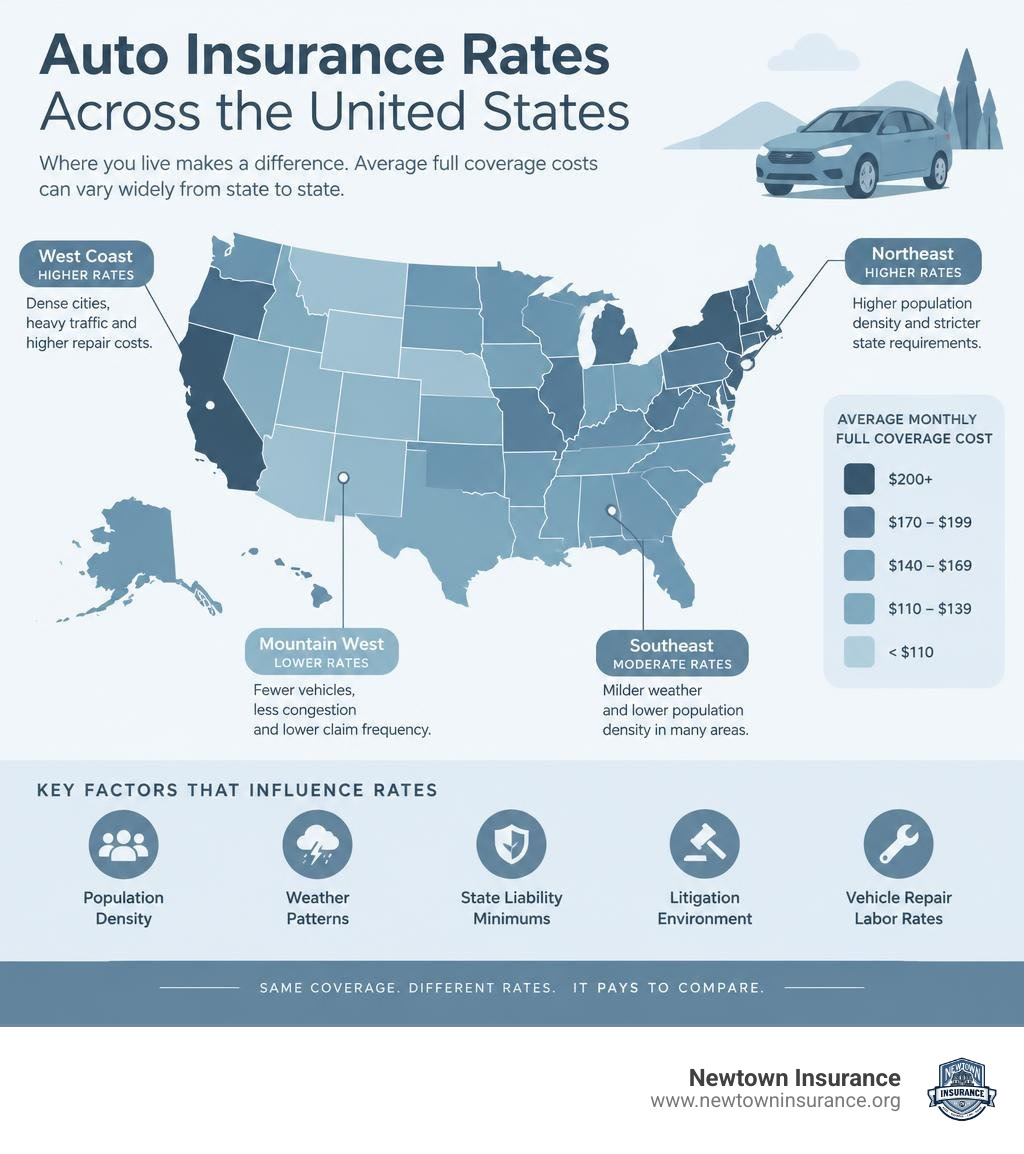
Auto insurance costs fluctuate across the country based on local population density, severe weather patterns, state liability minimums, litigation environments, and local vehicle repair labor rates.
Geographic Rate Factors and Regional Variations
Where you park your vehicle at night directly impacts your monthly bill. Densely populated metropolitan areas with heavy traffic and higher rates of vandalism naturally see elevated claim frequencies compared to quieter rural communities. Furthermore, states with higher statutory minimums or no-fault medical requirements often have higher base premiums. For example, nearby regions feature distinct pricing environments, such as those detailed in the NerdWallet New York insurance overview and The Zebra New York auto rates analysis.
State-Specific Rates and Coverage Benchmarks
For motorists in Pennsylvania, understanding local insurance structures is vital to managing premiums. Pennsylvania operates as a choice no-fault state, requiring drivers to carry Medical Payments or First Party Benefits while choosing between “Full Tort” and “Limited Tort” coverage. Selecting Limited Tort restricts your right to sue for non-economic damages (pain and suffering) after an accident in exchange for an immediate 15% to 20% discount on your premium.
To explore local pricing benchmarks and carrier options in detail, consult our cheap auto insurance Pennsylvania guide 2026 and our accompanying PA rates and best providers breakdown. You can also cross-reference broader regional insights through LendingTree’s cheap full coverage car insurance study.
| Geographic Territory / Region Type | Average Monthly Full Coverage Rate | Key Regional Influence Factors |
|---|---|---|
| Pennsylvania Statewide Average | ~$175 – $240 / month | Choice no-fault medical mandates, winter weather conditions |
| Low-Cost Rural States (e.g., ID, ME, VT) | ~$65 – $95 / month | Sparse traffic density, low litigation and theft rates |
| Dense Mid-Atlantic Metros | ~$210 – $320 / month | Elevated congestion, higher labor and medical care costs |
| National Blended Average | ~$166 / month ($1,997/year) | Baseline composite of urban, suburban, and rural drivers |
Proven Strategies to Lower Your Monthly Auto Premiums
Lowering your full coverage premium does not mean you have to settle for subpar protection. Strategic policy adjustments can generate substantial ongoing savings without exposing your assets to undue risk.
Optimizing Deductibles and Policy Limits
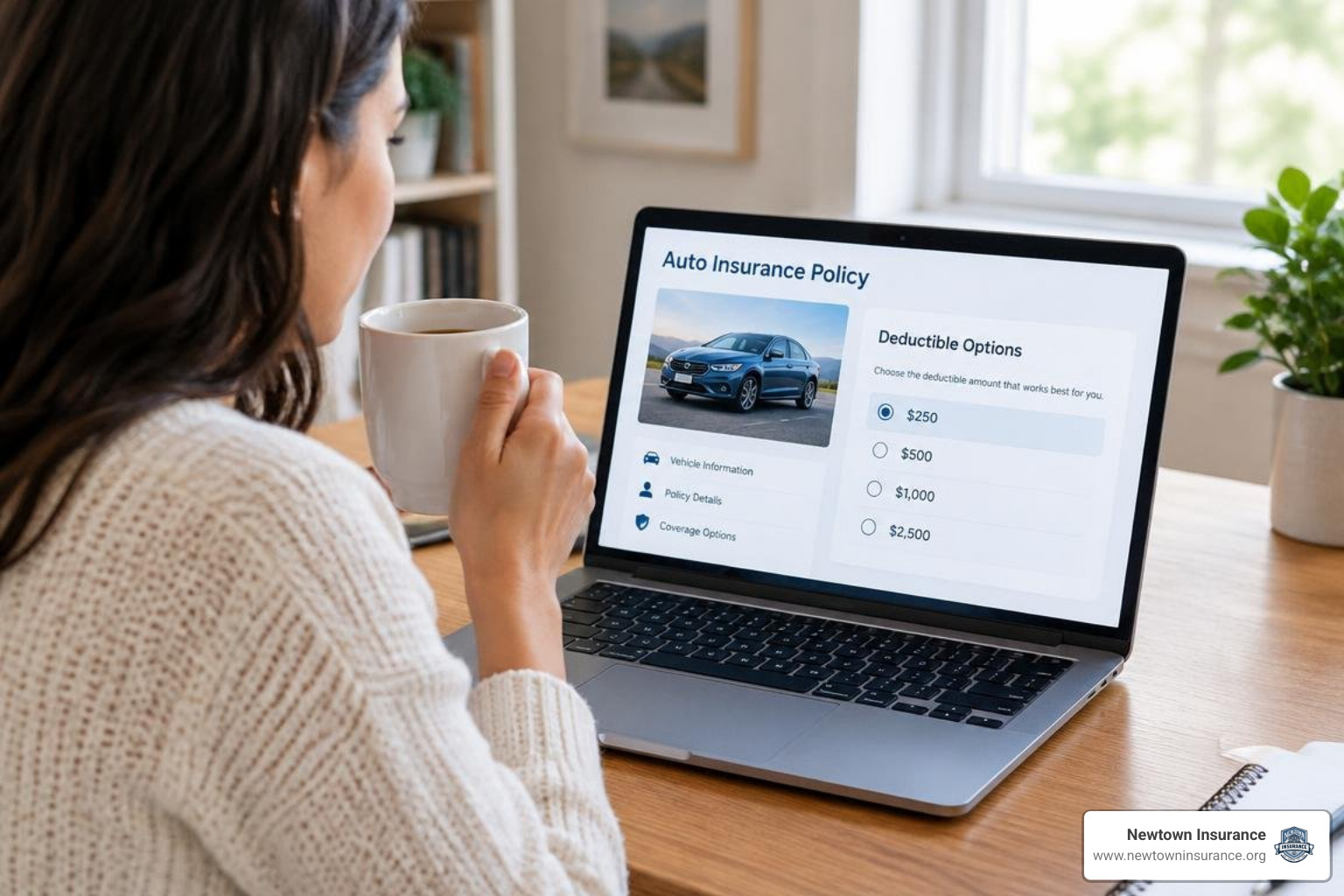
Your deductible is the out-of-pocket amount you agree to pay toward vehicle repairs before your collision or comprehensive coverage begins paying. Increasing your collision and comprehensive deductibles from $250 or $500 up to $1,000 is one of the fastest ways to lower your monthly premium, often reducing the physical damage portion of your bill by 15% to 30%.
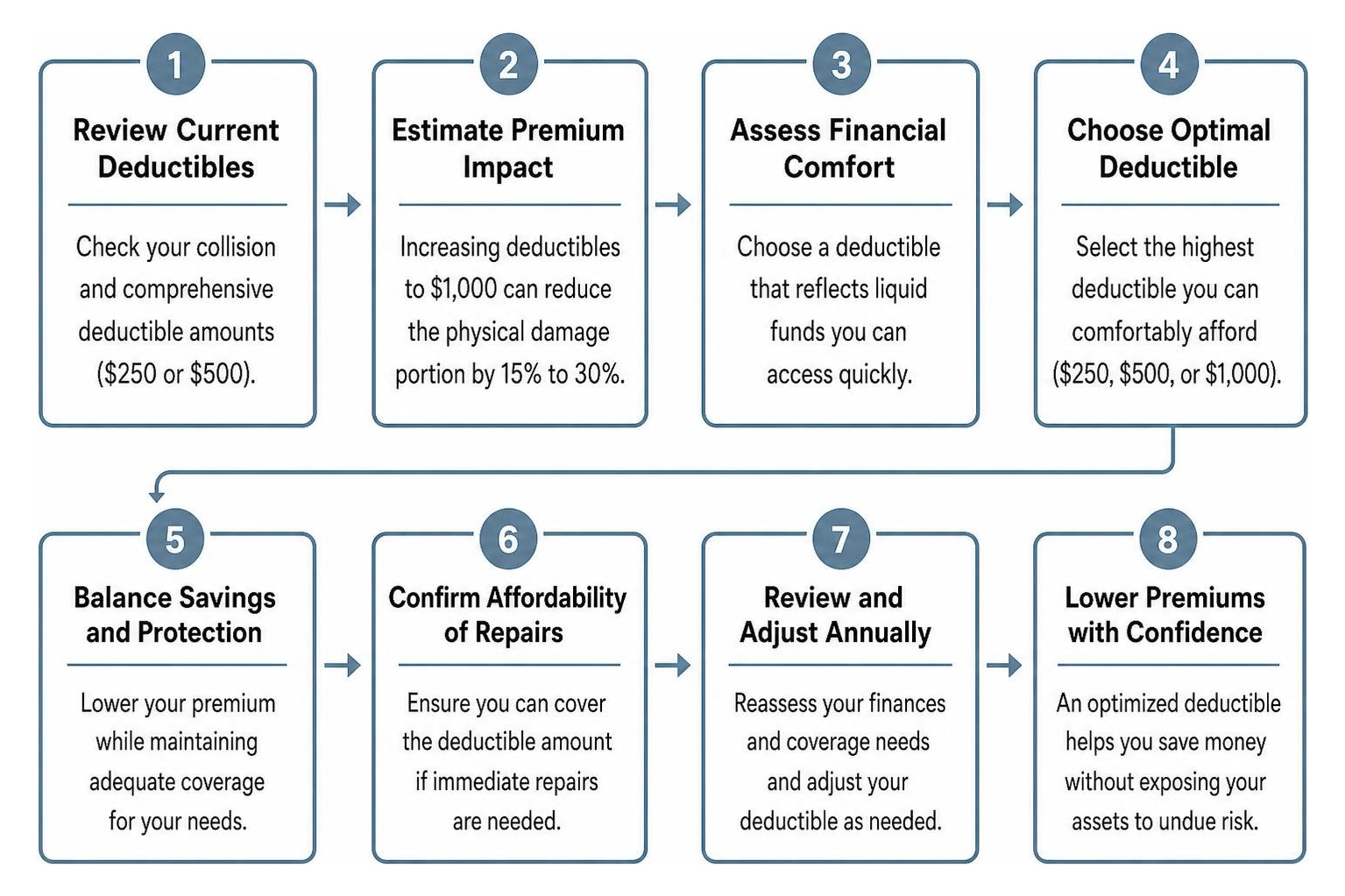
However, make sure that whatever deductible level you choose reflects liquid funds you can comfortably access on short notice. Never raise your deductible higher than what you can realistically afford if you need immediate repairs.
Unlocking High-Value Policy Discounts
Insurance providers offer a wide range of policy discounts that stack together to produce meaningful savings. Review our auto insurance discounts guide 2026 to ensure you are capturing every credit you qualify for, including:
- Multi-Policy Bundling: Combining your personal auto insurance with your homeowners, renters, or umbrella policy under the same carrier for savings up to 25%.
- Telematics and Usage-Based Programs: Installing a mobile app or plug-in device that monitors your safe driving habits (braking, speed, and driving time) to unlock rate reductions of 10% to 30%.
- Multi-Vehicle Discounts: Insuring more than one household vehicle on a single policy.
- Good Student Credits: Maintaining a “B” average (3.0 GPA) or higher for young drivers enrolled in high school or college.
- Defensive Driving Courses: Completing an approved state driver improvement or mature driver safety course.
- Paperless and Automatic Payments: Opting for electronic document delivery and automatic monthly bank transfers.
Frequently Asked Questions About Full Coverage Auto Insurance
Is $200 a month expensive for full coverage car insurance?
Paying $200 per month ($2,400 per year) is slightly above the national baseline average of $166 per month, but whether it is “expensive” depends on your driving profile and location. If you are a 35-year-old with a clean driving record operating a standard sedan in a suburban area, $200 per month is on the higher side. However, if you are under age 25, finance a high-value vehicle, live in an urban center, or have a recent ticket on your record, $200 per month represents a competitive rate for full coverage.
Do I need full coverage on a financed or leased vehicle?
Yes. While state law only mandates liability coverage, vehicle lenders and leasing companies legally require active comprehensive and collision protection as a binding condition of your loan agreement. This ensures that the financial institution’s asset is protected if the car is totaled or damaged before you pay off the balance. If you finance a brand-new vehicle, we also recommend pairing full coverage with gap insurance to protect against immediate vehicle depreciation.
How much does full coverage car insurance cost per month on average?
Nationwide, full coverage car insurance costs an average of $166 per month (equating to $1,997 per year) for a standard driver with a clean record and moderate coverage limits. Depending on your state, deductible choices, and risk profile, average rates typically range between $135 and $240 per month across major carrier benchmarks.
Conclusion
Securing dependable, high-quality auto coverage should never come at the expense of your family’s budget. By setting your liability limits responsibly, choosing manageable deductibles, and taking advantage of multi-policy discounts, you can protect your vehicle against unexpected accidents, weather events, and vandalism while keeping your monthly costs low.
At Newtown Insurance, we are committed to helping Pennsylvania drivers find customized, transparent policies built around their exact needs. To review your current coverage and explore personalized quotes, connect with us through our Newtown Insurance services page today.