Lancaster Auto Insurance: Costs, Coverage, and Local Risks
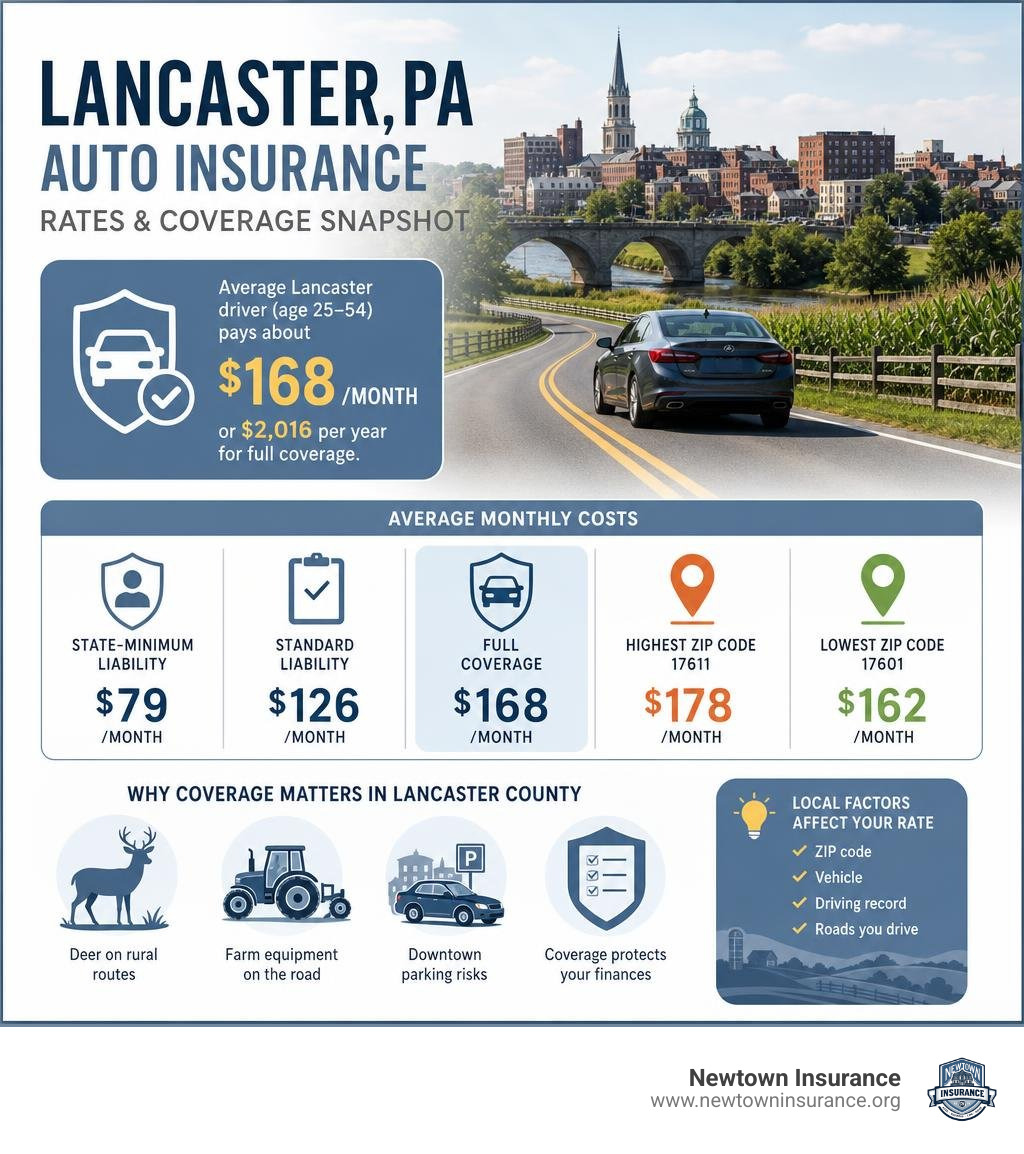
Auto insurance Lancaster PA drivers buy should fit both their budget and the roads they use. A typical Lancaster driver age 25 to 54 pays about $168 per month, or $2,016 per year, for full coverage. That is far below Philadelphia’s average of $389 per month, but local factors still matter: deer on rural routes, farm equipment, downtown parking damage, your ZIP code, vehicle, and driving record can all affect the price.
| Quick Lancaster insurance snapshot | Average cost |
|---|---|
| State-minimum liability | $79/month |
| Standard liability | $126/month |
| Full coverage | $168/month |
| Highest-priced local ZIP code: 17611 | $178/month |
| Lowest-priced local ZIP code: 17601 | $162/month |
The right policy is not always the cheapest quote. Lancaster County drivers often need to weigh Pennsylvania’s tort options, liability limits, collision coverage, and comprehensive coverage for deer strikes – especially when commuting on Route 30 or rural county roads.
I am Shawn Beihl of Newtown Insurance. With more than 15 years of experience in specialty insurance and risk management, I help Pennsylvania drivers make clearer decisions about auto insurance Lancaster PA coverage and long-term costs.
Auto insurance lancaster pa terms you need:
Costs and Rates for Auto Insurance Lancaster PA
When evaluating auto insurance Lancaster PA rates, understanding the broader pricing environment helps you know if you are getting a fair rate. On average, drivers across Lancaster pay $168 per month ($2,016 annually) for a full coverage policy. If you choose a standard liability policy, your rate drops to roughly $126 per month, while state-minimum liability averages about $79 per month. Premium protection plans with lower deductibles and additional policy endorsements average $228 monthly.
Location plays a noticeable role in your overall premium, even within Lancaster County. Differences in population density, localized traffic flow, and parking conditions create price variations across ZIP codes:
- 17611: $178 per month (highest local average)
- 17603: $176 per month
- 17602: $165 per month
- 17601: $162 per month (lowest local average)
Your vehicle make and model also heavily influence pricing. For example, insuring a performance vehicle like a Chevrolet Camaro in Lancaster averages $255 per month, whereas a practical compact car like a Honda Fit averages just $146 per month.
To explore state-level pricing trends and compare regional baseline metrics, check out our guide on the Average Cost of Car Insurance in PA. To run custom estimates based on your age, ZIP code, and driving record, check out the interactive 2026 Lancaster Car Insurance Calculator.
Key Drivers of Auto Insurance Lancaster PA Premiums
Insurance carriers calculate premiums by assessing risk profiles across several key demographic and behavioral variables. In Lancaster, driver age and driving history are among the most significant determinants of monthly rates:
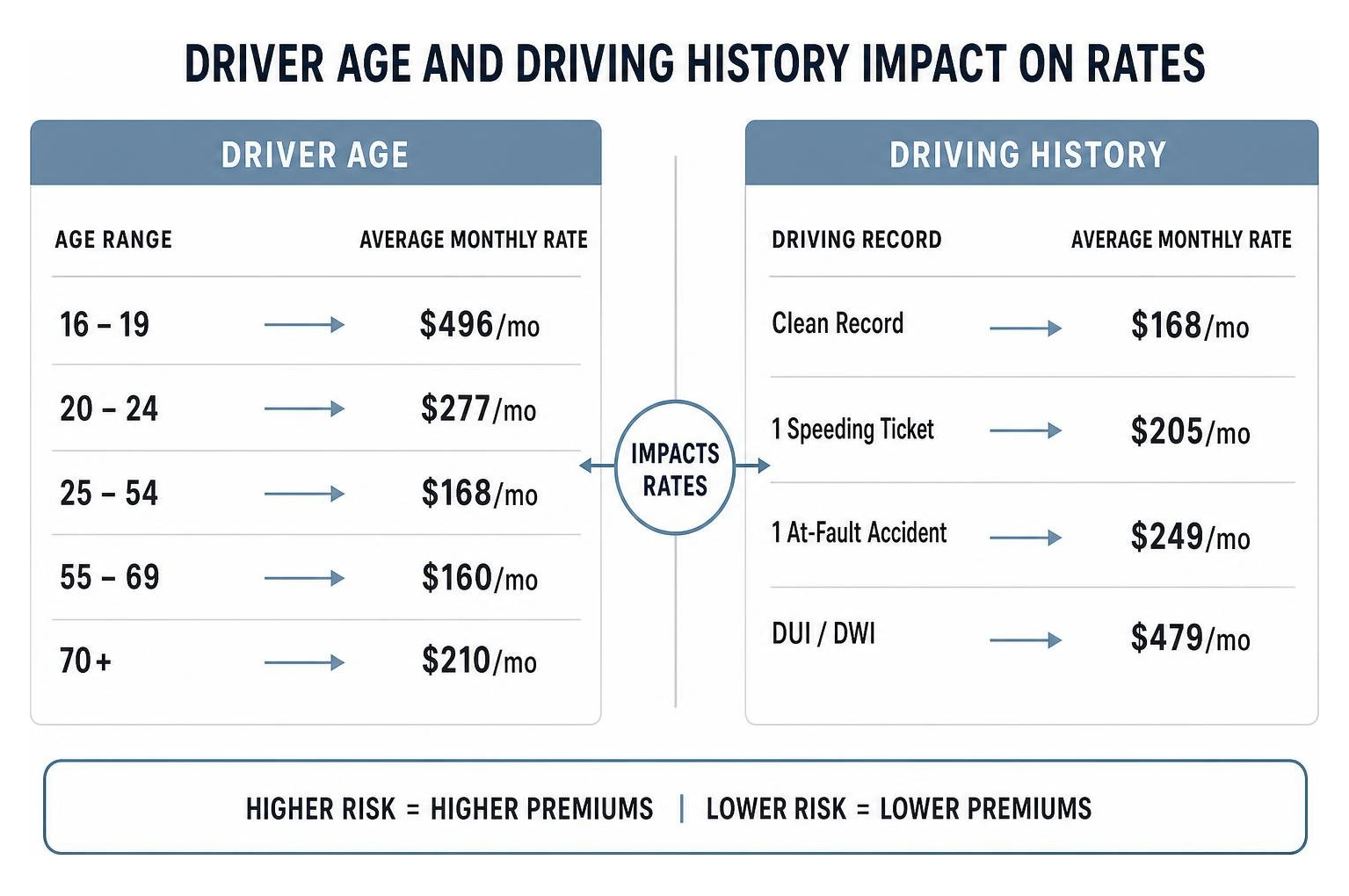
- Driver Age: Teenagers aged 16 to 19 face the highest premiums, averaging $496 per month due to their relative lack of experience on the road. Rates drop significantly as drivers gain experience: young adults aged 20 to 24 average $277 per month, mature drivers aged 25 to 54 average $168 per month, and drivers aged 55 to 69 enjoy the lowest rates at $160 per month. Drivers aged 70 and older see a modest increase to an average of $210 per month.
- Driving History: Maintaining a clean driving record keeps your rates at the local baseline of $168 per month. However, a single speeding ticket raises the average monthly cost to $205, while an at-fault accident increases it to $249 per month.
- Major Violations: A serious violation like a DUI or DWI has the most dramatic impact, spiking Lancaster’s average monthly rate to $479 per month—nearly triple the baseline for a clean record.
Regional Price Comparison: Lancaster vs. Neighboring Cities
Across Pennsylvania, Lancaster ranks as the #82 most expensive city for auto insurance. This middle-of-the-pack standing reflects a balanced risk environment—it avoids the severe congestion and high litigation rates of major metropolitan centers while maintaining slightly higher rates than lower-density rural boroughs.
Comparing Lancaster to nearby regional cities highlights these differences clearly:
| City | Average Monthly Rate | Regional Context |
|---|---|---|
| Philadelphia, PA | $389 | High traffic density and higher litigation frequency |
| Baltimore, MD | $413 | Out-of-state metro area with high claim rates |
| Lancaster, PA | $168 | Moderate urban core surrounded by agricultural roads |
| Elizabethtown, PA | $154 | Lower density suburban/rural borough in Lancaster County |
Lancaster drivers pay substantially less than commuters in Philadelphia or Baltimore, but slightly more than those living in smaller surrounding communities like Elizabethtown.
Understanding Pennsylvania Legal Requirements and Tort Options
Every driver operating a vehicle in Lancaster must carry at least the minimum mandatory legal auto insurance coverage established by state law. Pennsylvania requires all motor vehicle owners to maintain minimum liability insurance protection to cover harm caused to other people or property:
- $15,000 for bodily injury or death of one person in an accident
- $30,000 total for bodily injury or death of two or more people in an accident
- $5,000 for property damage per accident
- $5,000 in First Party Benefits (Medical Payments coverage for yourself and your passengers regardless of fault)
While meeting these 15/30/5 limits fulfills basic legal mandates, state-minimum coverage leaves drivers severely exposed financially after a serious crash. Modern vehicle repair costs and medical expenses easily exceed these threshold amounts.
To learn more about baseline legal standards across the state, review our detailed guide on Auto Insurance Requirements in Pennsylvania as well as the complete Pennsylvania Auto Insurance Guide 2026.
Full Tort vs. Limited Tort in Lancaster County
When selecting auto insurance Lancaster PA policies, one of the most critical decisions you must make is choosing between Full Tort and Limited Tort coverage options.

- Limited Tort: Choosing Limited Tort reduces your monthly policy premium. Under this option, you retain the right to recover out-of-pocket medical bills and financial losses resulting from an accident caused by another driver. However, you forfeit the legal right to sue the at-fault party for non-monetary, non-economic damages (such as “pain and suffering”), unless your injuries meet the state’s legal threshold of a “serious injury.”
- Full Tort: Opting for Full Tort costs more in monthly premiums, but it fully preserves your unrestricted right to seek legal compensation for pain, suffering, and non-economic damages after an accident, regardless of how severe your injuries are.
Because Lancaster County features a lower-litigation legal environment compared to heavily populated urban areas like Philadelphia, many local drivers find Limited Tort to be a sensible, budget-friendly choice that delivers solid savings without presenting excessive everyday legal risk.
Essential Coverage Options for Local Driving Hazards
Driving in Lancaster County presents a unique combination of roadway hazards. Commuters navigating busy arteries like Route 30 face heavy commuter traffic, while drivers venturing near historic Penn Square and downtown Lancaster must handle tight parallel parking spots and narrow historic streets where low-speed fender benders are common.
Meanwhile, venturing into the outer county roads introduces risks related to slow-moving agricultural machinery, horse-drawn buggies, and unlit rural stretches. Customizing your policy endorsements according to these localized hazards is critical to staying protected.
Managing Deer Collisions with Comprehensive Coverage
One of the most widespread driving hazards across Lancaster County is wildlife encounters—specifically white-tailed deer. Because Lancaster’s urban and suburban neighborhood boundaries connect directly into expansive active farmlands and woodland corridors, commuter highways like Route 30 and Route 340 frequently intersect major deer travel paths.

During autumn harvest and mating season—especially during peak dawn and dusk hours—deer strikes skyrocket.
It is vital to understand that hitting a deer is classified as an animal strike, which falls under Comprehensive Coverage, not Collision coverage. If you only carry basic liability or collision protection, your insurance company will not pay for damages caused by a deer strike. Carrying comprehensive coverage with a reasonable deductible ensures your vehicle repairs are fully covered if a deer darts onto Route 340 or a rural county road.
Collision and Roadside Protection on Rural Roads
Beyond wildlife encounters, Lancaster’s rural road network carries specific structural risks that make supplementary coverages essential:
- Collision Coverage: Protects your vehicle if you collide with stationary objects like stone farm walls, mailboxes, or utility poles along narrow back roads, or if you collide with another vehicle or farm implement.
- Roadside Assistance and Towing: Rural back roads outside municipal centers often fall outside standard quick-response towing zones. Having dedicated roadside protection ensures towing, fuel delivery, and tire change services are available when you are stuck on a secluded country route.
- Uninsured/Underinsured Motorist Coverage: Protects you and your passengers if you are struck by a driver who carries no insurance or carries insufficient liability limits to pay for your injuries and car repairs.
We generally recommend reviewing these policy endorsements to build a balanced, protective umbrella for county driving:
- Comprehensive coverage with a manageable $250 or $500 deductible
- Collision coverage for physical damage protection
- Uninsured/Underinsured Motorist limits matching your personal liability limits
- Roadside Assistance endorsement for emergency backroad towing
- Rental Reimbursement coverage while your vehicle undergoes repairs
Auto Salvage, Junkyards, and Total Loss Claims
When a vehicle suffers major damage from a severe collision or deer strike in Lancaster County, the costs to repair it can sometimes exceed the vehicle’s actual cash value (ACV). When this happens, insurance companies declare the car a total loss.
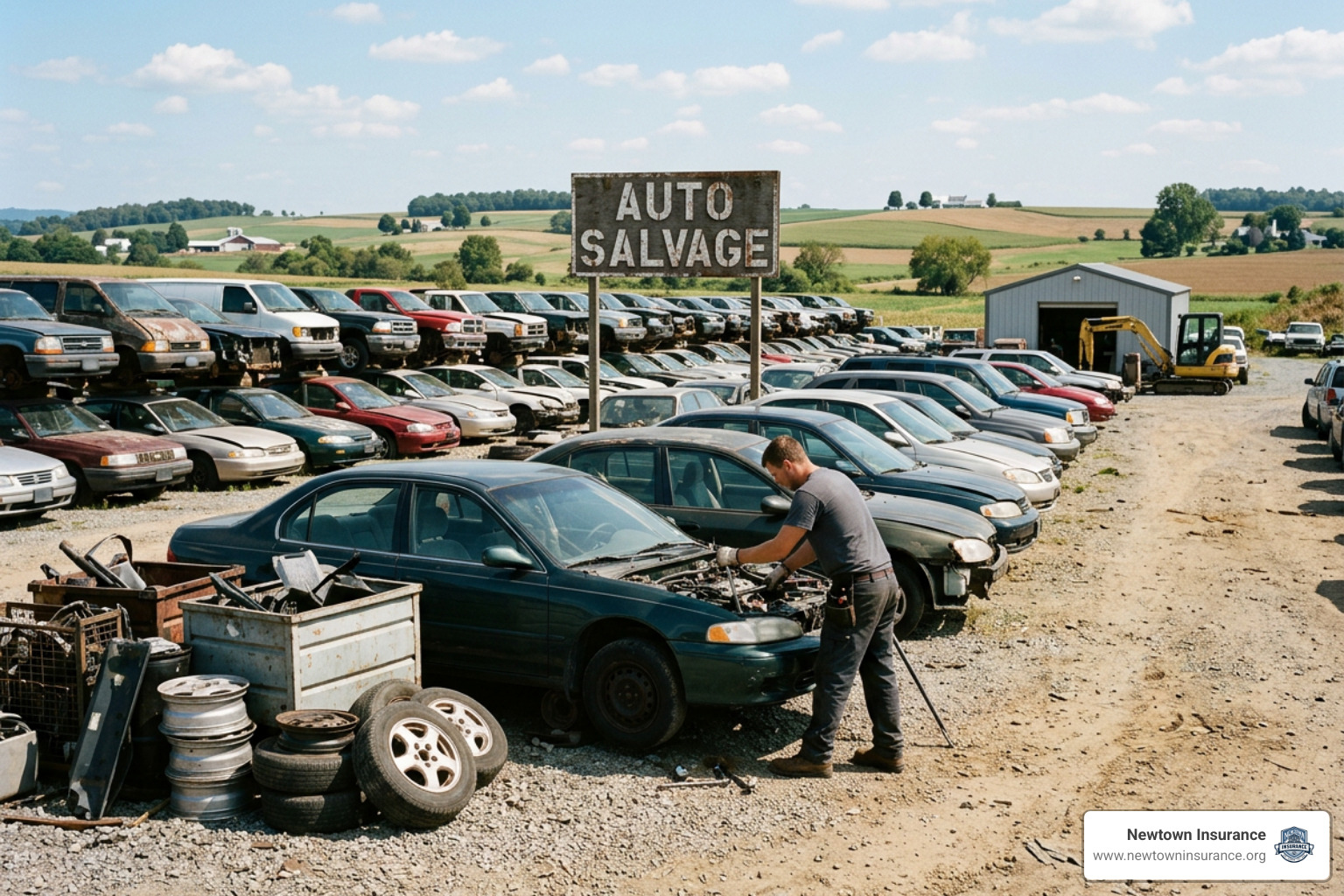
Lancaster features a robust local automotive recycling ecosystem. Local salvage facilities and scrap processors play an important role in the overall automotive ecosystem by accepting written-off vehicles, recycling scrap metal, and supplying quality used original equipment manufacturer (OEM) auto parts to local repair shops. This helps keep repair costs down for everyone in the area.
Navigating Total Loss Claims with Auto Insurance Lancaster PA
If your vehicle is declared a total loss following an accident in Lancaster, understanding the insurance settlement process will help you secure a fair payout:
- Actual Cash Value (ACV) Assessment: Your insurance adjuster calculates your vehicle’s fair market value right before the crash, taking into account its age, mileage, trim level, and local market conditions across Lancaster County.
- Settlement Offer: The insurer offers a total loss payout based on the ACV minus your applicable policy deductible.
- Salvage Retention Option: If you prefer to keep your damaged car, you can elect to “buy back” the vehicle from the insurance carrier. The insurer will deduct the estimated scrap or salvage value from your total settlement payout and issue you a payout for the difference.
- Titling and Rebuilding: In Pennsylvania, keeping a total loss vehicle requires converting its title to a Salvage Title. If you repair the vehicle to state safety standards, it must pass an enhanced safety inspection before receiving a Reconstructed Title so it can be legally driven on public roads again.
Smart Strategies to Lower Your Lancaster Insurance Rates
While maintaining quality protection is essential, you should never overpay for your auto policy. We recommend utilizing several proven, actionable strategies to reduce your monthly premiums in Lancaster County:
- Take Advantage of Discounts: Ask about multi-policy bundling discounts (combining your auto policy with home or renters insurance), safe driver discounts for maintaining a clean record, multi-vehicle discounts, and academic discounts for young drivers with good grades.
- Adjust Policy Deductibles: Raising your comprehensive and collision deductibles from $250 to $500 or $1,000 can significantly reduce your recurring monthly premiums. Just make sure you keep enough emergency savings on hand to cover the higher deductible if you need to file a claim.
- Select Cost-Effective Vehicles: Vehicles with high safety ratings, low theft rates, and reasonable repair costs (such as compact sedans or modest crossovers) cost far less to insure than sports cars or luxury SUVs.
- Reevaluate Your Tort Selection: If you drive primarily within low-litigation areas across Lancaster County, selecting Limited Tort can trim substantial percentage points off your annual rate.
For further insights on shopping for economical coverage options throughout the state, read our companion guides on the Cheap Auto Insurance Pennsylvania Guide 2026 and explore The 10 Best Car Insurance Pennsylvania Options Compared.
Frequently Asked Questions About Lancaster Auto Insurance
What is the average monthly cost of car insurance in Lancaster, PA?
The average cost of full coverage car insurance in Lancaster, PA is $168 per month (or $2,016 per year) for a standard driver aged 25 to 54. Drivers seeking standard liability pay around $126 per month, while state-minimum liability coverage averages $79 per month.
Why are comprehensive coverage claims so high in Lancaster County?
Comprehensive coverage claims in Lancaster County are heavily driven by the high rate of deer collisions. Because dense suburban developments directly border active farmland and woodland habitats, deer frequently cross major commuter corridors like Route 30 and Route 340 during dawn, dusk, and autumn harvest seasons.
Is Limited Tort a good choice for Lancaster drivers?
Yes, Limited Tort can be a smart choice for many Lancaster drivers. Because Lancaster County has a lower-litigation legal climate compared to major metropolitan hubs like Philadelphia, choosing Limited Tort allows drivers to lower their monthly premiums while maintaining solid financial protection for medical expenses and vehicle damage.
Conclusion
Finding the right auto insurance Lancaster PA coverage comes down to balancing your monthly budget with the unique hazards of driving in Lancaster County. From navigating tight parking spots in downtown Lancaster to driving alongside farm equipment and watching for deer on rural routes like Route 30 and Route 340, having tailored protection gives you complete peace of mind on every trip.
At Newtown Insurance, we are dedicated to providing clear pricing, customized coverage plans, and exceptional customer service to help Pennsylvania drivers protect what matters most without overpaying.
If you are ready to review your current policy, compare personalized quotes, or build an auto policy tailored specifically to your driving habits, explore our Newtown Insurance Services today!