Average Car Insurance in Philadelphia: What Drivers Pay
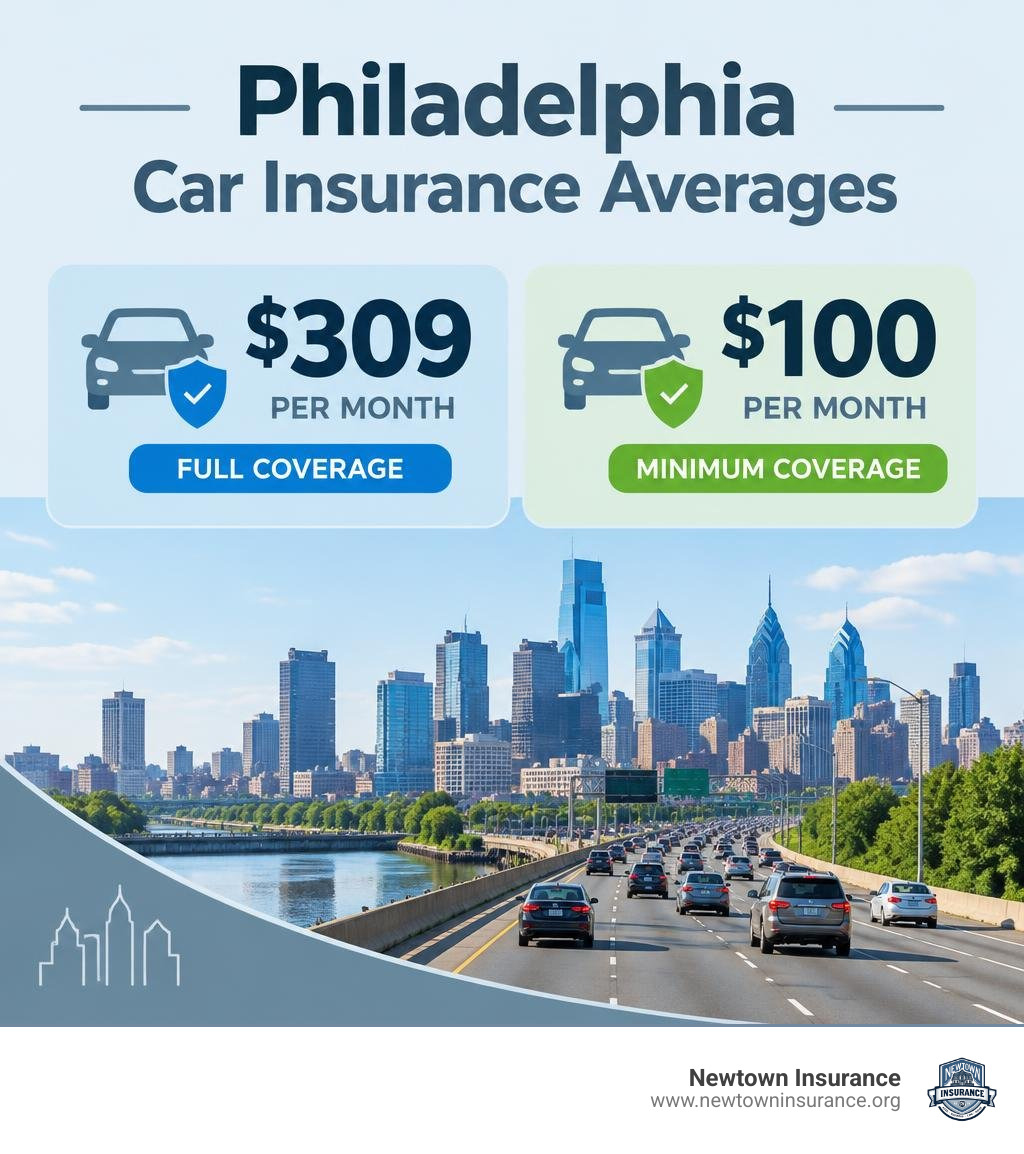
Average car insurance in Philadelphia costs about $309 a month for full coverage, or $100 a month for minimum coverage, based on published rate estimates. Full coverage costs about 78% more than the Pennsylvania average. Your price will depend on your ZIP code, driving record, vehicle, and coverage choices.
Heavy traffic, theft risk, and costly claims help explain the gap. This guide looks at what drives Philadelphia rates and how to compare coverage without paying for protection you do not need.
I’m Shawn Beihl. I’ve spent more than 15 years in specialty insurance, including property and casualty coverage, and I help Pennsylvanians searching for average car insurance philadelphia understand what those averages mean for their own budgets.
Easy average car insurance philadelphia glossary:
Understanding Average Car Insurance in Philadelphia: 2026 Benchmarks

Navigating auto insurance in Philadelphia often feels like an uphill battle. When you look closely at the average cost of car insurance in philadelphia, the baseline figures tell an eye-opening story. In recent years, Philadelphia drivers paid an average of $1,948 per year across all policy types combined just to keep their vehicles legally on the road. When focusing specifically on modern, comprehensive protection, the citywide full coverage average stands at roughly $309 per month ($3,708 annually).
State minimum liability coverage provides an alternative entry point at around $100 per month ($1,200 annually), though it carries significant financial risk in a dense urban environment. To understand where you fall within this pricing spectrum, you can estimate your monthly rate using an interactive 2026 Philadelphia Car Insurance Calculator.
Every driver’s profile shifts these numbers dramatically. Age, driving history, and credit standing heavily influence what you will pay:
| Driver Profile | Average Monthly Minimum Coverage | Average Monthly Full Coverage | Average Annual Full Coverage |
|---|---|---|---|
| Clean Record (Adult, Age 30–55) | $100 | $309 | $3,708 |
| Young Driver (Age 18–21) | $201 | $540 | $6,480 |
| One Speeding Ticket | $114 | $352 | $4,224 |
| One At-Fault Accident | $145 | $412 | $4,944 |
| Driver with DUI Conviction | $166 | $513 | $6,156 |
| Driver with Poor Credit | $185 | $580 | $6,960 |
Average Car Insurance in Philadelphia vs. Suburban PA Counties
The pricing gap between Philadelphia and surrounding regions is stark. Statewide, Pennsylvania drivers pay an average annual premium of $1,138. Philadelphia drivers pay roughly 71% above that figure. When assessing the wider average cost of car insurance in pa, urban density stands out as the primary cost multiplier.
Drivers living in the northern halves of neighboring Bucks County and Montgomery County enjoy some of the lowest premiums in Southeastern Pennsylvania. In fact, Philadelphia motorists pay approximately 62% more than drivers in northern Bucks and Montgomery counties. Looking further west, data from the Lancaster car insurance rate data shows an average monthly rate of just $168, highlighting that Philadelphia’s $309 to $389 overall cost range is more than double what rural and suburban drivers experience. For a deeper breakdown of statewide pricing dynamics, explore our car insurance rates pennsylvania guide 2026.
Average Car Insurance Philadelphia Rates by Neighborhood and ZIP Code
Auto insurance rates vary not just across county lines, but from block to block within the city limits. Insurers evaluate risk at the hyper-local ZIP code level, factoring in local traffic volume, garage availability, and claim frequency.
Roxborough (ZIP code 19128) offers some of the lowest average rates in the city at $239 per month for full coverage, thanks to lower density and more off-street parking. Conversely, areas like Nicetown-Tioga and Logan (ZIP codes 19140 and 19141) see average monthly full coverage rates reach $368, driven by higher congestion and claim exposure.
| Neighborhood | ZIP Code | Average Monthly Full Coverage | Relative Cost vs. City Average |
|---|---|---|---|
| Roxborough | 19128 | $239 | -23% (Cheapest) |
| Chestnut Hill | 19118 | $252 | -18% |
| Northeast Philadelphia / Bustleton | 19115 | $278 | -10% |
| South Philadelphia / Passyunk | 19148 | $312 | +1% |
| Center City | 19103 | $325 | +5% |
| West Philadelphia | 19139 | $355 | +15% |
| Kensington | 19134 | $362 | +17% |
| Nicetown-Tioga / Logan | 19140 / 19141 | $368 | +19% (Highest) |
Why Philadelphia Auto Insurance Costs Outpace the Rest of Pennsylvania

Why does crossing the county line into Philadelphia cause premiums to jump? The answer lies in a combination of traffic volume, legal exposure, property crime patterns, and structural differences in urban policyholding. Our pennsylvania auto insurance guide 2026 highlights how urban risk factors compound to push rates higher.
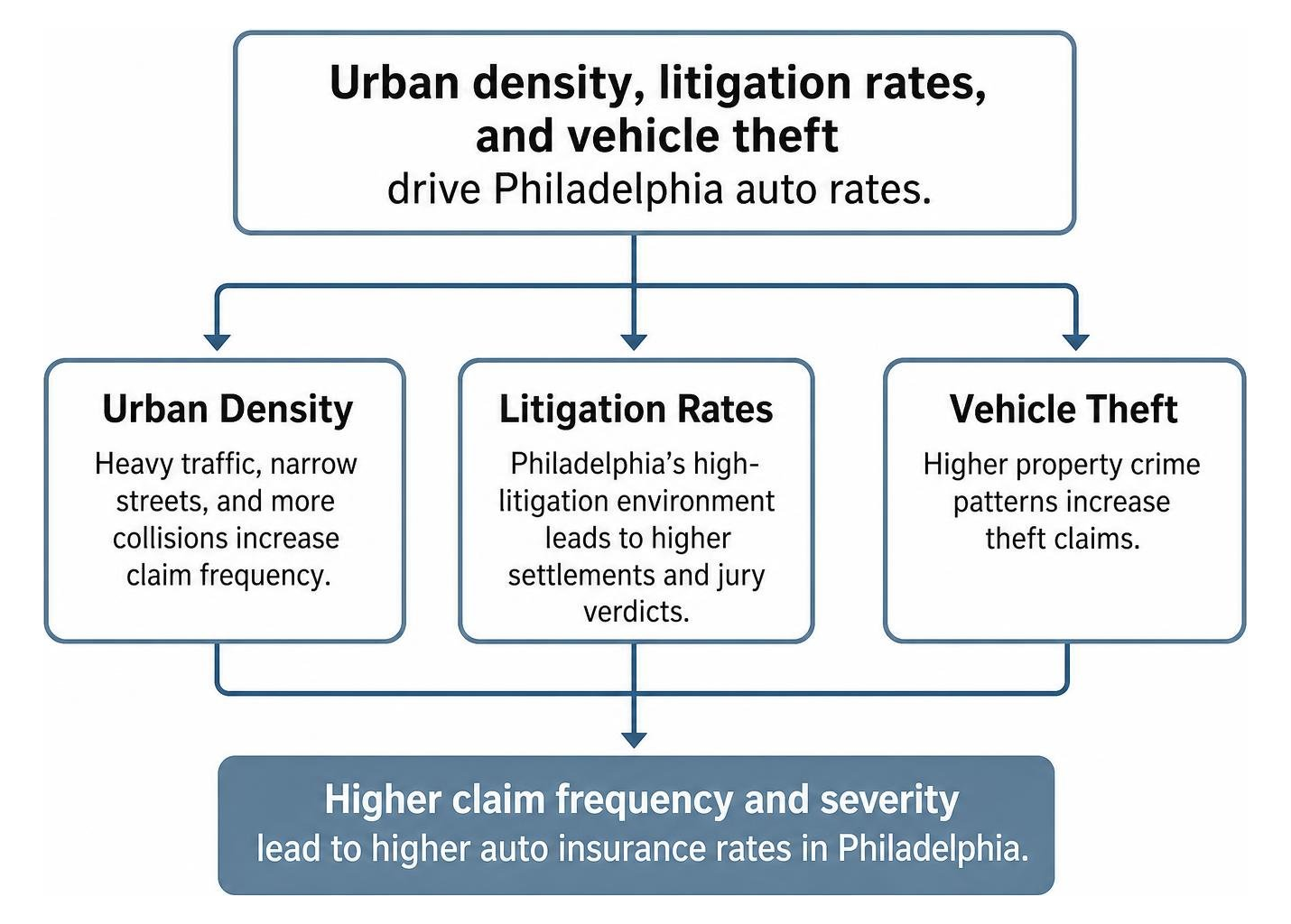
Dense highway corridors such as Interstate 76 (the Schuylkill Expressway) and Interstate 95 experience frequent stop-and-go collisions. Heavy pedestrian traffic, narrow rowhouse streets, and a higher proportion of uninsured motorists increase claim frequency and severity for insurers operating in the city.
High Litigation Exposure and Pennsylvania’s Tort Environment
Philadelphia operates under a unique legal environment. The city is widely recognized within the insurance industry as a high-litigation jurisdiction. Bodily injury claims stemming from accidents within Philadelphia often lead to lawsuits with significantly higher settlement and jury verdict values than identical claims filed in suburban counties.
Insurers must account for higher legal defense expenses and medical payouts, which directly elevates the liability portion of every policyholder’s bill across the city.
Auto Theft Trends, Rowhouse Street Parking, and Vandalism
Physical vehicle damage and theft represent major cost drivers in urban Pennsylvania. Auto thefts in Philadelphia surged between 2020 and 2023, peaking at approximately 23,000 stolen vehicles out of 34,000 statewide in 2023. Following coordinated enforcement and targeted auto theft arrests, Philadelphia thefts dropped under 16,000 in 2024.
Despite this improvement, comprehensive claim payouts remain elevated. Dense rowhouse street parking leaves vehicles vulnerable to side-mirror strikes, minor hit-and-runs, window break-ins, and catalytic converter theft. Parking in a secured private garage or driveway remains one of the most effective ways to lower the comprehensive portion of an auto premium.
Socioeconomic Factors and Multi-Policy Discount Access
Suburban homeowners frequently lower their auto rates by bundling auto insurance with a homeowners policy. In Philadelphia, a larger percentage of residents rent or live in multi-family housing, reducing the widespread use of multi-policy bundling discounts.
Additionally, credit-based insurance scoring and rising vehicle repair expenses (due to advanced sensors, cameras, and collision electronics) create higher baseline costs for city policyholders.
10-Year Trend: How Urban Rate Hikes Surpassed Inflation
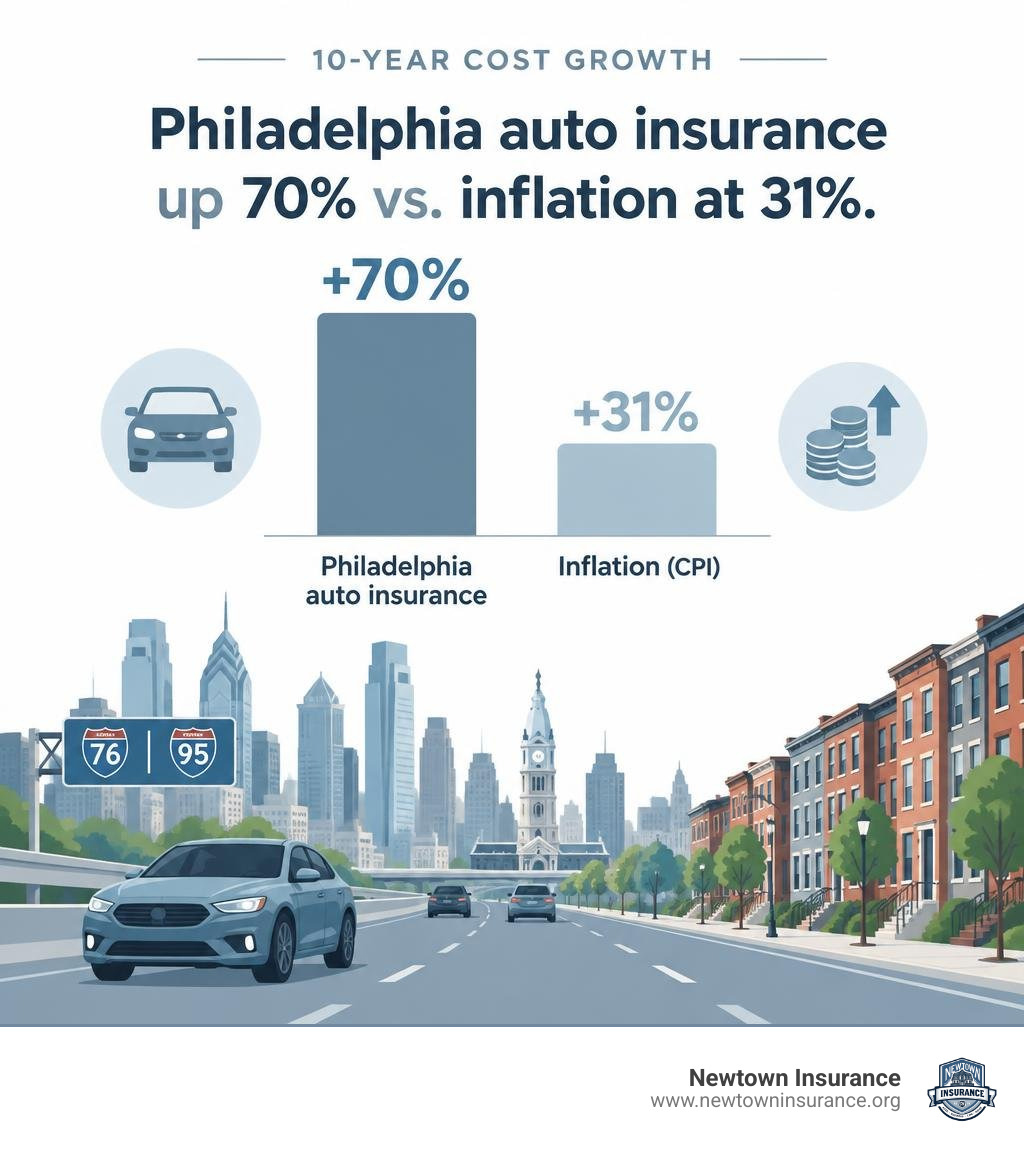
Over the past decade, Philadelphia car insurance rates have grown at an extraordinary pace. Between 2014 and 2023, the average auto insurance premium in Philadelphia surged by 70%, far outpacing the 31% rise in the Consumer Price Index (CPI) over the same timeframe.
As detailed in a 10-year Philadelphia auto insurance study, suburban premiums rose between 33% and 38% during that exact period—roughly half the rate of the city’s increase.
This divergence reflects substantial underwriting losses in dense metropolitan territories. Rising medical inflation, increased vehicle technology repair costs, and sustained litigation exposure forced major carriers to file recurring rate adjustments with the Pennsylvania Insurance Department.
Choosing the Right Coverage Level for Philadelphia Drivers
Selecting the right coverage involves balancing monthly affordability with meaningful asset protection. Reviewing the basic auto insurance requirements in pennsylvania is the first step toward building an effective policy. If you are searching for affordable car insurance philadelphia, understanding your coverage choices will keep you from overpaying or leaving yourself unprotected.
Full Tort vs. Limited Tort: Protecting Your Legal Rights
Pennsylvania law allows drivers to choose between Full Tort and Limited Tort coverage:
- Limited Tort: Offers an immediate premium discount (typically 15% to 20% off the liability premium). In exchange, you waive your right to sue an at-fault driver for non-economic damages, such as pain and suffering, unless your injuries meet the legal definition of “serious impairment of a bodily function.”
- Full Tort: Retains your unrestricted legal right to pursue compensation for pain and suffering following an accident caused by another driver, regardless of the severity of the injury.
In quieter suburban or rural areas, Limited Tort is a common cost-saving choice. However, given Philadelphia’s high rate of multi-vehicle collisions, pedestrian incidents, and aggressive driving corridors, many drivers opt for Full Tort to preserve full legal recourse if injured by a negligent motorist.
Minimum Liability vs. Robust Urban Coverage
Pennsylvania’s mandatory minimum liability limits are 15/30/5 ($15,000 bodily injury per person, $30,000 per accident, and $5,000 property damage), alongside $5,000 in mandatory first-party medical benefits.
Relying on a $5,000 property damage limit in Philadelphia is risky. A single collision involving a modern SUV or electric vehicle can easily cause tens of thousands of dollars in property damage.
For reliable protection, we recommend structuring your policy with:
- Higher Liability Limits: At least 100/300/100 ($100,000 per person, $300,000 per accident, $100,000 property damage).
- Collision & Comprehensive: Essential for vehicles under 10 years old or those parked on public streets.
- Uninsured/Underinsured Motorist (UM/UIM): Vital coverage in Philadelphia, where an estimated 10% to 15% of drivers carry no insurance or only state minimum limits.
For a broader look at smart discount strategies across all coverage types, see our auto insurance savings complete guide.
Frequently Asked Questions About Philadelphia Car Insurance
Why is car insurance in Philadelphia higher than the rest of Pennsylvania?
Philadelphia insurance costs are elevated due to high traffic density, frequent accident claims on major thoroughfares (I-76, I-95, Roosevelt Boulevard), higher litigation and legal settlement rates, and increased property claim exposure from street parking and vehicle theft.
Has the recent drop in Philadelphia car thefts lowered insurance premiums?
While vehicle thefts declined sharply after peaking in 2023, rate reductions take time to materialize. Insurers set premiums based on multi-year loss histories. Continued high repair costs and severe collision claims have absorbed much of the savings from reduced theft rates.
How can Philadelphia drivers lower their monthly auto insurance bills?
Drivers can manage costs by:
- Enrolling in telematics or safe-driver tracking programs.
- Increasing comprehensive and collision deductibles (e.g., from $500 to $1,000).
- Taking advantage of low-mileage discounts if you commute via SEPTA.
- Updating your policy if you have access to off-street garage parking.
- Comparing quotes regularly across reputable carriers.
Conclusion
Understanding Philadelphia’s auto insurance market helps you make informed choices about your coverage. While urban risk factors drive up local premiums, you do not have to settle for overpriced protection. At Newtown Insurance, we provide transparent, tailored guidance to help Pennsylvania drivers secure comprehensive coverage at fair rates. Contact Shawn Beihl and our team today for a clear, personalized policy review.