
Get More Value From Your Home Insurance
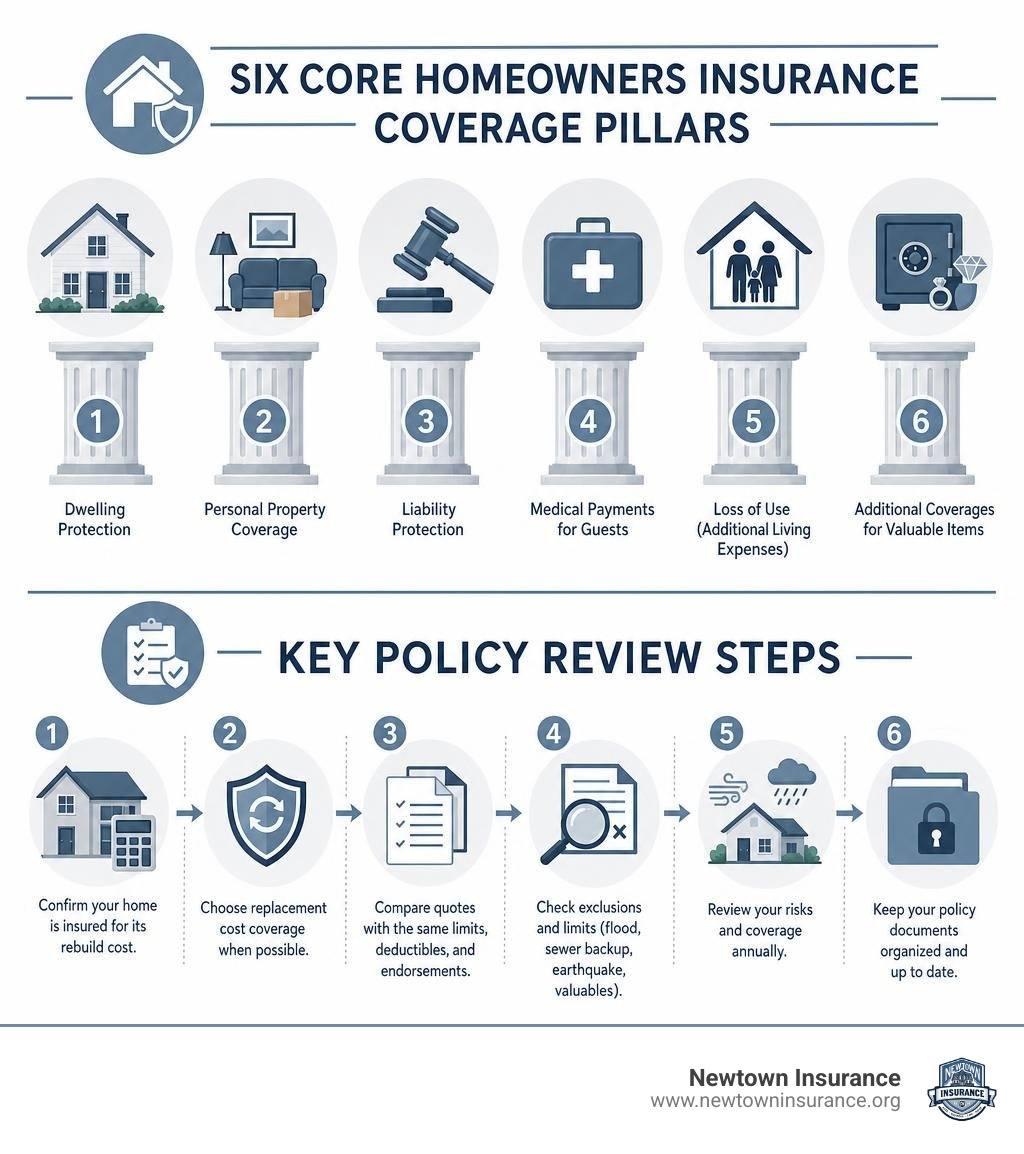
Good Home insurance advice starts with three steps: insure your home for its rebuild cost, not its market price; choose replacement cost coverage when possible; and compare quotes with the same limits, deductibles, and endorsements. Before you buy or renew, also check what the policy excludes – especially flood, sewer backup, earthquakes, and limits for jewelry or other valuables.
A standard homeowners policy generally protects your house, belongings, liability, guest medical payments, and extra living costs if a covered loss makes your home unlivable. But a low premium can hide a high deductible, limited roof coverage, or gaps that only become clear after damage occurs. The typical annual premium is about $1,695, but your price depends heavily on location, home condition, claims history, deductible, and local weather risk.
The goal is not simply to find the cheapest policy. It is to find clear coverage that you can afford to keep – and a deductible you could pay from savings if you need to make a claim.
I’m Shawn Beihl, with more than 15 years of experience across specialty insurance, commercial property and casualty, benefits, and risk management. My Home insurance advice focuses on spotting coverage gaps, understanding risk, and finding practical ways to control long-term costs.
Basic Home insurance advice glossary:
Understanding Policy Fundamentals: What Standard Coverage Protects
At Newtown Insurance, our team works every day to demystify property policies. Many homeowners assume that all policies are created equal, but true value comes from knowing exactly what is inside your policy contract. Standard homeowners insurance (commonly written on an HO-3 or HO-5 policy form) provides a package of protections designed to safeguard your largest financial asset against unforeseen disasters like fire, lightning, wind, hail, and theft.
According to the comprehensive Consumer Reports homeowners insurance guide, which surveyed nearly 24,000 policyholders across 28 insurance groups, the typical national annual homeowners insurance premium hovers around $1,695. However, what you pay and how well you are protected depends on precise underwriting guidelines, your choice of deductible, your property’s structural health, and the specific limits set within your policy framework.
Essential Home Insurance Advice on Policy Coverages A Through F
A standard residential policy is divided into six core sections. Understanding these designations ensures you do not leave critical assets exposed:
- Coverage A: Dwelling — This covers the physical structure of your house, including the roof, foundation, walls, framing, and built-in appliances. Dwelling coverage is the cornerstone of your entire policy.
- Coverage B: Other Structures — This protects detached buildings on your property, such as a detached garage, storage shed, fence, or gazebo. This limit is typically set by default at 10% of your Coverage A limit.
- Coverage C: Personal Property — This covers your personal belongings, including furniture, clothing, electronics, and tools, whether they are inside your home or temporarily with you while traveling. Standard policies typically establish personal property limits between 50% and 70% of Coverage A.
- Coverage D: Loss of Use — Also known as Additional Living Expenses (ALE), Loss of Use Coverage pays for temporary housing, restaurant meals, storage units, and extra commuting costs if a covered peril renders your home unlivable while repairs are completed. ALE limits usually default to 20% to 30% of your dwelling coverage.
- Coverage E: Personal Liability — If a visitor is injured on your property or you accidentally cause property damage or bodily injury to someone else, Coverage E pays for your legal defense, court fees, and any resulting settlements or judgments. Entry-level policies offer $100,000 in liability, but we recommend carrying at least $300,000 to $500,000 to protect personal wealth.
- Coverage F: Medical Payments to Others — Often called Guest Medical Coverage, this pays for minor medical bills (typically $1,000 to $5,000) for guests injured on your property, regardless of who was at fault, helping prevent small mishaps from escalating into expensive lawsuits.
Replacement Cost vs. Actual Cash Value: Why Valuation Matters
One of the most consequential decisions you will make when securing a policy is choosing between Replacement Cost Value (RCV) and Actual Cash Value (ACV).
Actual Cash Value calculates payouts by deducting depreciation based on age, wear, and tear. If an eight-year-old roof or five-year-old television is destroyed, ACV pays only what that used item was worth on the open market immediately before the loss. Replacement Cost Value, on the other hand, covers the actual expense to repair or replace the damaged property with brand-new materials of like kind and quality at current retail prices, without any deduction for depreciation.
Choosing an ACV policy might save a nominal percentage on your annual premium, but it exposes you to massive out-of-pocket expenses when disaster strikes. We consistently advise homeowners to secure replacement cost coverage for both their dwelling and personal belongings.
| Coverage Feature | Actual Cash Value (ACV) | Replacement Cost Value (RCV) |
|---|---|---|
| Depreciation Deduction | Yes — age and wear are subtracted from payout | No — pays current retail cost for new items |
| Out-of-Pocket Risk | High — policyholder covers the depreciation gap | Low — limited primarily to your deductible |
| Premium Cost | Slightly lower annual premium | Marginally higher (worth the extra protection) |
| Real Scenario: 10-Yr Roof Claim ($15,000 repair) | Payout: ~$7,500 (minus deductible) | Payout: $15,000 (minus deductible) |
| Real Scenario: 5-Yr Old Laptop Stolen ($1,800 new) | Payout: ~$400 | Payout: $1,800 |
How to Calculate Your Coverage Limits and Avoid Underinsurance

A frequent and dangerous mistake homeowners make is insuring their property for its market real estate value or remaining mortgage balance. Real estate market value includes the land underneath the house, which cannot be destroyed by fire or wind and does not need to be rebuilt. Conversely, during periods of rapid construction inflation, the cost of materials and labor can easily exceed what you originally paid for the property.
To learn more about local market dynamics and state-specific considerations, explore our Home Insurance Pennsylvania Complete Guide.
Rebuild Cost vs. Market Value and the Coinsurance Rule
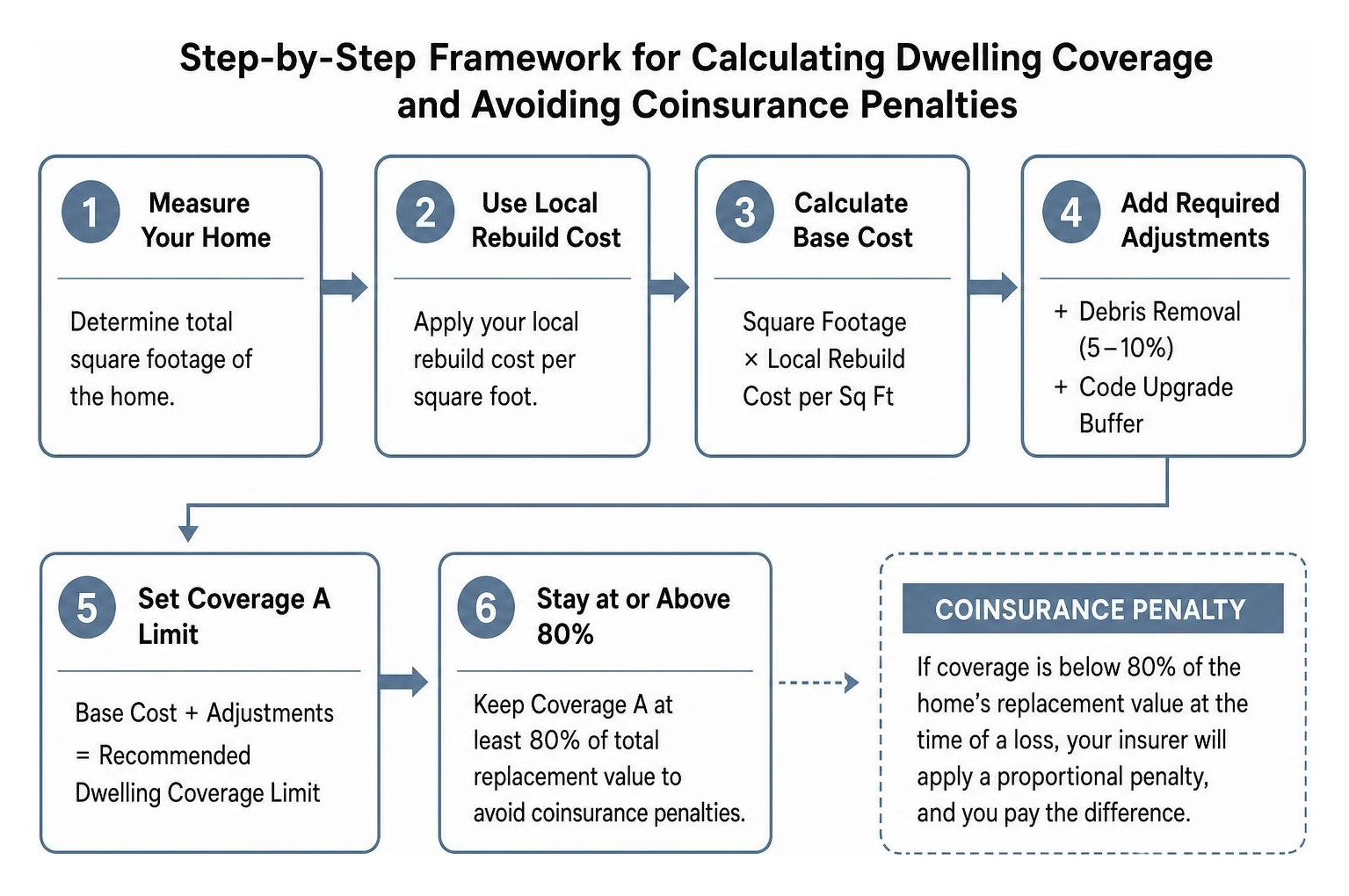
Your dwelling coverage must be calculated strictly on reconstruction cost. Rebuild costs generally range from $150 to $250 per square foot for standard construction, climbing to $300 to $400+ per square foot for custom architecture, premium finishes, or historic stone and masonry common in eastern Pennsylvania.
When establishing your Coverage A limit, calculate: $$\text{Total Square Footage} \times \text{Local Rebuild Cost/Sq Ft} + \text{Debris Removal (5–10\%)} + \text{Code Upgrade Buffer}$$
Proper calculation protects you from the 80% Coinsurance Rule. Most insurers stipulate that if your dwelling coverage drops below 80% of the home’s total replacement value at the time of a loss, the carrier will not pay the full amount on partial claims. Instead, they apply a proportional penalty formula, leaving you responsible for a significant share of minor repairs.
To further protect against labor spikes and material shortages following widespread storms (known as demand surge), look for Extended Replacement Cost endorsements. This add-on provides a safety cushion of 20% to 50% above your policy limit, while an Inflation Guard endorsement automatically adjusts your coverage annually to keep pace with economic trends.
Practical Home Insurance Advice for Evaluating Exclusions and Endorsements
Standard homeowners policies operate with distinct boundaries. They are designed for sudden, accidental occurrences—not maintenance neglect or broad regional environmental hazards.
The most common perils excluded from standard policies include:
- External flooding, storm surge, and ground surface water
- Earth movement, sinkholes, mudslides, and earthquakes
- Sewer backups, drain overflows, and sump pump failures
- Gradual wear, tear, rot, continuous plumbing leaks, and mold remediation
- Infestations from insects, rodents, or termites
To plug these dangerous gaps, we recommend adding specific endorsements:
- Water Backup & Sump Overflow: Standard policies strictly exclude water that backs up through sewers or drains. A dedicated water backup rider typically costs $50 to a few hundred dollars per year and provides $5,000 to $25,000+ in vital coverage.
- Scheduled Personal Property: Standard policies enforce strict sub-limits on high-value items (often capping jewelry theft at $1,500 to $2,500). Adding Scheduled Personal Property coverage provides itemized protection with zero deductible for luxury jewelry, watches, fine art, firearms, and musical instruments.
- Ordinance or Law Coverage: Older homes may require expensive structural and electrical upgrades to meet modern building codes during post-loss repairs. This endorsement covers those mandatory municipal upgrades.
For detailed consumer protection resources and statutory standards, consult the Commonwealth of Pennsylvania Insurance Department.
Expert Home Insurance Advice for Lowering Premiums and Maximizing Savings

Managing your insurance expenses shouldn’t require gutting essential protections. At Newtown Insurance, we guide clients through strategic adjustments that significantly lower annual premiums without exposing them to catastrophic financial risk.
Smart Deductible Management and Safety Upgrades
Your deductible is the out-of-pocket amount you pay before insurance coverage takes over. In Consumer Reports’ survey, the typical deductible selected by policyholders was $1,135, with approximately 50% choosing deductibles between $500 and $1,499.
Adjusting your Home Insurance Deductible is one of the fastest levers for premium reduction:
- Increasing your deductible from $500 to $1,000 typically cuts annual premiums by 10% to 15%.
- Raising it from $1,000 to $2,500 can reduce premiums by 20% to 30%.
Important Rule: Only raise your deductible if you maintain a dedicated, liquid emergency fund to cover that out-of-pocket expense on short notice. Also, beware of percentage-based deductibles (e.g., 2% for wind/hail or hurricane damage), which are calculated as a percentage of your total dwelling coverage rather than a flat dollar fee. On a $400,000 dwelling limit, a 2% deductible equals an $8,000 out-of-pocket cost.
You can also lower premiums through proactive home safety investments:
- Automatic Water Shutoff Valves: Smart leak-detection devices cut premium costs and eliminate the leading cause of internal property claims.
- Central Station Alarms: Monitored fire, smoke, and burglar alarms provide premium discounts ranging from 5% to 15%.
- Roof Upgrades: Modern, impact-resistant architectural shingles reduce risk and earn favorable underwriting tiers.
Multi-Policy Bundling and Hidden Policyholder Discounts
Combining multiple lines of coverage under a single carrier remains the most effective way to unlock double-digit savings. Setting up an Auto and Home Bundle delivers substantial premium discounts—often slashing 15% to 25% across both policies while streamlining customer service and renewals.
Check out our Home Insurance Discounts Ultimate Guide 2026 for a complete breakdown of available credits, which often include:
- Claims-Free Credits: Maintaining a claim-free record for 3 to 5+ consecutive years.
- Mature Homeowner / Retiree Discounts: Policyholders aged 55 and older who are retired spend more time at home, drastically reducing burglary and unnoticed leak risks.
- New Home Purchase Discount: Newly constructed homes or recently purchased properties receive discounted baseline rates.
- Gated Community / Proximity to Fire Services: Homes located close to responsive municipal fire departments and hydrants qualify for superior protection class ratings.
- Paperless & Auto-Pay Credits: Small administrative discounts for automated electronic billing.
Navigating Claims, Carrier Selection, and High-Risk Situations
Price is important, but a policy is only as reliable as the carrier standing behind it when severe property loss occurs. Choosing an insurer with proven financial strength and responsive claims management prevents painful delays during recovery. Review reputable Insurance Companies Pennsylvania with high independent financial stability ratings (such as AM Best ratings of “A-” or higher) and favorable customer satisfaction scores.
What to Expect During the Claims and Settlement Process
If your home suffers significant damage, knowing how the claims process works will help you protect your rights and expedite settlement payouts:
- Immediate Mitigation and Documentation: Take photos and video footage of all damage before moving anything. Make temporary, emergency repairs to prevent further damage (such as placing a tarp over a broken skylight or boarding a broken window), and save every hardware receipt.
- Filing the Claim: Notify your insurance company promptly. Insurers track loss history through the Comprehensive Loss Underwriting Exchange (CLUE) database for up to seven years. Avoid filing tiny claims that barely exceed your deductible, as multiple claims within a three-year period can trigger rate surcharges or non-renewal.
- Adjuster Inspection: An insurance adjuster will visit the property to estimate the scope of structural and contents loss. We strongly suggest having an independent general contractor present during the inspection to ensure all structural damage is accurately cataloged.
- Two-Check Claim Payments: Under replacement cost coverage, insurers commonly issue payments in two stages. The first check covers the Actual Cash Value (depreciated amount minus your deductible) to allow repair work to begin. Once repairs are completed and verified with final contractor invoices, the carrier issues a second check releasing the withheld depreciation.
- Dispute Resolution (Appraisal Clause): If you and your carrier cannot agree on the fair repair cost, most policies include an appraisal provision. Each party hires an independent appraiser, and the two appraisers select a neutral umpire to make a legally binding determination on the loss amount.
Handling Non-Renewals, Cancellations, and FAIR Plan Options
The insurance marketplace has tightened significantly. If you receive a notice of non-renewal—whether due to regional weather underwriting adjustments, roof age exceeding 15 to 20 years, or past claims history—take immediate action:
- Act Early: Most states require carriers to provide 30 to 60 days of advance notice before a non-renewal takes effect. Begin shopping immediately rather than waiting for coverage to lapse.
- Rectify Underwriting Triggers: If a non-renewal is linked to tree branches overhanging a roof, peeling paint, or an outdated roof, addressing the maintenance issue and providing photo proof can occasionally persuade the underwriter to reinstate coverage.
- State FAIR Plans: If you cannot secure insurance through the standard private market after diligent searches, you can access coverage through a state Fair Access to Insurance Requirements (FAIR) Plan. FAIR Plans serve as insurers of last resort, providing basic property coverage (typically fire, lightning, smoke, and internal explosion).
- Difference in Conditions (DIC) Policies: Because FAIR Plans offer bare-bones protection, you should pair a FAIR Plan policy with a companion Difference in Conditions (DIC) policy to restore critical coverages like personal liability, theft, and water damage.
Frequently Asked Questions About Home Insurance Advice
How much dwelling coverage do I need in 2026?
You should carry enough dwelling coverage to equal 100% of the cost to completely reconstruct your home from the ground up at current local construction rates. Calculate your home’s total interior square footage and multiply it by prevailing regional building costs ($150 to $400+ per square foot, depending on materials and finishes), plus a 10% to 20% margin for demolition, site cleanup, and contractor overhead. Never base your dwelling coverage on real estate purchase price or loan balance.
Does standard homeowners insurance cover flood damage?
No. Standard homeowners insurance policies strictly exclude damage caused by outside surface water, storm surges, mudflows, or overflowing rivers and drainage basins. To protect against rising water, you must purchase a separate flood insurance policy through the National Flood Insurance Program (NFIP) or a private flood insurer. NFIP policies typically enforce a strict 30-day waiting period before coverage becomes effective, meaning you cannot buy a policy when a storm is already forecasted.
How does my deductible affect my annual insurance premium?
Your deductible represents your shared financial responsibility during a covered loss. Choosing a higher deductible directly reduces your annual premium because it lowers the insurer’s potential claim payout and discourages the filing of small, high-frequency claims. Increasing your deductible from $500 to $1,000 or $2,500 can cut policy premiums by 10% to 30%, but you must ensure that out-of-pocket amount is readily available in savings if an emergency arises.
Conclusion: Securing the Right Protection for Your Home
Securing reliable home insurance isn’t about chasing the absolute lowest rate on a comparison site—it’s about building a dependable safety net that protects your household against catastrophic financial loss. By understanding the core pillars of coverage, insisting on replacement cost protection, properly accounting for construction rebuild costs, and adding vital endorsements for water backup and valuables, you gain true peace of mind.
At Newtown Insurance, our mission is to eliminate coverage confusion through transparent advice, customer-first support, and customized policies that optimize savings without compromising quality. Review your policy annually and adjust your limits whenever you renovate or expand your home.
Ready to protect your property with clear, competitive coverage? Connect with our experienced local team today to explore tailored coverage solutions for your property and ensure your home is fully protected for years to come.