
Core Home Insurance Benefits: The Six Pillars of Coverage
When evaluating home insurance benefits, it helps to look at your policy as a multi-layered financial safety net. A standard policy does not just protect the physical roof over your head; it wraps around your personal belongings, financial liability, and daily emergency expenses. Broadly speaking, comprehensive property insurance is built around six fundamental pillars of protection defined in standard guidelines, such as those published in the Basic Types of Homeowners Insurance Coverage handbook.
Dwelling, Other Structures, and Personal Property
The first three pillars form the structural and physical defense of your policy:
- Dwelling Coverage (Coverage A): This protects the main physical structure of your house, including attached elements like a built-in garage, porch, or heating system. If a sudden fire or major windstorm damages your walls, roof, or foundation, dwelling coverage pays to repair or rebuild.
- Other Structures (Coverage B): Your property often includes detached structures such as detached garages, storage sheds, gazebos, or perimeter fences. Standard policies typically allocate 10% of your total dwelling limit to cover these detached elements. For instance, if your dwelling coverage is $350,000, you will automatically have up to $35,000 dedicated to repairing detached structures.
- Personal Property Coverage (Coverage C): From furniture and clothing to electronics and appliances, your personal property adds up fast. Personal property limits usually range between 50% and 70% of your dwelling limit. Standard policies even extend worldwide off-premises protection, meaning if your laptop or luggage is stolen while traveling, your home policy can help replace it.
To ensure seamless claim handling, we strongly recommend keeping detailed digital records of your belongings. Storing photos, video walkthroughs, and receipts in a secure cloud folder or email account ensures you can access proof of ownership even if physical records are destroyed during a loss. For deeper guidance on organizing your belongings, check out our comprehensive guide on home insurance information.
Loss of Use, Personal Liability, and Medical Payments
The remaining three pillars focus on your daily life, ongoing expenses, and legal protection:
- Loss of Use / Additional Living Expenses (Coverage D): If a covered disaster renders your home uninhabitable, Loss of Use coverage pays for the temporary lifestyle disruption. It reimburses hotel stays, apartment rentals, restaurant meals, storage fees, and moving costs that exceed your regular household spending budget.
- Personal Liability Protection (Coverage E): If someone is injured on your property, or if you, your family members, or your household pets cause accidental property damage or injury to someone else, liability coverage protects your assets against legal lawsuits. Standard policies generally start at $100,000 in liability limits, paying for legal defense fees as well as awarded settlement costs.
- Medical Payments to Others (Coverage F): Known as “no-fault” medical coverage, this pillar pays for minor medical expenses if a guest suffers a small injury on your property—like slipping on an icy step—regardless of who was at fault. Limits usually range from $1,000 to $5,000 per incident, providing a quick way to resolve minor incidents without entering formal legal battles.
Policy Types: Named Perils vs. Open Perils

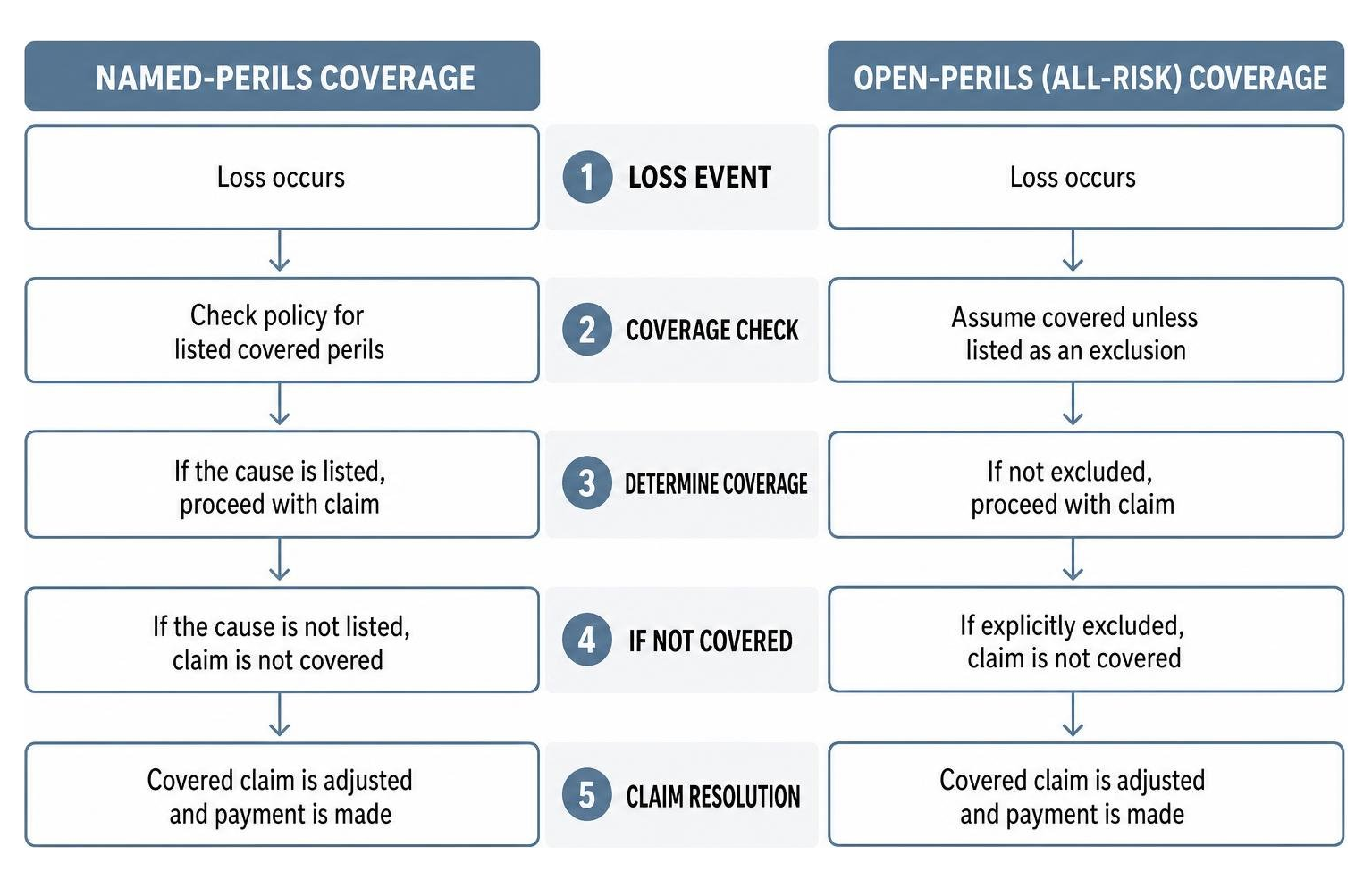
Understanding home insurance benefits requires knowing exactly what events trigger a claim. Insurance contracts generally operate under two distinct risk frameworks: named-peril policies and open-peril policies.
A named-peril policy only covers losses caused by specific events listed explicitly in the contract. If a hazard is not written on the page, it is not covered. Standard broad policies typically protect against 16 named perils, including fire, lightning, windstorm, hail, explosion, riot, aircraft damage, vehicle damage, smoke, vandalism, theft, falling objects, weight of ice/snow, accidental water discharge, sudden tearing of heating systems, and freezing of plumbing.
Conversely, an open-peril policy (also known as “all-risk” coverage) protects against all causes of loss except those explicitly listed as exclusions in the policy wording.
Comparing Standard HO-3 and Comprehensive HO-5 Policies
In the United States, roughly 79% of homeowners policies written are HO-3 policies, making HO-3 the standard choice across the industry.
- The HO-3 (Special Form): This policy employs a hybrid approach. It provides open-peril coverage for your dwelling and other structures, meaning any structural damage is covered unless explicitly excluded (e.g., flood or earthquake). However, it uses named-peril coverage for personal property, protecting your furniture and personal items only against the 16 listed perils. Under standard HO-3 terms, personal property claims are typically settled at Actual Cash Value (ACV) unless upgraded.
- The HO-5 (Comprehensive Form): Designed for high-value homes or homeowners seeking complete coverage, the HO-5 form offers open-peril protection for both the dwelling AND personal property. It also provides higher baseline limits for high-value items like jewelry and electronics, and defaults to Replacement Cost Value (RCV) for personal contents.
Home Insurance Benefits for Specialized Properties: HO-4, HO-6, and HO-7
Not every living space is a standalone single-family house. Specialized policy forms adapt core home insurance benefits to fit modern property arrangements:
- HO-4 (Renters Insurance): Renters do not own the physical building, so HO-4 policies skip dwelling coverage entirely. Instead, HO-4 focuses exclusively on personal property (Coverage C), Loss of Use (Coverage D), and Personal Liability (Coverage E). It ensures tenant belongings are protected against fire, theft, and water leaks.
- HO-6 (Condo Insurance): Condominium living involves shared ownership. The condo association’s master policy usually covers the outer building shell and common areas. An HO-6 policy provides “walls-in” structural protection (covering interior walls, upgrades, cabinetry, and fixtures), personal property coverage, loss of use, and liability protection.
- HO-7 (Mobile and Manufactured Home Insurance): Mobile homes face distinct structural considerations. HO-7 policies tailor standard dwelling and open-peril protections specifically to manufactured structures. If you live in or own a manufactured residence in the Keystone State, read our specialized resource on mobile home coverage in PA.
Financial Protection: Valuation and the 80% Rule
The actual financial payout you receive after a claim depends heavily on your policy’s valuation method and co-insurance rules.
| Coverage Valuation Feature | Actual Cash Value (ACV) | Replacement Cost Value (RCV) | Guaranteed / Extended RCV |
|---|---|---|---|
| Depreciation Deduction | Yes (subtractions based on age and wear) | No (pays full cost of new materials) | No (pays full cost regardless of price spikes) |
| Out-of-Pocket Risk | High (especially on older roofs/belongings) | Low (covers standard modern market rates) | Minimal (protects against surge inflation) |
| Baseline Premium Cost | Standard baseline cost | ~10% higher than ACV | Slightly higher endorsement cost |
| Best Used For | Basic budget policies / older outbuildings | Primary dwellings & personal property | High-demand hazard zones & historic homes |
Key Financial Home Insurance Benefits: RCV vs. ACV Claims
The distinction between Replacement Cost Value (RCV) and Actual Cash Value (ACV) is often the single biggest factor determining out-of-pocket expenses after a disaster.
Suppose a severe storm destroys a seven-year-old roof original cost $15,000. Under an ACV policy, the insurer factors in depreciation—say, 50% wear over time—and pays out roughly $7,500 (minus your deductible). You must make up the $7,500 shortfall yourself.
Under an RCV policy, the insurer pays the full $15,000 required to install a brand-new roof of similar quality, minus your deductible. While upgrading personal property and structural coverage to RCV typically increases annual premiums by around 10%, it offers dramatically superior financial security when major losses occur.
The 80% Rule and Calculating True Dwelling Rebuild Costs
A critical clause in standard homeowners contracts is the 80% Coinsurance Rule. Insurers require policyholders to maintain dwelling coverage equal to at least 80% of the home’s total replacement cost. If your dwelling limit falls below this threshold, the insurance company applies a proportional payout penalty on future partial loss claims.
For example, if replacing your home entirely would cost $400,000, your dwelling limit must be at least $320,000 (80%). If you carry only $200,000 in coverage (50% of the true rebuild value), the insurer will only pay a proportional fraction of any minor or partial repair claim, leaving you with massive unexpected out-of-pocket costs.

It is crucial to remember that dwelling coverage must reflect replacement cost, not real estate market value. Market value includes land value, neighborhood location, and local school district demand—none of which burn down in a fire. Rebuild cost is calculated strictly by multiplying your home’s total square footage by local per-square-foot construction and labor rates. In periods of economic inflation, adding an Inflation Guard endorsement automatically adjusts your dwelling limit annually to match rising construction prices.
Exclusions, Endorsements, and Cost-Saving Strategies

While the core home insurance benefits are extensive, standard policies explicitly exclude several major perils. Understanding these gaps allows you to customize your protection using target endorsements.
Addressing Exclusions and Optional Endorsements
Standard homeowners policies exclude natural floods, earthquakes, sewer backups, sump pump failures, mold from maintenance neglect, and gradual wear and tear.
- Flood Insurance: Flooding is America’s most common natural disaster. Standard home policies exclude rising surface water entirely. Roughly 40% of all flood claims originate from properties outside designated high-risk flood zones. Considering that just one inch of water can cause $25,000 in structural damage, purchasing a separate policy through the National Flood Insurance Program (NFIP) or a private carrier is essential. The median NFIP policy costs roughly $786 per year, while average NFIP claims pay around $68,000.
- Sewer Backup & Sump Pump Failure: If heavy rains overload municipal drain lines or your basement sump pump loses power during a storm, standard policies will not cover the resulting water backup. Adding a dedicated Sewer Backup endorsement costs between $40 and $100 annually—a tiny expense compared to a $15,000 basement cleanup bill.
- Ordinance or Law Coverage: If a disaster damages your older home, local building codes may mandate costly modern updates (such as upgraded electrical panels or sprinklers) during repairs. Ordinance or Law coverage pays for these mandated code compliance upgrades.
- Scheduled Personal Property Floaters: Standard personal property limits cap high-value items like jewelry, fine art, or collectibles at around $1,500 to $2,000 for theft claims. Scheduling these items separately removes deductibles and ensures full replacement value protection anywhere in the world.
For localized regulations and state-specific consumer protection guidelines, homeowners can consult the official Pennsylvania Insurance Department Consumer Guide.
Smart Strategies to Lower Your Premium
You do not have to reduce essential coverage limits to make your insurance affordable. According to insurance industry data, the average annual home insurance premium nationwide sits at $2,927 for $350,000 in dwelling coverage with a $1,000 deductible, following an 11.2% rate increase reported in recent NAIC data. You can combat rising costs using several proven strategy levers:

- Optimize Your Deductible: Raising your baseline deductible from $500 to $1,000 can reduce your annual home premium by up to 25%. To learn how to select the right out-of-pocket balance, explore our guide on home insurance deductible optimization.
- Bundle Policies: Combining your property policy with your auto insurance under the same carrier routinely yields discount savings between 10% and 25%. Read more about saving money with an auto and home policy bundling strategy.
- Install Smart Home & Security Systems: Installing centrally monitored burglar and fire alarm systems can lower annual policy premiums by 15% to 20%. Smoke detectors, deadbolts, water-leak sensors, and gas shutoff valves also qualify for policy discounts.
- Maintain Good Credit & Claim History: Carriers use credit-based insurance scores in states like Pennsylvania to establish baseline rates. Maintaining a strong credit profile and avoiding minor, low-value claims helps preserve claims-free discount tiers over time.
Frequently Asked Questions About Homeowners Insurance
What does Additional Living Expenses (ALE) cover if my home is uninhabitable?
Additional Living Expenses (Coverage D) pays for the increase in living costs you incur while your home is being repaired after a covered loss. It reimburses hotel bills, short-term apartment rentals, restaurant meals (above your normal grocery budget), pet boarding, laundry expenses, and temporary storage units. If you rent out a portion of your home to tenants, ALE also replaces the lost rental income during the reconstruction period.
Why should dwelling coverage reflect replacement cost instead of market value?
Market value represents what a home will sell for on the open real estate market, incorporating local land values, school districts, and market demand. Land does not burn down or blow away in a windstorm. Rebuild costs focus strictly on physical construction expenses—labor, lumber, concrete, roofing materials, and architectural fees. Insuring for replacement cost ensures you have enough capital to rebuild your structure from the ground up, even if regional material costs surge after a natural disaster.
How do optional endorsements fill severe coverage gaps?
Endorsements act as policy add-ons that modify your base contract. Because standard policies exclude common financial hazards like drain backups, foundation earthquakes, service line collapses under your yard, and strict building code updates, optional endorsements allow you to add targeted protection for a few dollars a month. Attaching floaters for sewer backup, scheduled high-value items, or service lines bridges high-risk coverage gaps without forcing you to buy entirely separate policies.
Conclusion
Maximizing your home insurance benefits comes down to striking the ideal balance between comprehensive structural protection, liability peace of mind, and smart savings strategies. By understanding your policy forms, updating your personal property records, adjusting dwelling limits to match true local construction costs, and utilizing endorsements for excluded hazards, you ensure your greatest financial asset remains fully secure.
At Newtown Insurance, we specialize in helping homeowners evaluate coverage choices with complete transparency. We review your existing policy details, identify hidden risk exposures, apply top bundling and security discounts, and tailor coverage to your unique lifestyle.
Ready to make sure your home has optimal protection without paying for unnecessary extras? Explore Tailored Protection with Newtown Insurance and secure your home’s financial future today.