A Realistic Starting Point for Commercial Vehicle Insurance Costs
The average cost of commercial vehicle insurance depends heavily on what you drive, where it is garaged, how far it travels, and the coverage you choose. As a practical 2026 benchmark, minimum commercial auto coverage averages about $163 per month, or $1,959 per year, nationwide. Small businesses with light-duty pickups, vans, or cars often budget $150 to $300 per vehicle per month. Heavy trucks and for-hire operations cost much more: $1 million in commercial truck liability averages about $421 per month.
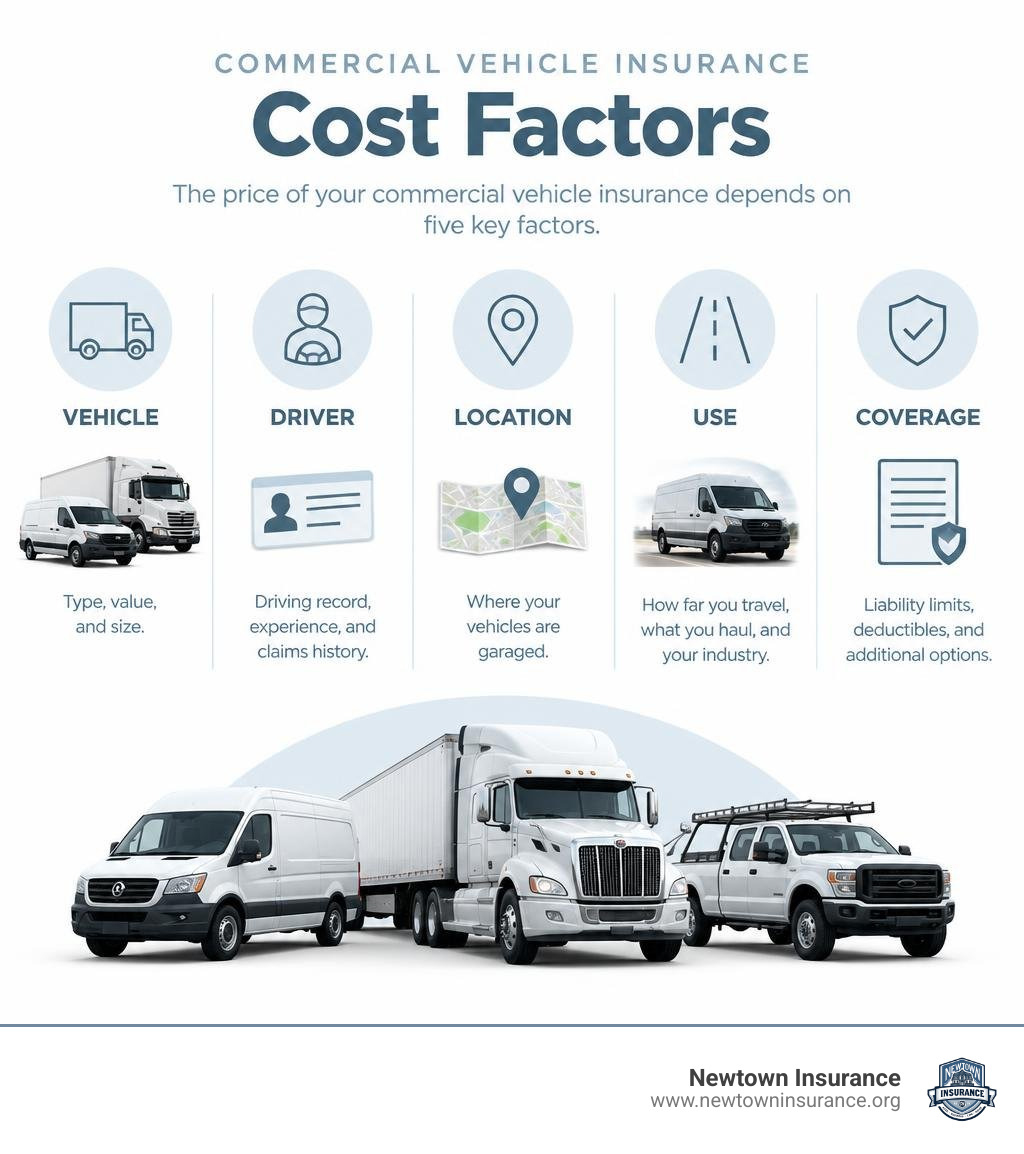
That range is wide for a reason. A local Pennsylvania contractor with a clean-driving service van has a very different risk profile than a new long-haul trucking company hauling freight across state lines. Higher liability limits, physical-damage coverage, driver records, claims, cargo, vehicle value, and your vehicle’s garaging location can all change the final price.
The good news is that transparent pricing is possible when you compare the same limits, deductibles, vehicles, and drivers across quotes. This guide explains realistic cost ranges, common coverage gaps, Pennsylvania-specific considerations, and ways to lower premiums without buying too little protection.
I am Shawn Beihl of Newtown Insurance, with more than 15 years of experience in specialty insurance, commercial property and casualty coverage, and loss-control planning. I help business owners understand the average cost of commercial vehicle insurance and identify the real risk factors behind their premium before we move into the numbers.
Similar topics to average cost of commercial vehicle insurance:
What Is the Average Cost of Commercial Vehicle Insurance?
When establishing your fleet’s annual operating budget, you quickly discover that insurance is not a one-size-fits-all product. While national baseline numbers provide a general starting point, your actual outlay depends on whether you are running a single passenger sedan for client meetings or managing a regional fleet of freight haulers.
The national baseline for state-minimum liability sits at $1,959 per year ($163 monthly), but comprehensive protection for business-critical operations requires higher coverage tiers, comprehensive, collision, and specialized endorsements.
| Vehicle Classification & Weight Class | Typical Monthly Cost (Minimum Coverage) | Typical Monthly Cost ($1M Combined Single Limit + Physical Damage) | Typical Annual Cost Range |
|---|---|---|---|
| Light-Duty (Class 1–3) (Sedans, SUVs, Pickups, Small Cargo Vans) |
$100 – $160 | $150 – $300 | $1,800 – $3,600 |
| Medium-Duty (Class 4–6) (Box Trucks, City Delivery, Utility Rigs) |
$220 – $350 | $330 – $670 | $4,000 – $8,000 |
| Heavy-Duty (Class 7–8) (Semi-Tractors, Dump Trucks, Flatbeds) |
$350 – $550 | $750 – $1,250+ | $9,000 – $15,000+ |
| Specialty / For-Hire / Hazmat (Tankers, Oversized, Limousines) |
$500 – $900 | $1,000 – $2,000+ | $12,000 – $24,000+ |
According to published market research, including the Average Commercial Auto Insurance Cost (2026 Report), policy costs scale directly with the risk of property damage and bodily injury that larger or high-mileage vehicles represent.
National Monthly and Annual Commercial Auto Benchmarks
For standard commercial auto coverage, many businesses opt for a $1,000,000 Combined Single Limit (CSL). A CSL provides a unified pool of liability protection for both bodily injury and property damage resulting from an accident, which satisfies standard client contracts and municipal vendor requirements.
While minimum coverage averages $163 per month, carrying robust $1M limits on standard commercial trucks yields an average cost of $421 per month. For growing enterprises managing multiple overhead items, securing affordable business insurance means finding the right balance between necessary risk mitigation and manageable monthly expenses.
Average Cost of Commercial Vehicle Insurance by Vehicle Type
Vehicle classification remains the primary pricing variable used by insurance underwriters. Heavier vehicles with higher gross vehicle weight ratings (GVWR) cause significantly more physical damage in an accident, which translates into higher baseline rates.

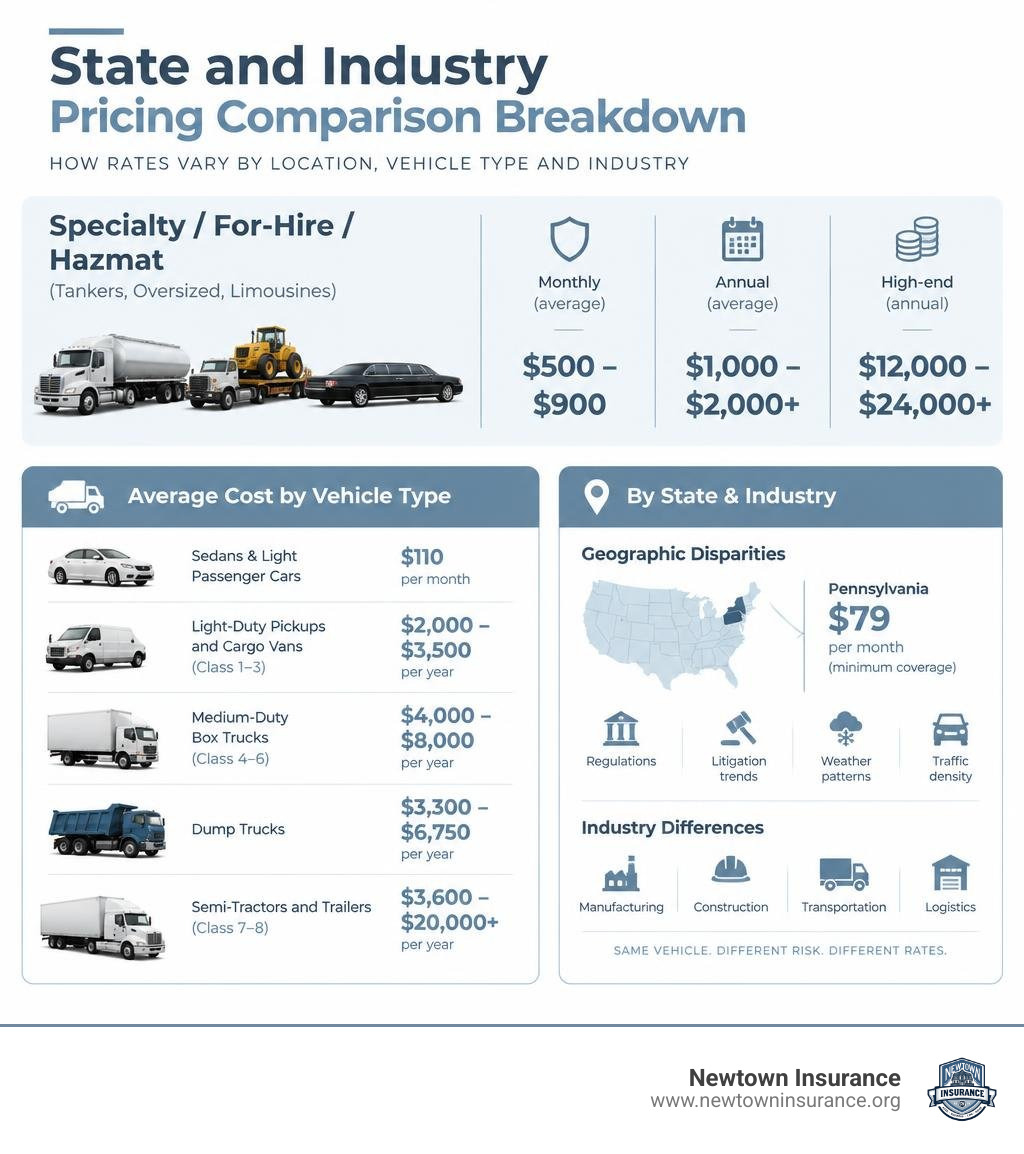
- Sedans and Light Passenger Cars: Averages around $110 per month for standard business operations—roughly 32% below the national baseline.
- Light-Duty Pickups and Cargo Vans (Class 1–3): Typically cost between $2,000 and $3,500 annually per vehicle.
- Medium-Duty Box Trucks (Class 4–6): Range from $4,000 to $8,000 per year ($3,000 to $11,000 across varied usage profiles).
- Dump Trucks: Single-axle dump trucks average around $3,300 per year, while heavier triple-axle configurations average roughly $6,750 per year.
- Semi-Tractors and Trailers (Class 7–8): Leased owner-operators often pay between $3,600 and $5,000 annually for non-trucking liability, while operators with their own operating authority face annual premiums ranging from $9,000 to over $20,000 ($1,000 to $1,800 monthly).
If your operation relies on heavy haulers, our specialized guide to commercial truck insurance in PA details the specific coverage structures required for larger machinery.
Commercial Vehicle Insurance Rates by State and Industry
Geographic location and industry classification introduce major pricing variations into commercial vehicle policies. Two companies operating the exact same truck will receive vastly different renewal quotes based on their garaging address and line of work.
Regional Geographic Disparities
State regulatory environments, local court litigation trends, weather patterns, and traffic density drive regional loss-cost filings. Pennsylvania business owners benefit from one of the most competitive rate environments in the nation:
- Pennsylvania: Averages around $79 per month for standard commercial auto minimums, making it one of the lowest-cost states in the country.
- Michigan: Tops the higher end of the pricing spectrum at $312 per month for baseline coverage.
- New York: Higher urban congestion and litigation exposure drive average monthly truck liability premiums to $666 ($7,996 annually).
- Maine: Represents the lower end of New England truck rates at $275 per month ($3,298 annually).
Because garaging ZIP codes dictate your base territory rate, operating within the Commonwealth provides local businesses with an advantageous starting cost profile, as outlined in our business insurance guide for Pennsylvania in 2026.
High-Risk vs Low-Risk Industry Classifications
Your industry classification defines how frequently your vehicles are on the road and the hazards they encounter during normal operations:
- Low-Risk Professional Services: Marketing agencies, consulting firms, and administrative businesses average just $89 per month per vehicle.
- Trade and Artisan Contractors: Plumbers, electricians, and general builders typically see premiums between $150 and $280 per month.
- Transportation and Logistics: Freight carriers and hot-shot delivery businesses average $349 per month, running 114% above national commercial averages.
- Passenger Transit and Hazmat: Limousine fleets average $870 monthly due to passenger liability, while hazardous material haulers regularly exceed $2,000 per month per unit.
For specialty building and trade businesses, exploring dedicated contractor insurance coverage in Pennsylvania helps bundle vehicle risks with essential trade liabilities.
Key Factors That Influence Commercial Fleet Premiums
Underwriters rely on several core variables when calculating risk and determining policy premiums.

Driver Records and Authority Age
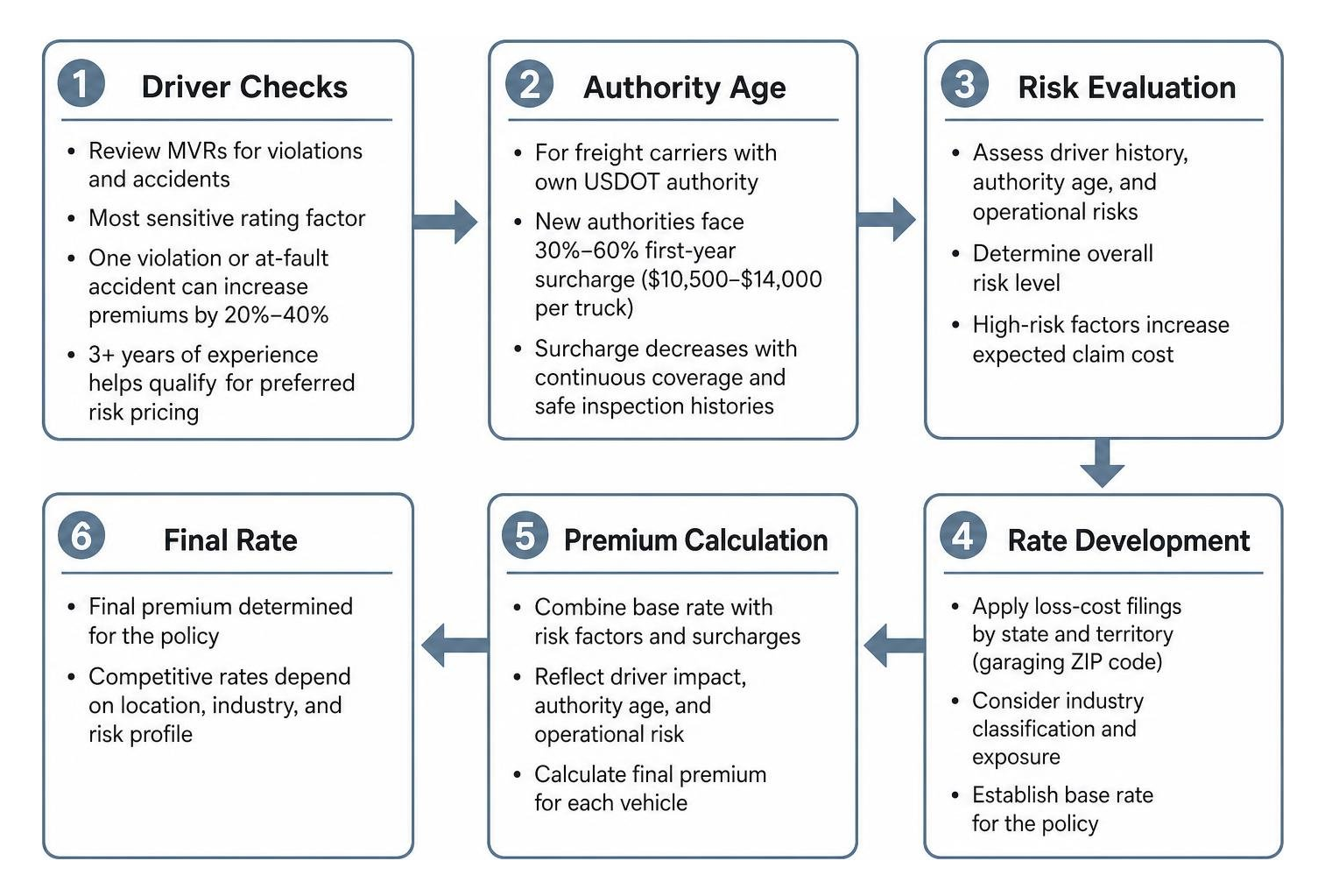
Your drivers’ Motor Vehicle Records (MVRs) represent the most sensitive rating factor on your policy. A single moving violation, speeding ticket, or at-fault accident can increase individual vehicle premiums by 20% to 40%. Conversely, retaining drivers with three or more years of commercial experience helps qualify your fleet for preferred risk pricing.
For freight carriers, authority age is equally important. New motor carriers operating under their own USDOT authority typically face a 30% to 60% first-year surcharge ($10,500 to $14,000 per truck), which decreases as the business establishes continuous coverage and safe inspection histories.
Policy Limits and Deductibles
Higher liability limits safeguard your balance sheet against catastrophic claims, but they also increase baseline costs:
- Minimum Limits: Baseline coverage starts at $163/month.
- Mid-Level ($500K CSL): Adds approximately $71/month.
- High Limits ($1M CSL): Adds approximately $190/month over baseline.
Adjusting physical damage deductibles gives you direct control over your rates. Raising your comprehensive and collision deductibles from $500 to $1,000 or $2,500 can lower the physical damage portion of your bill by 15% to 25%. To protect high-value tools and machinery installed on your vehicles, pair auto liability with dedicated business equipment insurance protection.
Practical Strategies to Lower Your Commercial Vehicle Insurance Costs
You do not have to accept soaring renewal premiums as an unchangeable cost of doing business. Proactive risk management and smart policy management can unlock double-digit percentage savings. For an in-depth look at regional strategies, review our guide on smart ways Pennsylvania entrepreneurs save on business insurance.
How to Reduce the Average Cost of Commercial Vehicle Insurance
- Bundle Multi-Line Policies: Packaging commercial auto with General Liability, Property, or a Business Owner’s Policy (BOP) delivers savings of 10% to 20%.
- Pay Premiums Annually: Paying your policy upfront eliminates monthly payment processing surcharges and administrative fees.
- Audit Fleet Inventory: Remove inactive, seasonal, or decommissioned vehicles promptly so you only pay for active road risks.
- Compare Identical Coverage Quotes: When shopping the market, work with an independent agency to compare quotes using identical limits and deductibles. Review our resource on finding the best commercial vehicle insurance company for small business budgets for step-by-step guidance.
Telematics, Dashcams, and Fleet Safety
Investing in fleet safety technology delivers immediate and lasting returns:
- Dashcams: Forward-facing and dual-facing dashcams provide objective proof during disputed accident claims, cutting claim resolution times and preventing fraudulent liability payouts.
- Telematics Devices: GPS-based telematics tracking monitors speeding, harsh braking, and rapid acceleration. Carriers offer direct rate discounts of 5% to 15% for fleets that use active telematics coaching.
- Formal Safety Programs: Implementing regular MVR screening and defensive driving refresher courses proves risk mitigation to underwriters.
Commercial Auto Insurance vs. Personal Policies and Exclusions
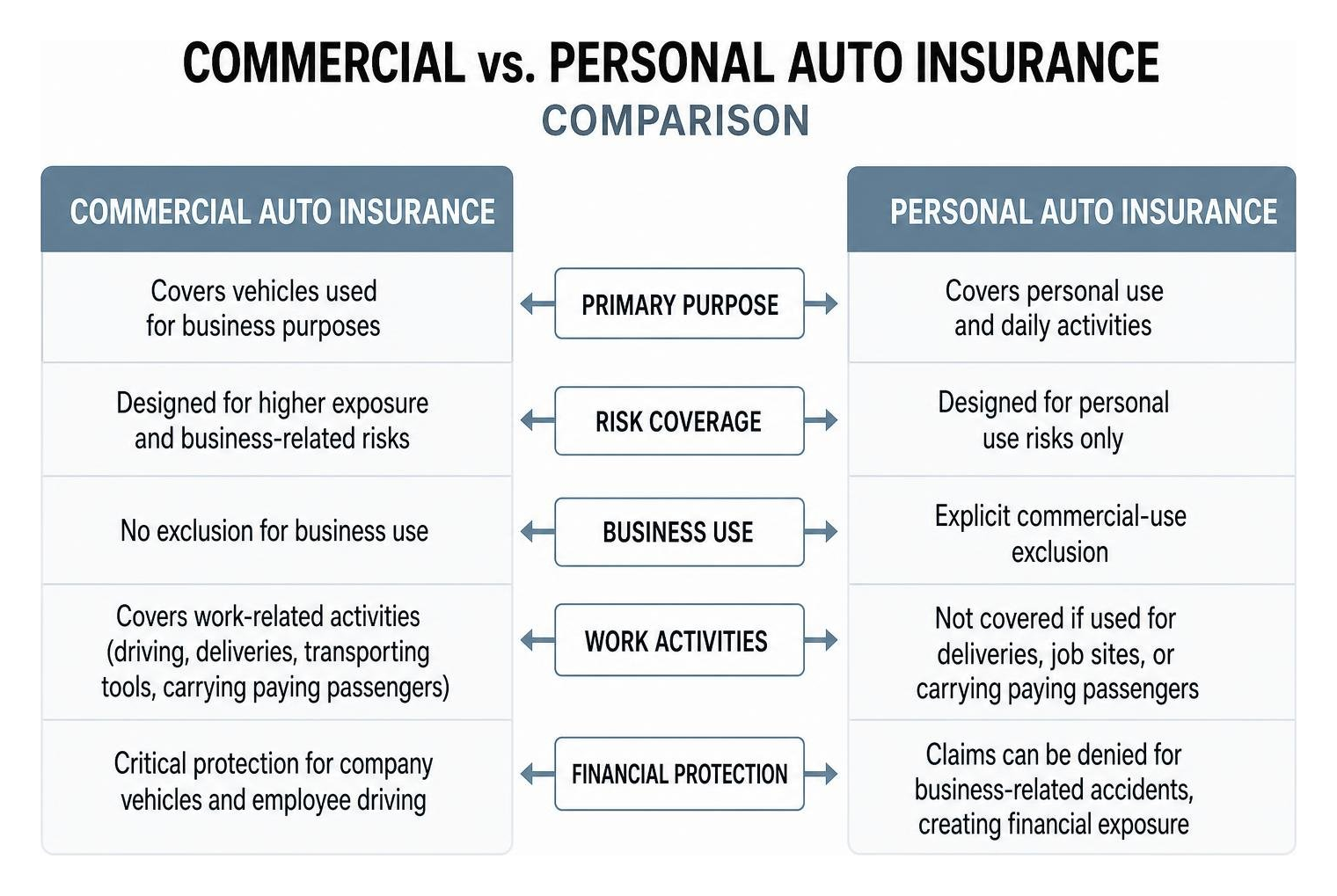
A common misconception among newer business owners is that personal auto insurance will cover business errands or work trucks. Relying on personal policies for commercial activities creates significant financial exposure.
When selecting the right protections, setting up tailored commercial insurance in PA ensures your company vehicles are correctly rated for business use.
Commercial Use Exclusions and Endorsements
Personal auto policies carry explicit commercial-use exclusions. If an employee causes an accident while delivering goods, transporting tools between job sites, or carrying paying passengers, personal insurers can deny the claim entirely.
Key commercial endorsements bridge vital protection gaps:
- Hired and Non-Owned Auto (HNOA): Extends liability protection when employees use personal vehicles for business errands or when your business rents short-term vehicles.
- Motor Truck Cargo: Covers physical damage or theft of transported freight, which standard commercial auto liability excludes.
- Bobtail / Non-Trucking Liability: Protects leased owner-operators operating their tractor without a trailer when off dispatch.
Minimum Liability Requirements and Gaps
The Federal Motor Carrier Safety Administration (FMCSA) mandates minimum financial responsibility limits for interstate commerce:
- General Freight (GVWR > 10,001 lbs): $750,000 minimum public liability limit.
- Hazardous Materials Transport: $1,000,000 to $5,000,000 minimum limit, accompanied by an MCS-90 endorsement verifying compliance.
Ensuring your business vehicles meet both federal standards and state regulations is simple when you establish comprehensive business insurance coverage tailored to your specific operations.
Frequently Asked Questions About Commercial Vehicle Insurance Costs
How much does commercial vehicle insurance cost per month for small businesses?
Most small businesses operating light-duty vehicles (such as pickup trucks, cargo vans, or passenger cars) budget between $150 and $300 per month per vehicle. Exact costs depend on driver records, garaging ZIP codes, and whether you carry comprehensive and collision coverage alongside $1 million liability limits.
Why does commercial auto insurance cost more than personal auto insurance?
Commercial policies carry higher risk exposures due to increased annual mileage, heavier vehicle weights, job-site hazards, and higher required liability limits. When an accident occurs involving a commercial vehicle, the resulting property damage and injury severity are often higher than in personal passenger car collisions.
What is not covered by a standard commercial vehicle insurance policy?
Standard commercial auto policies do not cover cargo inside the vehicle (which requires motor truck cargo insurance), normal mechanical wear and tear, personal belongings left inside the cab, or unlisted drivers operating vehicles without authorization.
Protect Your Fleet with Newtown Insurance
Managing vehicle insurance expenses should not require guessing games or sacrificing necessary coverage. At Newtown Insurance, we work alongside Pennsylvania business owners to deliver transparent pricing, customized policy design, and proactive safety strategies that keep your vehicles protected on the road.
To review your fleet’s policies and explore cost-saving options tailored to your operations, explore our commercial vehicle coverage solutions today.