How to Compare and Choose the Best Personal Accident Insurance Quote
To find the right personal accident insurance quote, compare three key factors across providers:
- Benefit payout type: Look for policies offering direct, unrestricted cash payments rather than slow medical reimbursements.
- Occupational risk rating: Insurers price plans based on your daily hazard exposure; ensure your exact job role is categorized correctly so you don’t overpay.
- Deductible alignment: Match your policy benefit to your health plan’s out-of-pocket maximum to eliminate surprise medical debt.
Most standard plans start between $15 and $35 per month, offering guaranteed acceptance without a physical exam. Because these benefits pay cash directly to you, you can use the funds for hospital deductibles, rehabilitation, or everyday household bills like groceries and mortgage payments.
I’m Shawn Beihl from Newtown Insurance, and over the past 15 years, I’ve helped individuals and families navigate risk management to secure the most cost-effective personal accident insurance quote without hidden fees. Below, we’ll break down the smartest ways to compare coverage tiers, unlock discounts, and protect your household budget from sudden injury costs.
Quick look at personal accident insurance quote:
- personal health insurance quotes
- personal liability insurance quotes
- personal umbrella insurance quote
Understanding Personal Accident Insurance vs Health Insurance
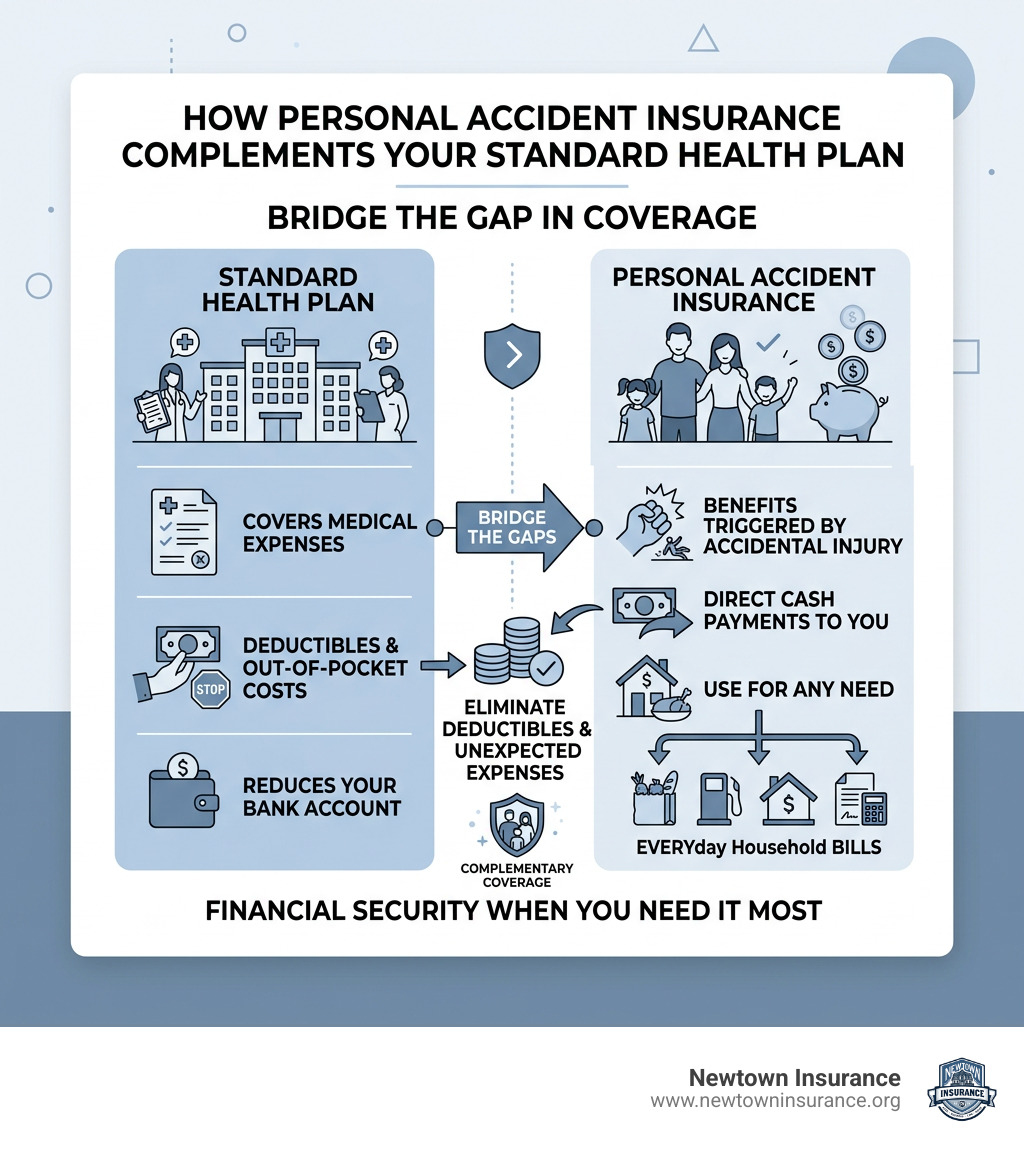
A common question we hear at Newtown Insurance is whether accident insurance is redundant if you already have standard health insurance. The short answer is no. While primary medical insurance pays hospitals, doctors, and pharmacies directly for illnesses and injuries, accident coverage serves a completely different financial purpose.
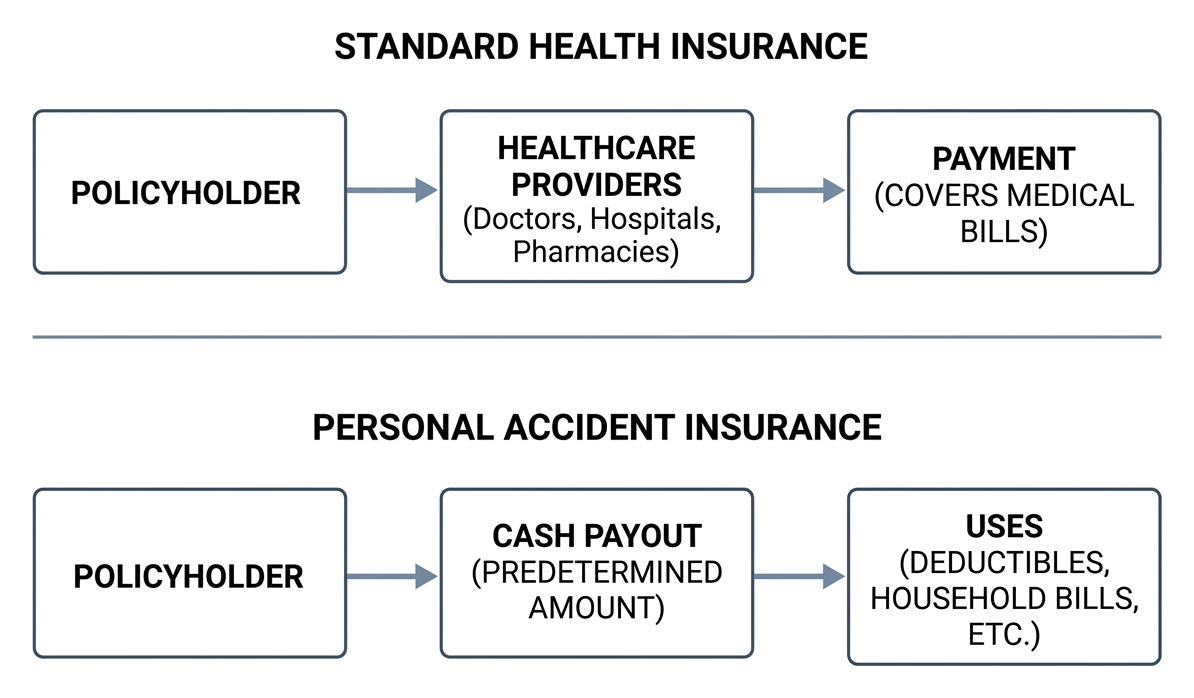
Major medical coverage leaves you responsible for copays, high deductibles, coinsurance, and non-medical bills if an injury keeps you off your feet. Personal accident insurance bridges that gap. When an accidental injury strikes, the policy issues a predetermined cash payout directly to you, regardless of what other insurance you carry. You can read our detailed health insurance quotes guide 2026 to understand how out-of-pocket exposure works under modern medical plans.
| Coverage Feature | Standard Health Insurance | Personal Accident Insurance |
|---|---|---|
| Primary Purpose | Covers sickness, chronic disease, and emergency medical care | Provides direct financial protection for accidental injuries |
| Payout Recipient | Paid directly to doctors, clinics, and hospital networks | Paid directly to you, the policyholder |
| Benefit Structure | Covers eligible medical costs after deductibles and copays | Fixed cash lump sums based on injury severity and medical services |
| Use of Proceeds | Restricted exclusively to covered clinical medical bills | 100% unrestricted (deductibles, rent, groceries, lost income) |
| Underwriting Requirements | Strict open enrollment periods and network constraints | Year-round guaranteed acceptance without physical medical exams |
| Coverage Scope | Sickness, surgery, preventive care, prescriptions | Accidental fractures, burns, dislocations, hospital stays |
Core Coverage Options and Policy Benefits
Accident policies package multiple layers of coverage to protect your financial wellness. Here are the core benefits typically built into an individual accident insurance policy:
- Accidental Death and Dismemberment (AD&D): Pays a substantial lump-sum benefit (often ranging from $50,000 to over $250,000) to your designated beneficiaries if a fatal accident occurs, or directly to you if you suffer limb or vision loss.
- Permanent Total and Partial Disablement: Provides financial relief if an injury leaves you permanently unable to work in your regular capacity or perform daily living activities.
- Emergency Medical Treatment and Hospitalization: Reimburses or pays fixed schedule fees for ambulance transportation, emergency room visits, diagnostic imaging (X-rays, MRIs), and surgical procedures.
- Daily Hospital Confinement Cash: Supplies a cash stipend (such as $100 to $200 per day) for every day you are admitted to an inpatient hospital room or intensive care unit.
- Burn and Fracture Schedules: Distributes established cash tiers for specific injuries, such as $1,500 for a broken arm or $4,000 for severe third-degree burns.
- Sports and Leisure Riders: Extends coverage to injuries sustained during organized amateur athletics, youth sports, and active outdoor recreation.
Key Cost Drivers and Underwriting Criteria
Understanding how underwriters evaluate your risk profile is the most reliable way to secure a lower rate. Fortunately, accident plans bypass extensive medical history reviews. Instead, insurers focus primarily on your physical environment and routine activities.
When evaluating quotes, reviewing our tips for saving money on insurance can help you identify policy structures that maximize value without compromising protection.
Factors That Determine Your Personal Accident Insurance Quote
Your rate is shaped by several distinct variables:
- Occupational Risk Classification: Insurers place workers into risk tiers (typically Classes 1 through 4).
- Class 1 (Low Risk): Office professionals, administrative staff, accountants, and teachers.
- Class 2 (Moderate Risk): Real estate agents, retail supervisors, and sales reps who travel locally.
- Class 3 (Skilled Manual Labor): Electricians, mechanics, plumbers, and delivery drivers.
- Class 4 (High Hazard): Construction laborers, heavy equipment operators, and roofers.
- Benefit and Sum Insured Maximums: Selecting a $100,000 AD&D limit alongside a $3,000 medical expense benefit will yield a substantially lower premium than a $500,000 maximum payout tier.
- Family and Dependent Bundling: Covering a spouse and children under a single unified policy frequently unlocks family discounts, with some policies providing free or discounted coverage for dependent children.
- Custom Policy Riders: Adding specialized protection for high-risk recreational sports or travel extensions will slightly increase the base rate. Exploring personalized insurance quotes allows you to select only the specific add-ons you need.
Standard Exclusions and Policy Limitations
To avoid surprises during a claim, you should always review policy exclusions. Personal accident insurance is strictly designed for unforeseen, sudden physical trauma. Standard policy limitations include:
- Pre-Existing Medical Conditions and Illnesses: Sicknesses, viral infections, degenerative conditions, and physical injuries that occurred prior to the policy’s effective date are excluded.
- Intoxication and Unlawful Acts: Injuries sustained while operating a motor vehicle under the influence of drugs or alcohol, or resulting from participation in illegal activities, are denied.
- Professional and Extreme Hazardous Sports: Competitive professional athletics, motorsports racing, skydiving, and mountaineering often require specialized commercial riders.
- Intentional Self-Harm: Deliberate injuries or suicide attempts are strictly excluded.
- Extended International Stays: Most domestic policies restrict continuous coverage overseas to trips under 90 to 180 consecutive days unless an international rider is attached.
How to Compare a Personal Accident Insurance Quote Across Top Providers
When comparing quotes from different insurers, price should never be your only metric. A policy that costs $3 less per month is rarely a bargain if it imposes tight sub-limits on basic diagnostic tests or requires extensive waiting periods.

Before making a final choice, consult our compare insurance quotes complete guide to verify that you are evaluating identical benefit structures.
Key Steps to Request an Accurate Personal Accident Insurance Quote Online
To streamline your quote comparison process, follow this structured approach:
- Calculate Your Health Plan Out-of-Pocket Gap: Review your medical insurance deductible and copay requirements. If your family deductible is $6,000, look for an accident plan that provides at least $5,000 to $7,500 in combined injury benefits.
- Specify Your Exact Daily Job Duties: Ensure the quoting engine reflects your actual duties. If you manage a warehouse from a desk, classifying yourself as administrative rather than manual labor can cut your rate in half.
- Evaluate Family Rider Packages: Look for plans that include automatic child benefits. Some insurers offer complimentary coverage for minor children when both parents enroll on the same policy schedule.
- Verify No-Fee Pricing and Payment Schedules: Annual payments often eliminate monthly installment processing fees. We recommend choosing no hidden fee insurance providers that present clear, transparent pricing upfront.
Is Personal Accident Insurance Worth It for Your Household?
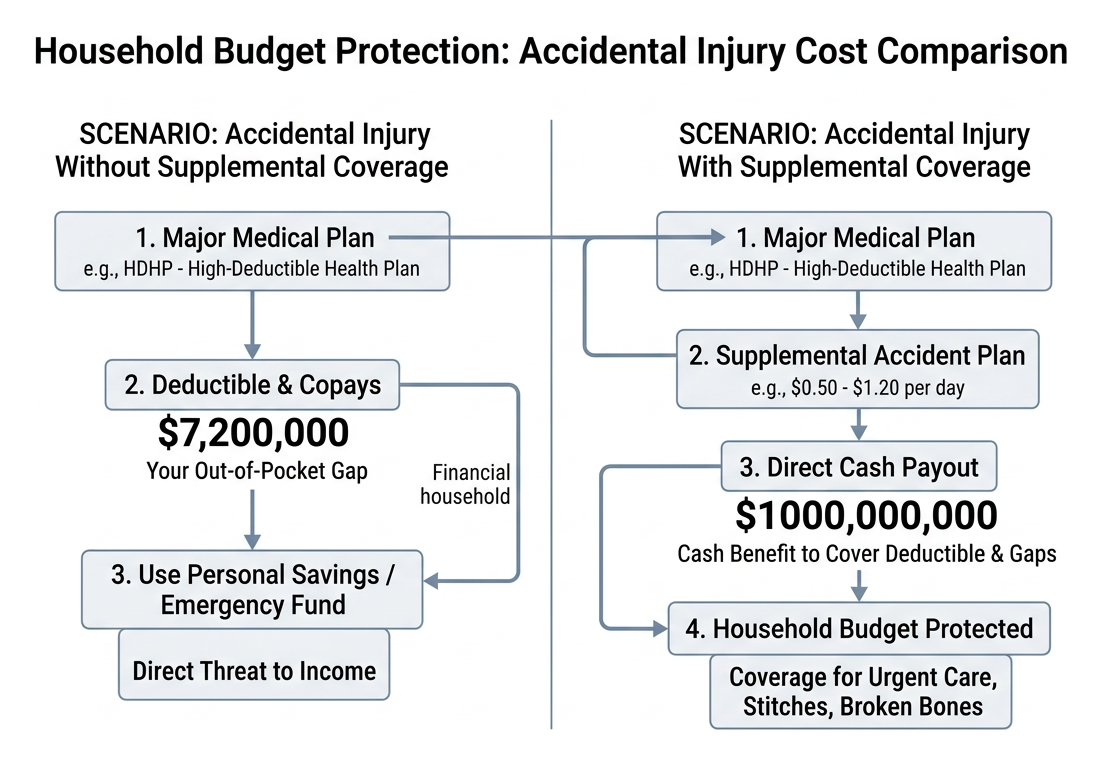
Accidents happen without warning, but dealing with the financial fallout doesn’t have to drain your bank account. For most working individuals, supplemental accident coverage costs roughly $0.50 to $1.20 per day—about the cost of a cup of coffee each week.
This coverage delivers the greatest financial return for:
- Families with Active Children: Youth sports, playground trips, and bicycle rides often lead to urgent care visits, stitches, and broken bones.
- High-Deductible Health Plan (HDHP) Holders: An accident cash benefit directly covers your deductible before major medical kicks in, protecting your emergency fund.
- Self-Employed Individuals and Gig Workers: If you don’t have paid sick leave or corporate disability benefits, an injury can immediately threaten your income. Direct cash payouts keep your household running while you recover.
- Tradespeople and Manual Workers: Those whose livelihoods depend directly on physical mobility and manual dexterity benefit immensely from disablement and injury cash schedules.
Frequently Asked Questions About Accident Insurance
Can I receive payouts from both health insurance and personal accident insurance?
Yes. Personal accident insurance plans operate on a non-coordination of benefits model. Because the insurance company issues cash disbursements directly to you rather than paying the clinic or hospital network, your primary health insurance claim remains completely independent. You can submit claims to both policies for the same accident without any reduction in your total benefit.
Does accident insurance require a comprehensive medical exam?
No. Personal accident insurance uses simplified issue underwriting. You do not have to undergo blood tests, physical examinations, or submit extensive historical medical records. Acceptance is typically guaranteed or subject to a few basic qualifying questions regarding your current employment status and age.
Can accident insurance payouts be used for non-medical expenses?
Yes. Benefit payments are made directly to the policyholder with zero spending restrictions. Once your claim is processed and the funds are deposited into your account, you can use the cash for your health plan deductible, physical therapy copays, monthly mortgage or rent payments, grocery shopping, or utility bills while you take time off to heal.
Conclusion
Securing the right supplemental policy is one of the most cost-effective ways to protect your hard-earned savings against unforeseen injuries. By aligning your benefit maximums with your household deductible, accurately defining your occupational tier, and selecting transparent, fee-free coverage, you can secure comprehensive peace of mind at an affordable monthly rate.
At Newtown Insurance, we specialize in helping individuals and families across Pennsylvania find tailored, transparent protection without unnecessary upsells. Explore our tailored insurance services today, request your personalized quote, and let our dedicated team help you build a resilient financial safety net for the road ahead.