Why Personal Liability Insurance Quotes Matter
Personal liability insurance quotes show what it may cost to add protection when a lawsuit or injury claim is larger than your home or auto policy can pay. In many cases, this protection is called a personal umbrella policy: it adds liability coverage above the limits of qualifying homeowners, renters, condo, auto, boat, or recreational vehicle policies.
| Quick answer | What it means |
|---|---|
| What it protects | Savings, property, and potentially future income after a covered liability claim exceeds underlying policy limits |
| Common coverage amount | Often starts at $1 million and can go to $5 million or more, depending on the insurer and state |
| What affects a quote | Your state, home and auto liability limits, drivers and vehicles in the household, claims and violation history, property risks, and requested limit |
| Why compare carefully | The lowest premium may come with stricter eligibility rules, higher required underlying limits, or coverage terms that do not fit your situation |
A serious accident can create costs well beyond a standard policy’s liability limit. For example, a homeowner accident involving tree removal led to medical costs that exceeded the homeowners policy; umbrella coverage paid the remaining $800,000 in that reported claim. The point is not to expect the worst – it is to understand where your current coverage ends before a major claim puts your finances at risk.
I am Shawn Beihl of Newtown Insurance, with more than 15 years of experience across specialty insurance and risk management. I help clients make sense of personal liability insurance quotes, identify exposure gaps, and weigh coverage choices without the generic-plan runaround.
Understanding Personal Umbrella Policies and Coverage Limits

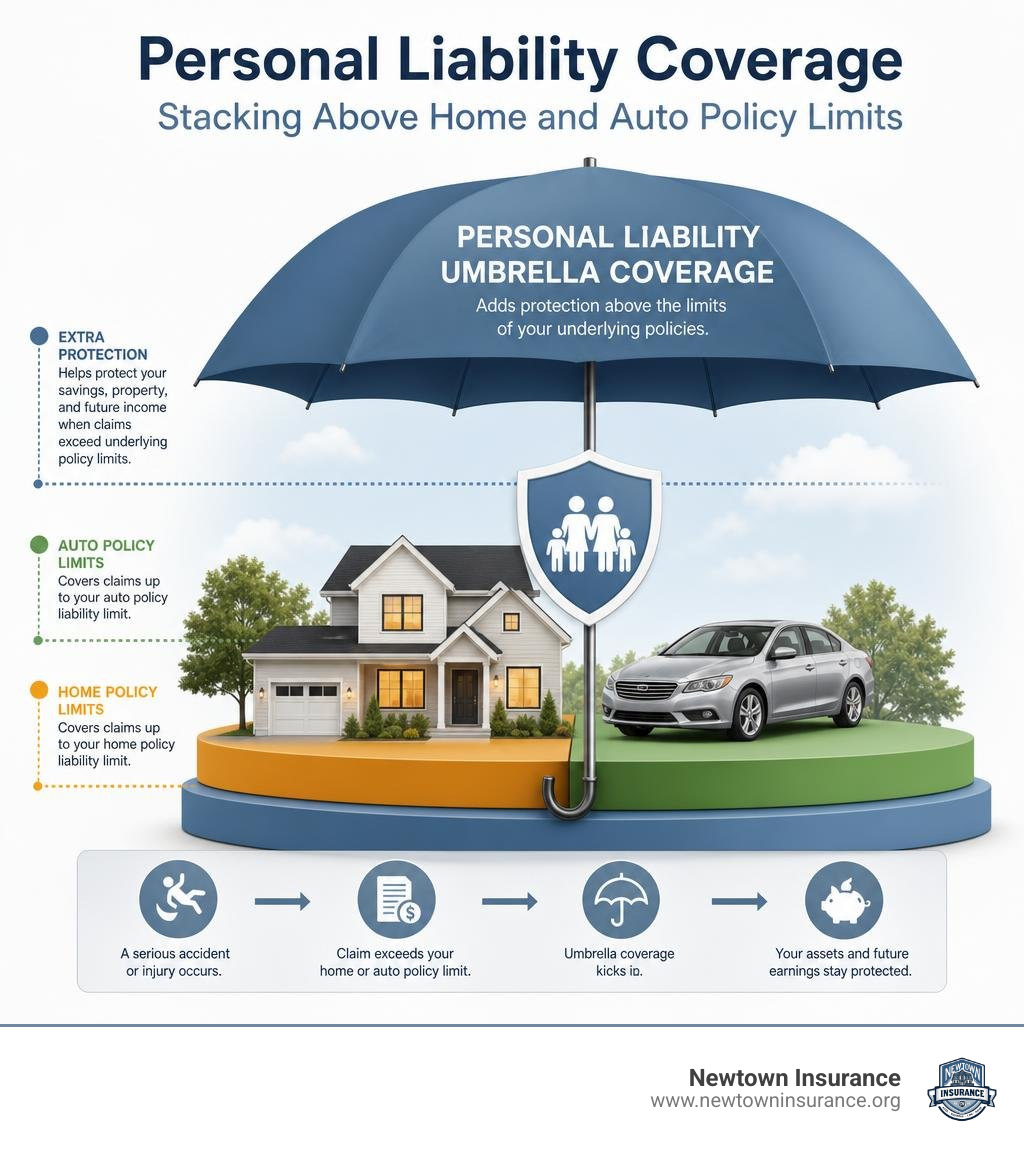
When evaluating personal liability insurance quotes, it helps to picture your insurance portfolio as a set of protective shields. Your baseline homeowners, renters, condo, or auto policy acts as your first line of defense. However, every standard primary insurance policy comes with a fixed cap on personal liability coverage—frequently $300,000 or $500,000. If an unfortunate event triggers a severe injury or property damage claim that breaches that cap, you become personally responsible for paying the rest.
This is where a personal umbrella policy (PUP) enters the picture. An umbrella policy provides excess stackable coverage that sits on top of your primary policies. When primary insurance limits are exhausted, the umbrella coverage kicks in to absorb the surplus loss up to your policy limit, which usually starts at $1 million and can extend to $5 million or higher.
To understand how these policies are issued, it is critical to recognize the difference between admitted and non-admitted policies:
- Admitted Policies: These policies are fully backed and regulated by state insurance departments. Insurers must file their rates and policy forms with the state. If an admitted carrier ever experiences financial insolvency, state guaranty funds offer a safety net to help pay covered claims. Admitted policies usually feature convenient direct billing options.
- Non-Admitted (Surplus Lines) Policies: These carriers do not submit forms or rates for state regulatory approval, giving them broader underwriting flexibility to write unique, higher-risk, or specialty policies. However, surplus lines carriers are not backed by state guaranty funds, and policies are typically handled via agency billing.
Another vital element available in select excess policies is Uninsured and Underinsured Motorist (UM/UIM) coverage. Standard primary auto coverage protects you against drivers without adequate insurance, but a severe hit-and-run or highway collision with an underinsured driver can easily result in hundreds of thousands of dollars in personal bodily injury. Adding excess UM/UIM protection to your personal umbrella policy guarantees that your family receives high-limit bodily injury coverage even if the driver at fault carries little to no insurance.
Before finalizing your umbrella coverage options, it is wise to review our compare insurance quotes complete guide to see how different underlying policy tiers impact your overall annual premiums.
Evaluating Personal Liability Insurance Quotes Across Different States
Personal umbrella limits and eligibility rules depend heavily on state regulations, carrier filings, and underlying baseline requirements. While $5 million limits are widely available across most regions, certain states enforce lower maximum coverage caps or strict risk criteria.
| State / Region | Maximum Standard Limit | Carrier / Admitted Status Examples | Required Underlying Limits (Typical Baseline) |
|---|---|---|---|
| Pennsylvania & Most States | Up to $5 Million | Admitted & Non-Admitted Options Available | Home: $300,000 / Auto: $250k/$500k/$100k (or $500k CSL) |
| Florida (FL) | Up to $1 Million (Standard Excess) | Admitted / Surplus Lines Options | Home: $300,000 / Auto: $250k/$500k/$100k |
| California (CA) | Up to $1 Million (Standard Excess) | Admitted / Surplus Lines Options | Home: $300,000 / Auto: $250k/$500k/$100k |
| Alabama (AL) | Up to $1 Million (Standard Excess) | Admitted / Surplus Lines Options | Home: $300,000 / Auto: $250k/$500k/$100k |
In high-litigation states like California or Florida, standard consumer programs often cap excess personal umbrella limits at $1 million unless specialty surplus carriers are utilized. For Pennsylvania residents, standard carriers offer up to $5 million in personal liability limits, provided household members meet minimum underlying auto and homeowners threshold qualifications.
How Excess Coverage Interacts with Auto and Homeowners Policies

Excess liability policies do not operate in a vacuum. Instead, they require you to maintain minimum baseline liability limits on your primary underlying policies. If you do not maintain these designated limits, a coverage gap occurs, and you must pay that difference out of pocket before your umbrella policy responds.
Consider this standard policy integration structure:
- Primary Auto Insurance: Requires underlying bodily injury liability limits of at least $250,000 per person / $500,000 per accident (or a $500,000 Combined Single Limit).
- Primary Homeowners / Renters Insurance: Requires underlying personal liability coverage of at least $300,000.
- Personal Umbrella Layer: Sits directly above those limits to provide $1,000,000 to $5,000,000 in excess financial protection.
If a guest suffers a severe brain injury after falling near your swimming pool and a court awards $1.2 million in damages, your underlying homeowners policy pays its maximum limit of $300,000. The excess personal umbrella policy then steps in to cover the remaining $900,000, plus legal defense fees that do not erode your policy limits. Without the umbrella policy, your hard-earned personal savings and home equity would be exposed to satisfy the court judgment.
For specialty programs like Starwind Personal Lines Solutions, excess personal liability coverage can even follow form over standalone landlord policies, secondary vacation homes, or residential properties undergoing major structural renovations.
Who Needs Umbrella Protection and What Assets Are at Risk?

A common misconception is that personal umbrella coverage is strictly meant for ultra-wealthy individuals. In reality, anyone with savings, a home, retirement accounts, or even future earning potential can be vulnerable to a catastrophic lawsuit. In today’s litigious environment, a single slip-and-fall on a icy walkway or a multi-car highway pile-up can result in lawsuit awards that quickly outpace standard insurance limits.
Assets that are at risk during a legal judgment include:
- Primary Real Estate and Equity: Your home, vacation property, or rental real estate holdings.
- Liquid Savings and Investments: Brokerage accounts, bank balances, certificates of deposit, and mutual funds.
- Future Wages and Earnings: Courts can garnish up to 25% of your future income to satisfy unpaid personal liability judgments.
- Recreational Assets: Boats, jet skis, ATVs, and recreational vehicles.
If you own rental property, host guests frequently, manage short-term vacation rentals, or have teenage drivers in your household, your liability exposure increases significantly. In Pennsylvania, local property owners should review our dedicated guide on liability insurance pa to learn more about state-specific asset protection strategies.
Eligibility Criteria for Personal Liability Insurance Quotes
When insurance carriers evaluate personal liability insurance quotes, underwriting guidelines look at the overall risk profile of your household. While underwriting rules vary across insurance carriers, standard modern guidelines have become flexible enough to accommodate everyday drivers and homeowners.
Common eligibility criteria include:
- Operator Age Requirements: Standard umbrella programs frequently target household operators between the ages of 23 and 75. Drivers outside this window may require specialized carrier filings.
- Driving Record Allowances: While clean driving records yield the lowest rates, modern excess programs can accept up to 6 moving violations and up to 3 major accidents per household.
- Major Infractions (DWI/DUI Rules): Premier carriers such as RLI Personal Umbrella – Get a quote or make a payment allow up to 1 completed DWI or DUI conviction per household, provided minimum underlying conditions are satisfied.
- Residential Property Limits: Comprehensive Personal Liability (CPL) policies allow homeowners to bundle multiple properties. Standard programs cover up to 15 residential locations per policy, including 1-4 family dwellings, vacant land, condo units, mobile homes, and RV lots. Specialty excess umbrella programs can even support up to 25 underlying locations per household.
Real-World Examples: When Primary Insurance Isn’t Enough
To realize the true value of an umbrella policy, look at how real-world liability claims unfold when standard home or auto limits fall short.
The Dock Renovation Tree-Felling Incident A homeowner operated a hired backhoe on his residential waterfront property to clear mature tree limbs while building a dock replacement. While attempting to lower a heavy limb, a branch snapped and struck a visiting family friend. The friend sustained permanent spinal cord injuries resulting in astronomical medical bills, rehabilitation expenses, and lost career wages totaling nearly $1.1 million.
The homeowner’s baseline primary homeowners policy had a standard liability limit cap of $300,000, which was paid out immediately. Because the homeowner had secured a $1 million personal umbrella policy, the excess carrier step in to cover the remaining balance of $800,000. Without this layer of umbrella coverage, the homeowner faced losing his home, savings accounts, and future retirement funds to satisfy the court settlement.
How to Compare Personal Liability Insurance Quotes Online
Gathering and comparing personal liability insurance quotes online is a straightforward process when you know what details to have ready. Taking an organized approach helps guarantee you receive transparent, accurate rates without unexpected underwriting surprises down the road.
Follow this simple step-by-step process when comparing online personal liability quotes:

- Gather Primary Policy Declarations Pages: Check that your underlying auto liability limits match or exceed $250k/$500k/$100k (or $500k CSL) and your home liability limits are at least $300,000.
- Audit Household Drivers and Vehicles: Count all licensed household members, including young drivers, and list all titled automobiles, motorhomes, watercraft, and off-road vehicles.
- Disclose Incident History: Identify any moving violations, accidents, or prior claims within the last 3 to 5 years. Program guidelines, such as those from RLI or Starwind, accommodate minor infractions or up to 1 past DWI/DUI per household.
- Select Desired Limit Options: Select between a $1 million, $2 million, or $5 million personal umbrella limit based on your net worth and asset protection requirements.
- Review Admitted vs. Non-Admitted Options: Verify whether the policy direct-bills through an admitted carrier or relies on agency billing for non-admitted specialty risks.
For a customized evaluation tailored to your family’s unique situation, visit our page on personalized insurance quotes to see how seamlessly we can integrate excess coverage with your existing coverage.
Frequently Asked Questions About Personal Liability Coverage
How much does a personal umbrella policy cost?
For most standard single-family households, a $1 million personal umbrella policy is surprisingly affordable, usually costing between $150 and $300 per year. Adding a second $1 million layer of coverage typically adds around $75 to $100 to your annual premium. Primary cost drivers include the number of motor vehicles, young drivers in the household, watercraft, rental properties, and past driving infractions. Maintaining higher underlying auto and home liability limits helps keep your umbrella insurance rates low.
Can I get a policy with a past driving violation?
Yes. Many top-tier excess liability programs accept drivers with past moving violations or minor accidents. Specialized providers accept households with up to 6 moving violations and 3 minor accidents. Furthermore, programs like RLI Personal Umbrella allow up to 1 past DWI/DUI per household, making excess asset protection accessible even if your driving history includes a past mistake.
What is the difference between admitted and non-admitted coverage?
An admitted personal umbrella policy is issued by an insurer approved by your state’s insurance division, follows state-filed rates and policy forms, offers direct billing choices, and is protected by state guaranty funds if the insurer defaults. A non-admitted (surplus lines) policy provides flexible coverage solutions for unusual, high-risk, or complex liabilities that standard insurers reject. Non-admitted policies do not carry state guaranty fund protection and are typically billed through agency accounts.
Conclusion
Securing personal liability protection does not have to be a complicated or stressful experience. By taking the time to review personal liability insurance quotes, you can easily identify potential gaps where standard auto or homeowners limits leave your financial security exposed. Whether you are safeguarding your retirement savings, protecting equity in your home, or shielding future earnings from unexpected legal judgments, adding a $1 million to $5 million umbrella policy is one of the most cost-effective investments you can make for long-term peace of mind.
At Newtown Insurance, we pride ourselves on delivering tailored protection, smart savings, and fully transparent pricing to our neighbors across Pennsylvania. As we guide clients through 2026 and beyond, our team remains committed to offering warm, expert, customer-first support so you never overpay for high-quality insurance coverage.
Ready to protect your personal assets without the headache? Visit our pillar resource page to explore our Tailored Insurance Services or contact our experienced team today to request your personalized excess liability quote.