Compare Personal Watercraft Insurance Quotes Before You Ride
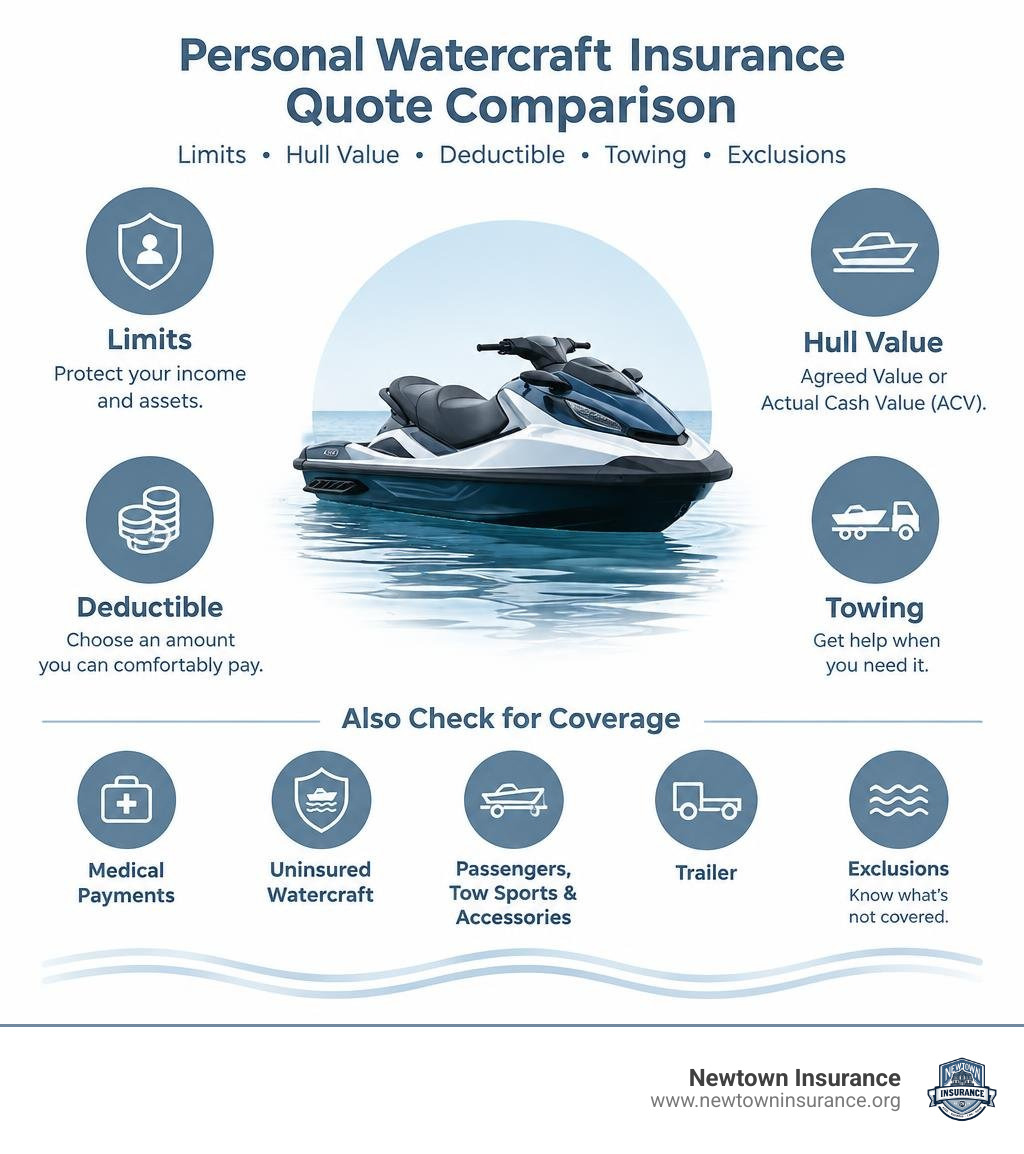
To compare a personal watercraft insurance quote fairly, make every insurer price the same coverage: liability limits, hull value method, physical damage deductible, medical payments, uninsured watercraft coverage, and towing. A lower premium is not a better deal if it comes with less protection after an accident, theft, or total loss.
Start with these four choices:
- Choose liability limits that protect your income and assets. Many PWC owners consider limits from $300,000 to $1 million or more.
- Pick Agreed Value or Actual Cash Value (ACV) hull coverage. Agreed Value can provide a more predictable total-loss payout; ACV accounts for depreciation.
- Set a deductible you could comfortably pay from savings, commonly $250, $500, or $1,000.
- Confirm coverage for your real use, including passengers, tow sports, accessories, trailer, and the waters where you ride.
Personal watercraft can cause serious injury or property damage even on a short ride. A solid policy can also help with medical payments, uninsured watercraft losses, towing, wreck removal, fuel spills, and damaged gear, subject to the policy’s limits and exclusions. Homeowners and standard boat policies may offer limited protection or require a separate endorsement, while marinas and lenders may require proof of insurance.
I am Shawn Beihl, an insurance professional with more than 15 years of experience in specialty insurance, commercial property and casualty, benefits, and risk management. I help clients review a personal watercraft insurance quote with a focus on clear coverage choices, practical risk control, and long-term value.
Personal watercraft insurance quote vocab explained:
- personal liability insurance quotes
- personal umbrella insurance quote
- personal accident insurance quote
Core Coverages Included in PWC Policies
Personal watercraft (PWCs) like WaveRunners, Jet Skis, and Sea-Doos are nimble, fast, and remarkably fun. However, their high power-to-weight ratio introduces distinct risks on crowded waterways. When you secure a specialized watercraft policy, you are putting a financial shield between unpredictable on-water hazards and your personal assets.
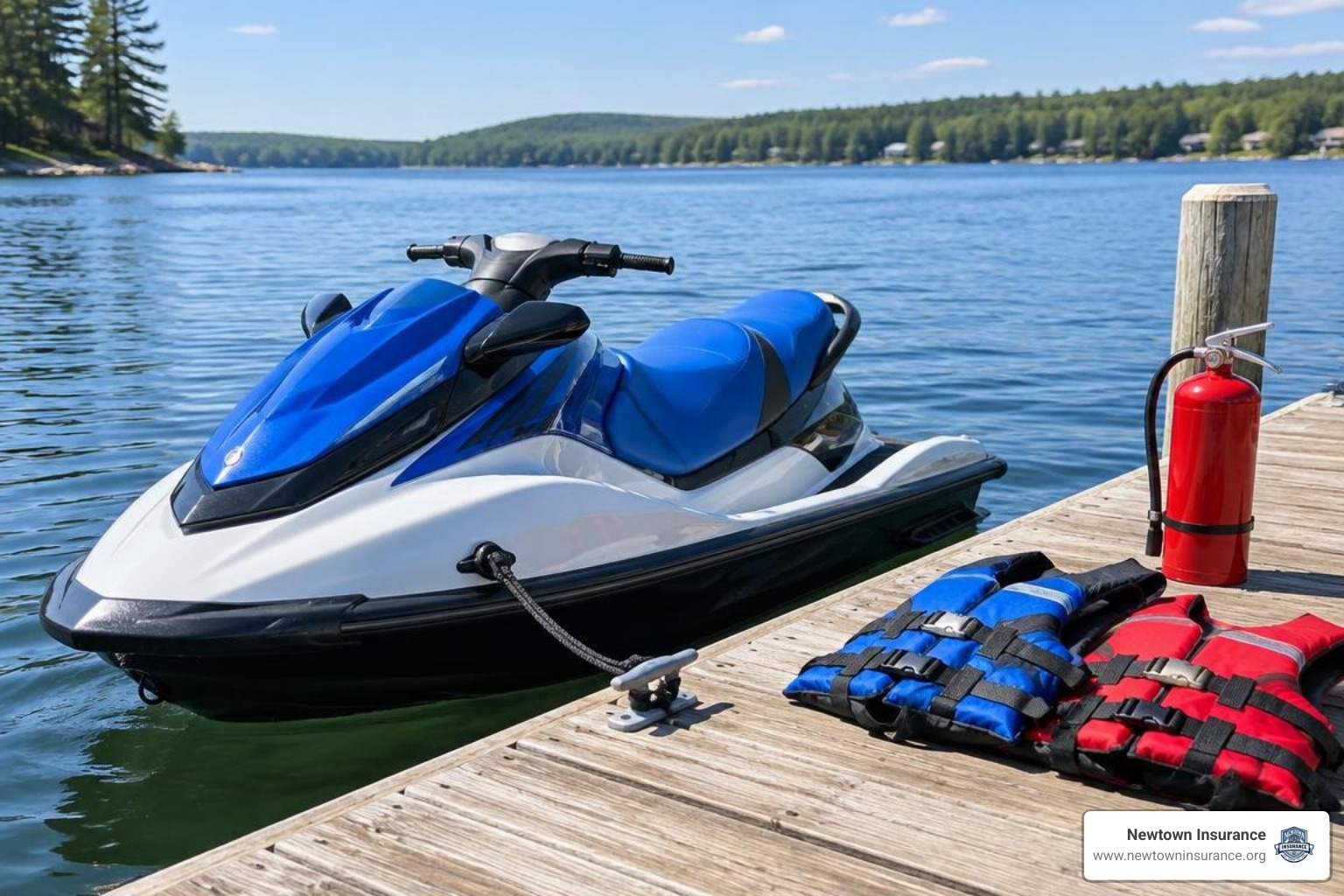
A comprehensive PWC policy bundles several distinct coverage parts to address physical damage, personal injuries, and environmental liabilities:
- Collision Damage: Covers physical damage sustained by your craft if you collide with another vessel, a dock, submerged debris, or a rocky shoreline.
- Comprehensive Perils: Protects against non-collision losses such as fire, vandalism, lightning, windstorms, and theft (both on the water and while stored on land).
- Fuel Spill Containment: Federal and state environmental laws impose strict fines if a sunken or damaged craft leaks oil or fuel. Marine policies include dedicated liability limits to handle containment and remediation cleanups.
- Wreckage Removal: If your craft sinks in a navigable channel or marina, authorities will mandate its removal. Salvage operations are costly, and this coverage pays to raise and remove the hull.
Liability Limits and Uninsured Watercraft Protection
Watercraft liability is the most vital element of your policy. If an operator causes an accident that injures a swimmer, a passenger, or another boater, medical bills and legal defense costs can escalate rapidly. Liability limits typically range from $300,000 to $1,000,000 or more. These can be structured as split limits (covering bodily injury per person, bodily injury per accident, and property damage separately) or as a Combined Single Limit (CSL), which provides a single pool of money applied to all claims resulting from an incident.
When evaluating liability, having personal liability insurance quotes explained without the headache makes it clear that minimum liability limits are rarely sufficient to protect major household assets.
Equally important is uninsured watercraft coverage. If an irresponsible, uninsured boater crashes into your WaveRunner, this coverage pays for your medical treatment and physical recovery. Uninsured watercraft limits generally range from $10,000/$20,000 up to $500,000 CSL, though carrier rules dictate that this limit cannot exceed your selected bodily injury liability limit.
Agreed Value vs. Actual Cash Value for Hull Damage
When insuring the physical craft, the valuation method you choose dictates your payout after a severe accident or total loss. Choosing between Agreed Value and Actual Cash Value (ACV) represents the biggest structural difference in your policy terms.
| Feature | Agreed Value | Actual Cash Value (ACV) |
|---|---|---|
| Depreciation Applied | No depreciation deducted for total loss | Factor in age, wear, tear, and market depreciation |
| Payout Calculation | Stated policy amount agreed upon upfront | Fair market value immediately prior to loss |
| Premium Impact | Slightly higher annual premium | Lower upfront annual premium |
| Best Fit For | Newer models, financed units, high-value crafts | Older crafts, budget-conscious seasonal riders |
| Partial Loss Repairs | Often covers new parts without depreciation | Deducts depreciation on replacement components |
For newer watercraft, Agreed Value eliminates settlement surprises by guaranteeing a predetermined payout. Conversely, ACV keeps your initial premiums lower but shifts the burden of market depreciation onto you. Evaluating both options helps you determine how each valuation structure aligns with your craft’s age and overall risk tolerance.
Medical Payments, On-Water Towing, and Gear Sublimits
Beyond the major liability and hull structures, supplemental endorsements provide everyday practical relief:
- Medical Payments: Ranging from $1,000 to $10,000+, this provides no-fault coverage for minor medical expenses incurred by you, your family, or your passengers after an on-water mishap, regardless of who caused it.
- On-Water Towing and Roadside Assistance: Running out of fuel or suffering an engine stall miles from the boat ramp can result in steep private salvage towing fees. A typical $500 towing endorsement covers emergency on-water tows, fuel delivery, and roadside assistance for your trailer.
- Accessories and Gear Sublimits: Life jackets, dry bags, sound systems, watersports tow ropes, and GPS depth finders can add up to thousands of dollars. Marine policies include baseline sublimits (often $500 to $2,500) for personal effects, with the option to schedule higher limits for specialized aftermarket upgrades.
What Moves Your Rate: Key Factors and Smart Discounts
Underwriters calculate your premium based on the statistical likelihood of an accident or theft. Understanding these rating variables allows you to take proactive steps to reduce costs while maintaining robust coverage.
Driving Records, Craft Specifications, and Navigational Territory
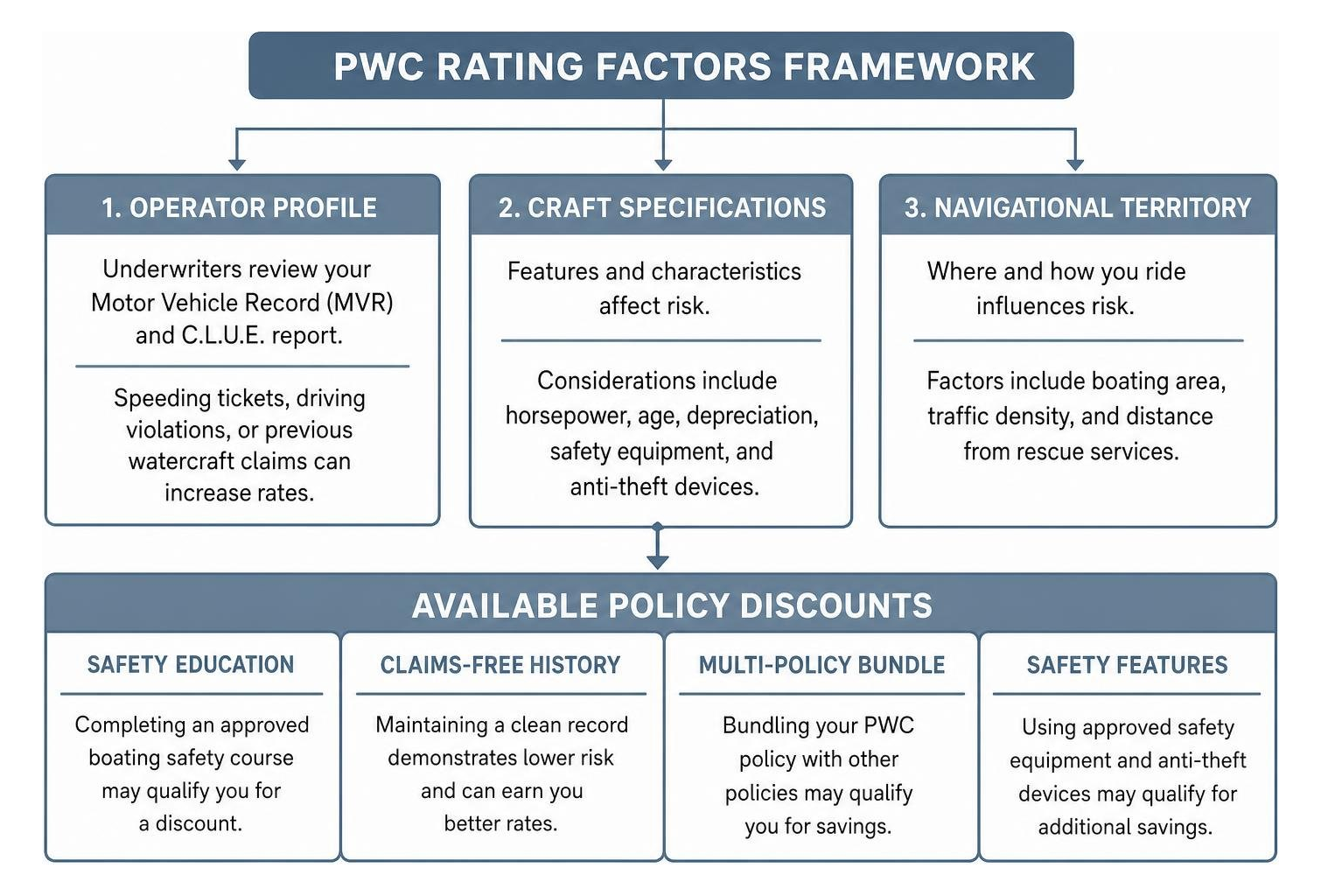
Underwriters evaluate three primary risk pillars when pricing your policy:
- Operator Profile: Carriers review your Motor Vehicle Record (MVR) and Comprehensive Loss Underwriting Exchange (C.L.U.E.) report. Speeding tickets in your car, driving violations, or previous watercraft claims will push rates upward.
- PWC Specifications: High-performance, supercharged watercraft boasting 300+ horsepower carry higher risk profiles than modest touring models. The craft’s hull design, engine displacement, top speed capabilities, and market value directly dictate physical damage rates.
- Navigational Territory: Where you operate your craft matters. Navigating calm inland lakes and rivers presents lower collision and salvage risks than coastal waters, tidal inlets, or busy navigational channels. Exploring Pennsylvania boat insurance quotes helps clarify how regional water choices impact overall rates.
Boater Safety Courses, Secure Storage, and Policy Bundles
You do not have to accept baseline pricing without exploring available discounts. We frequently help operators apply several effective credits:
- Boater Safety Education: Completing a state-approved boating safety course or a U.S. Coast Guard Boating Safety certified course can yield an immediate 10% to 15% discount on the liability portion of your premium.
- Secure Storage & Anti-Theft Measures: PWCs are primary targets for thieves due to their portability. Storing your craft in a locked garage during the season and using GPS tracking devices, hitch locks, or wheel boots reduces comprehensive premiums.
- Multi-Craft and Multi-Policy Bundles: Insuring multiple personal watercraft on a single policy earns multi-unit credits. Furthermore, bundling your watercraft with existing personal lines streamlines your billing and unlocks household tier discounts. You can connect with our team to identify which policy credits apply to your profile.
Step-by-Step: Securing an Accurate Personal Watercraft Insurance Quote
Rushing through an insurance application often results in rate adjustments later during underwriting or, worse, coverage denials after a loss. Following a structured quoting process ensures your policy performs exactly as expected.
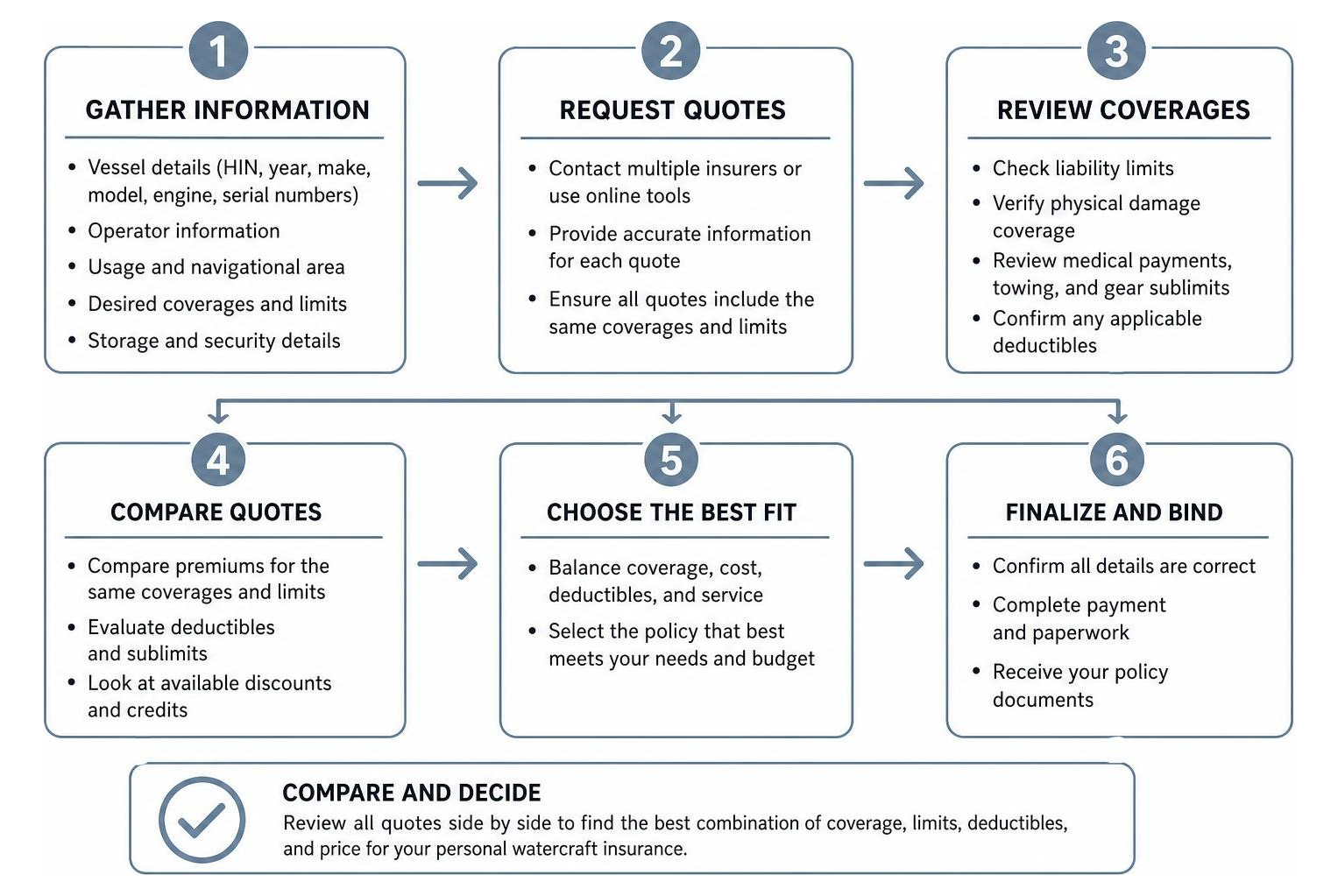
Essential Information Needed for an Accurate Personal Watercraft Insurance Quote
To generate a precise quote without mid-term adjustments, gather the following details before you begin:
- Vessel Details: The 12-character Hull Identification Number (HIN), year, make, model, engine displacement (cc or horsepower), and serial numbers.
- Valuation Preference: Invoices for recent purchases, documentation of aftermarket modifications, and your selection between Agreed Value and ACV.
- Operator Info: Full legal names, dates of birth, driver’s license numbers, and boater safety certificate IDs for all intended operators in your household.
- Operating and Storage Locations: The primary zip code where the craft is docked or stored, storage type (garage, marina slip, outdoor driveway), and primary bodies of water navigated.
- Lienholder Information: Name and address of your financing bank or leasing company, including any mandatory minimum liability requirements.
Comparing Every Personal Watercraft Insurance Quote Apples-to-Apples
A lower premium quote may simply reflect lower coverage limits, omitted endorsements, or a massive deductible. To conduct a meaningful comparison, use a structured evaluation method. Utilizing a compare insurance quotes complete guide helps ensure you align every variable across potential policies:
- Match the Liability Limits: Ensure both quotes offer identical Combined Single Limits (e.g., $500,000) or identical split bodily injury/property damage structures.
- Standardize the Deductible: Ensure you are not comparing a $250 deductible on one quote against a $1,000 deductible on another. Watch for separate, higher deductibles specifically for theft or named storms.
- Check Towing and Emergency Service: Confirm whether on-water assistance is included or omitted.
- Review Exclusions: Check whether tow sports (tubing, wakeboarding) are included or barred under the policy terms, especially if you plan to pull family and friends.
Navigating Legal Requirements, Homeowners Limits, and Trailer Coverage
Many PWC owners operate under dangerous misconceptions regarding legal mandates and existing insurance coverage. Relying on an auto or home policy to cover a jet ski often leaves significant financial exposure.

State Mandates, Marina Contracts, and Homeowners Exclusions
While some state laws do not legally require standalone watercraft liability insurance on all public waters, operating without coverage is a massive gamble. To understand local regulations, review whether do you need boat insurance in PA based on waterway jurisdictions, state park launch permits, and licensing mandates.
Furthermore, private entities step in where state laws leave off:
- Marinas and Yacht Clubs: Most commercial marinas require proof of at least $300,000 to $500,000 in liability insurance before allowing you to use a slip, dry dock, or private launch ramp.
- Lienholders: If you financed your WaveRunner, your lender will mandate full physical damage coverage (comprehensive and collision) to protect their collateral.
- Homeowners Limitations: A standard homeowners policy provides very little help. Most home policies strictly limit watercraft property coverage to $1,000–$1,500 and exclude liability coverage entirely for inboard or water-jet craft exceeding 50 total horsepower.
Coordinating Auto vs. PWC Endorsements for Trailer Protection
Transporting your PWC to and from the boat ramp introduces unique road risks. You must coordinate your auto and watercraft policies to ensure seamless protection:
- Trailer Liability: When your trailer is hitched to your vehicle, your personal auto insurance liability extends to cover third-party damage if the trailer strikes another vehicle on the highway.
- Trailer Physical Damage: Your auto policy will not automatically repair physical damage to the trailer itself if it fishtails, flips, or gets stolen from a launch parking lot. You must schedule the trailer on your personal watercraft policy, selecting comprehensive and collision hull-and-trailer limits with an appropriate deductible.
Frequently Asked Questions About PWC Insurance
Does a standard boat insurance policy automatically cover a personal watercraft?
Generally, no. Marine insurers classify personal watercraft under distinct underwriting categories due to their jet propulsion, rapid acceleration, and high maneuverability. While some multi-vessel boat policies allow you to add a PWC via a specific endorsement, the craft must still undergo specialized PWC underwriting. A standalone PWC policy is usually preferred because it includes provisions tailored to jet-pump debris ingestion, passenger liability, and specialized watersports.
How do high-risk tow sports impact personal watercraft coverage limits?
Towing water-skiers, wakeboarders, or tubers significantly elevates your liability risk. If a passenger on a towable tube is swung into a dock or another vessel, the craft operator is held legally responsible. Most modern PWC policies permit recreational tow sports, but you must verify that your contract does not contain a watersports liability exclusion. When engaging in tow sports, we strongly recommend increasing your liability limit to at least $500,000 CSL and carrying higher medical payments limits ($5,000 to $10,000) to cover guest rider injuries.
What physical damage deductible should I choose for my Jet Ski or WaveRunner?
Your physical damage deductible should reflect your available cash reserves. Standard deductibles range from $250 to $1,000:
- $250 to $500 Deductible: Best for riders who prefer minimal out-of-pocket expenses following a mishap and do not mind paying a slightly higher annual premium.
- $1,000 Deductible: Ideal for experienced owners who maintain an accessible emergency fund. Choosing a $1,000 deductible can reduce your physical damage premium by 10% to 20%, generating meaningful long-term savings if you maintain a clean, loss-free operating record.
Conclusion: Maximize Protection and Ride with Confidence
Securing the right personal watercraft coverage allows you to enjoy every hour on the water knowing your assets, your passengers, and your vessel are protected. By prioritizing appropriate liability limits, choosing the right hull valuation method, and actively capturing safety discounts, you can build a policy that provides complete peace of mind without overpaying.
At Newtown Insurance, we specialize in providing clear, customer-first guidance to help you navigate marine insurance options. Whether you are launching a brand-new WaveRunner or insuring a family fleet of Sea-Doos, our team will help you review, customize, and finalize a policy tailored to your unique riding habits.
To explore customized coverage options and get transparent pricing tailored to your needs, explore our watercraft coverage and personal advisory services today.