Essential Car Insurance Savings Tips for Every Driver
With overall auto insurance premiums climbing past $2,600 per year for the average American driver, taking control of your policy structure is the most reliable way to slow the bleeding. Rate variations between carriers are staggering—a single driver can receive quotes that differ by more than $600 annually for identical coverage.
By strategically evaluating shopping habits, deductible thresholds, and physical damage coverage, you can lower costs without exposing your personal finances to severe risk.
| Deductible Change | Estimated Premium Savings | Out-of-Pocket Risk Increase |
|---|---|---|
| $250 to $500 | 15% – 25% | $250 per claim |
| $500 to $1,000 | 20% – 28% | $500 per claim |
| $1,000 to $2,000+ | 10% – 15% additional | $1,000+ per claim |
Shopping Around and Comparison Shopping
If you have been with the same auto insurance company for years, you might be paying a loyalty penalty. Many insurance carriers use an analytical strategy known as “price optimization,” where rates are quietly bumped up for long-term policyholders who are statistically unlikely to shop around.
Re-shopping your policy annually—ideally 30 days before your renewal date—is the single fastest way to lower your annual bill. Policyholders who re-shop their coverage save an average of $694 a year. Across larger surveys, drivers who switched carriers achieved median annual savings of $461.
When shopping, make sure you compare apples to apples. Always request verified quotes rather than relying on rough online estimates. A verified quote checks your actual motor vehicle record and claims history upfront, ensuring you aren’t surprised by price hikes on your first official statement. Working with an independent agent allows you to compare multiple top-rated insurers simultaneously while using a complete Auto Insurance Savings Complete Guide to steer your decisions.
Actionable Car Insurance Savings Tips for Deductibles and Coverage
Adjusting your comprehensive and collision deductibles is an immediate leverage point for lower monthly premiums. Going from a $250 deductible to $500 can trim collision and comprehensive costs by up to 25%, while bumping your deductible from $500 to $1,000 can shave off an additional 28%.
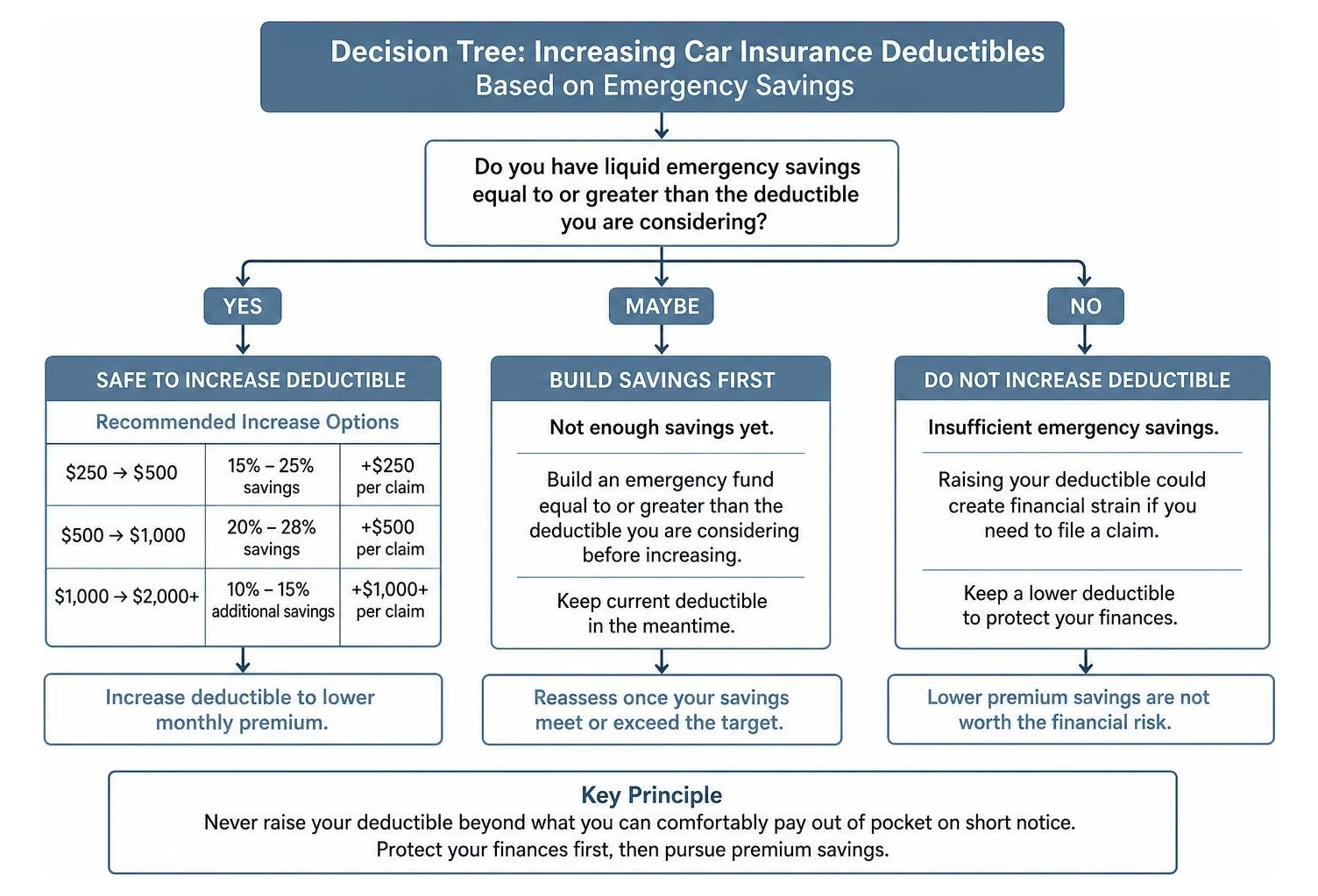
Before making this change, run a basic break-even analysis:
- If moving from a $500 to a $1,000 deductible saves you $200 a year, it will take 2.5 claim-free years to break even on the additional $500 out-of-pocket risk.
- Never raise your deductible beyond what you can comfortably pay out of pocket on short notice. If a $1,000 repair bill would force you into high-interest credit card debt, stick with a lower deductible until you build a dedicated emergency fund. You can review official consumer guidance from the Tips for Saving on your Auto Insurance – NAIC to balance out-of-pocket risk against premium costs.
When to Drop Comprehensive and Collision Insurance
Comprehensive insurance covers non-collision damage (such as theft, vandalism, weather events, or striking an animal), while collision pays to repair your car after a crash. If your vehicle is older and fully paid off, maintaining full coverage may cost more than the car is worth.
A helpful rule of thumb is the 10% Rule: if the annual combined cost of collision and comprehensive coverage exceeds 10% of your vehicle’s Actual Cash Value (ACV), consider dropping physical damage coverage. Dropping collision and comprehensive insurance can save about $1,165 a year on average.
For example, if your older sedan is worth $3,000 and the physical damage portion of your policy costs $450 per year with a $1,000 deductible, the maximum net payout you could ever receive after a total loss is $2,000. Paying $450 annually to protect a potential $2,000 payout rarely makes financial sense. Instead, redirect those savings into a savings account to fund your next vehicle purchase. You can explore more strategies in our article on Money Saving Car Insurance.
Maximize Discounts and Policy Stacking

Insurance carriers offer dozens of built-in savings opportunities, but they rarely apply them automatically. To get the best possible price, you need to conduct a proactive discount audit with your provider and stack every reduction you qualify for.
Unlocking High-Value Discounts and Bundling
Bundling your car insurance with a homeowners or renters policy under the same carrier is one of the highest-yield discounts available, often delivering total savings of up to 25% or 30%. Beyond policy bundling, ensure you are claiming every individual discount applicable to your household:
- Multi-Car Discounts: Insuring two or more vehicles on a single policy frequently lowers the rate for each car.
- Good Student Discounts: Full-time high school or college students who maintain a “B” average (3.0 GPA) or higher can earn 10% to 25% off their coverage.
- Defensive Driving Courses: Completing a state-approved driving course can grant a 10% to 15% discount, especially for mature drivers.
- Billing & Administrative Credits: Enrolling in automatic payments, opting for paperless statements, or paying your annual or six-month premium upfront in a single lump sum can save up to 10% by eliminating monthly administrative installment fees.
For a comprehensive look at standard discounts you might be missing, read our breakdown of 6 Car Insurance Discounts You Should Ask About.
Modern Telematics and Usage-Based Programs
Usage-Based Insurance (UBI) programs track your actual driving habits using a smartphone app or plug-in OBD device. These telematics applications evaluate speed, hard braking, rapid acceleration, cornering, time of day, and total mileage logged.
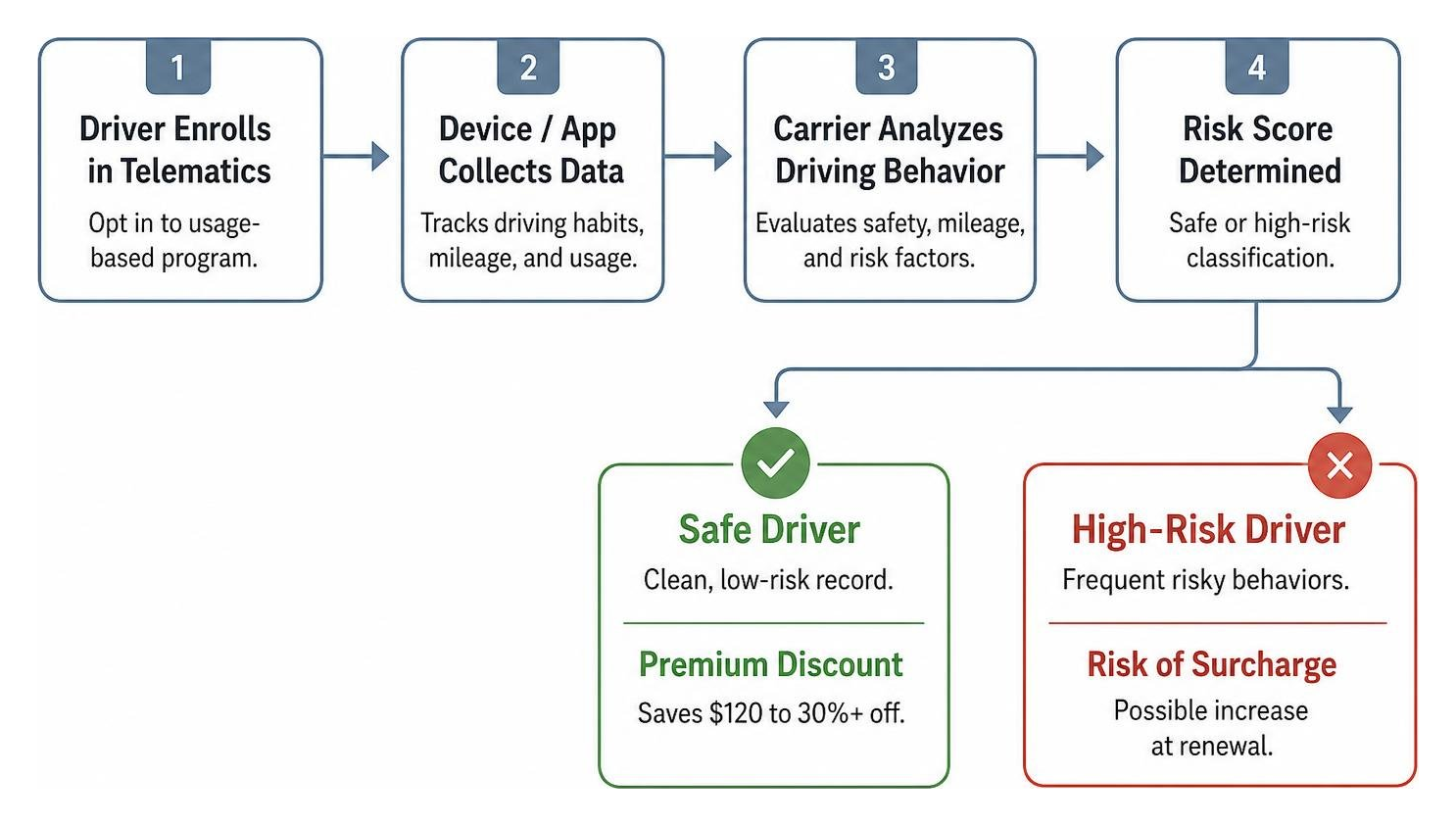
While insurers advertise maximum savings up to 30% or 40%, real-world data from policyholder surveys reveals a median annual savings of $120 for signing up for driver monitoring. Low-mileage drivers who log under 7,500 miles a year can achieve even higher percentage discounts by switching to pay-per-mile structures.
However, consider the privacy trade-offs before enrolling. Telematics software requires continuous location and driving telemetry collection. Furthermore, while most programs only offer discounts, some carriers reserve the right to increase your rates upon renewal if the app detects frequent late-night driving or sudden braking. For more details on safe driving incentives, check out our guide on Safe Driver Insurance Discounts.
Managing Personal Factors and Life Events
Your auto insurance premium is an active, evolving calculation influenced by your lifestyle, address, credit history, and milestone events. Managing these personal rating factors directly helps lower your ongoing car expenses.
Credit Score Impact and Credit-Based Insurance Scores
In most states, insurance companies rely heavily on credit-based insurance scores to predict claim frequency. Actuarial data shows that drivers with lower credit scores file claims more frequently, leading insurers to charge them significantly higher rates. On average, drivers with poor or no credit pay 67% to 98% more for auto insurance compared to drivers with excellent credit, and those with very poor credit scores can pay over two times as much for full coverage.
To improve your credit-based insurance score quickly:
- Keep revolving credit card balances below 30% of your total limits.
- Set up automated payments to ensure a 100% on-time payment history.
- Audit your credit reports for inaccurate negative marks and dispute errors immediately.
Using credit to determine auto insurance rates is legally prohibited or restricted in California, Hawaii, Massachusetts, and Michigan.
Major Life Change Car Insurance Savings Tips
Key life milestones offer prime opportunities to re-evaluate your insurance structure and lower costs:
- Marriage: Married drivers statistically get into fewer accidents than single drivers, resulting in premium reductions of up to 10% to 12% after updating policy details.
- Relocation: Moving to a new zip code—even just a few miles away—can alter your rates due to varying local traffic density, theft statistics, and garage parking options.
- Remote Work or Job Changes: If your commute shortens or you switch to a work-from-home schedule, notify your insurer right away to reclassify your vehicle usage from “commute” to “pleasure” and log lower annual mileage.
- Adding Teen Drivers: Adding a 16- or 17-year-old driver can cause a policy to double or triple, adding $1,000 to $3,000 per year. Mitigate this bump by assigning the teen driver to the oldest, safest vehicle on the policy, securing good student discounts, and having them complete driver safety education.
For state-specific strategies to manage these rating shifts, review our Cheap Auto Insurance Pennsylvania Tips 2026.
Smart Savings Strategies for Seniors Over 70
Car insurance rates tend to start creeping upward again once drivers enter their 70s due to higher risk statistics for bodily injury in accidents. Senior drivers can offset these rate hikes by taking targeted action:
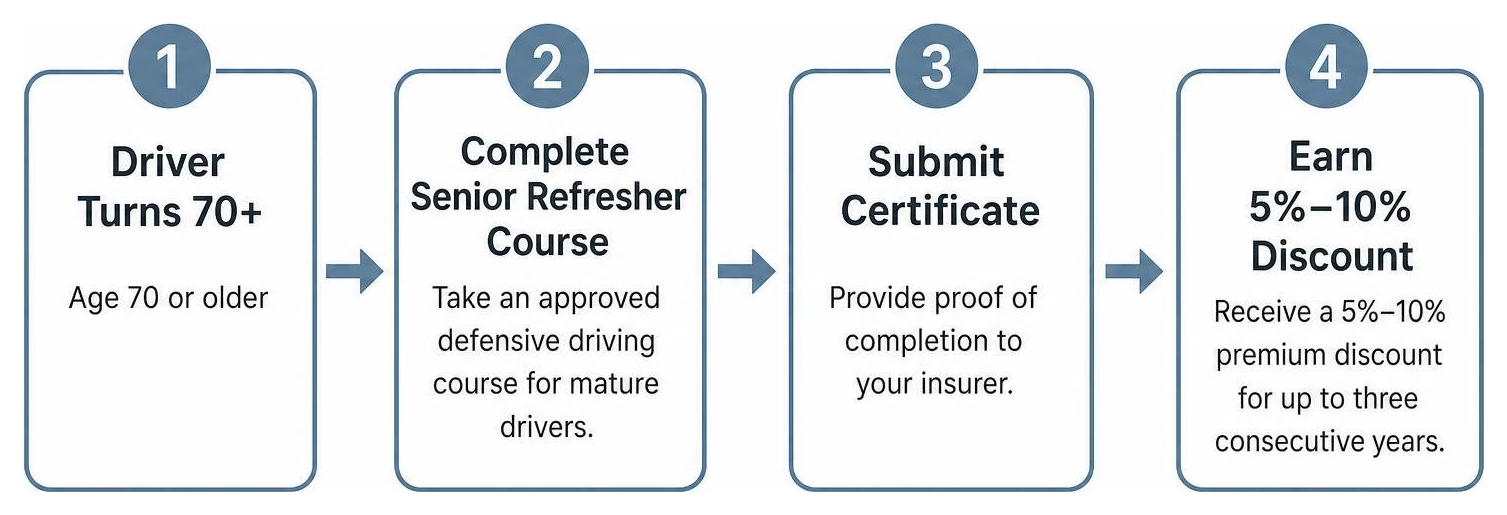
- Defensive Driving Refreshers: Completing an approved mature driver safety course unlocks state-mandated discounts of 5% to 10% for three consecutive years in many jurisdictions.
- Report Reduced Driving: Retired drivers who no longer commute should make sure their annual mileage is adjusted down to reflect actual leisure driving habits.
- Re-Shop the Market: Different insurance carriers weight age factors uniquely. Re-shopping your coverage after turning 70 can surface carriers that offer lower base rates for older adults.
Structuring Adequate Liability and Umbrella Coverage
While finding car insurance savings tips is important, trimming your liability limits down to legal state minimums is a dangerous move. Skimping on liability leaves your personal bank accounts, home equity, and future earnings exposed to severe legal claims if you cause an accident.
Determining Sufficient Liability Insurance Limits
State minimum liability mandates are woefully inadequate for serious collisions. In Pennsylvania, for example, minimum financial responsibility requirements only mandate $15,000 per person and $30,000 per accident for bodily injury, along with $5,000 for property damage (15/30/5). Considering the average cost of a modern vehicle is around $48,000 and emergency room visits easily surpass five figures, a minor accident can quickly exceed state minimums.
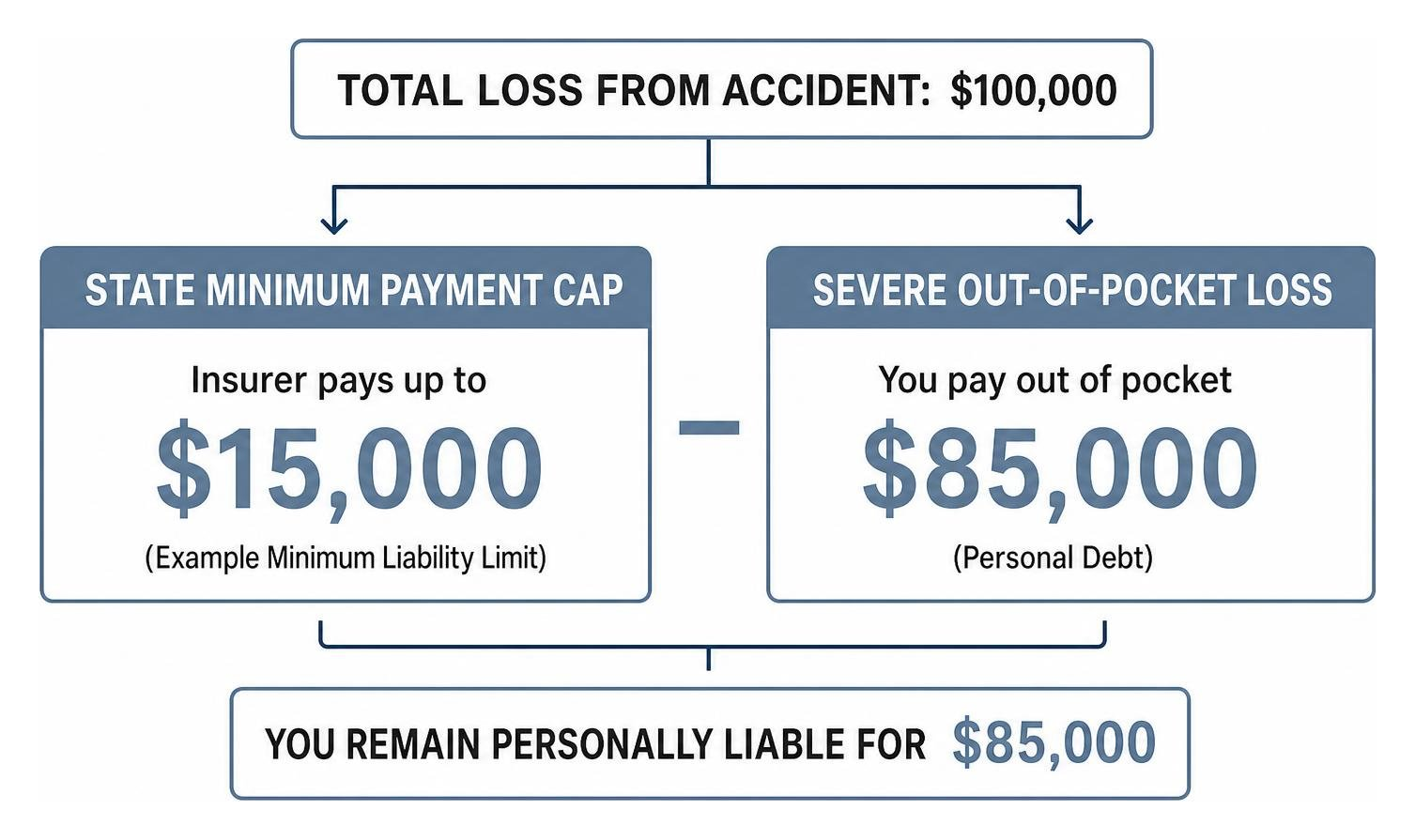
If you cause $100,000 in physical damage and medical care while carrying minimum coverage, you remain personally liable for the remaining $85,000 balance. Insurance experts strongly recommend maintaining liability limits of at least 100/300/100:
- $100,000 Bodily Injury per Person
- $300,000 Bodily Injury per Accident Total
- $100,000 Property Damage
Review official regulations via the Auto Insurance – Commonwealth of Pennsylvania resource to ensure your liability limits meet proper legal standards.
Protecting Assets with Personal Umbrella Insurance
If you own a home, have significant retirement savings, or earn a high income, medical judgements from a major car crash can threaten your financial security. A Personal Umbrella Policy provides extra liability protection on top of your primary auto and homeowners coverage.
An umbrella policy kicks in once your underlying auto liability limits (typically requiring $250,000/$500,000 bodily injury limits) are exhausted. A $1 million umbrella policy usually costs between $250 and $300 per year, making it one of the most cost-effective forms of asset defense available. Explore more ways to shield your financial future with our comprehensive list of Insurance Savings Tips.
Frequently Asked Questions About Car Insurance Savings
How much can I save on average by shopping around for car insurance?
Re-shopping your policy yields an average annual savings of $694, while drivers who switch carriers achieve a median savings of $461. Because every insurer weighs risk factors differently, the price difference between the highest and lowest quote for the same driver averages over $600 per year.
Will raising my deductible actually lower my premium right away?
Yes. Increasing your comprehensive and collision deductibles from $500 to $1,000 reduces physical damage premium costs by 20% to 28% immediately on your next statement. Just ensure you keep enough liquid savings on hand to cover the higher out-of-pocket amount if you need to file a claim.
Can telematics programs increase my insurance rates?
In most cases, telematics programs only apply discounts ranging from 5% to 30%. However, certain carriers do use driving telemetry to increase renewal rates or apply surcharges if the tracking app consistently detects dangerous habits, such as hard braking or late-night driving.
Conclusion
Finding car insurance savings tips isn’t about compromising your coverage—it’s about managing your policy details effectively. By shopping matching quotes annually, stacking policy discounts, adjusting deductibles, and keeping liability limits high enough to protect your assets, you can keep your monthly expenses low while staying protected on the road.
At Newtown Insurance, our team works closely with drivers throughout Pennsylvania to deliver custom auto policies, clear pricing, and reliable service. We compare rates across multiple leading carriers so you get the exact protection you need without overpaying. Contact Newtown Insurance today to complete an annual policy audit and see how much you can save on auto insurance.