Find the Best Auto and Home Insurance Bundle for Your Budget
The best insurance companies to bundle auto and home are often those that give you the lowest total annual cost with the home, auto, deductible, and claims support you need, rather than simply the carrier with the biggest advertised discount.
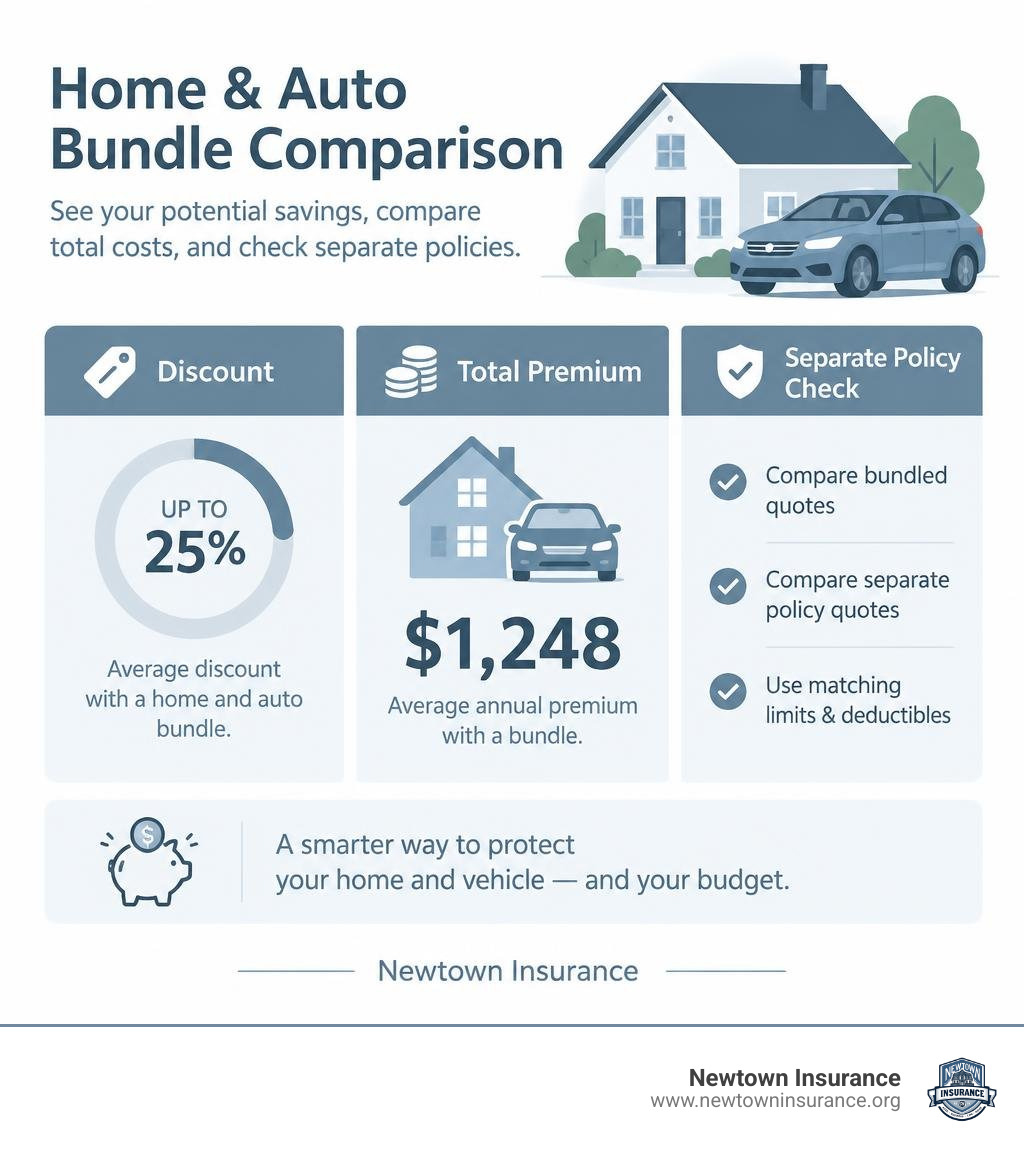
Bundling saves drivers an average of $542 per year, according to MoneyGeek’s 2026 analysis. Still, prices can change sharply by Pennsylvania ZIP code, driving record, home location, credit-based insurance score where permitted, and the coverage you select.
Auto premiums rose 18% from January 2025 to January 2026, while homeowners insurance costs have also climbed in recent years. That makes a quick bundle comparison worthwhile. Get bundled quotes and separate-policy quotes using matching limits and deductibles before assuming one insurer is cheaper.
I am Shawn Beihl of Newtown Insurance, with more than 15 years of experience in specialty insurance, commercial P&C, benefits, disability, and risk management. I help clients evaluate the best insurance companies to bundle auto and home by looking beyond a headline discount to find coverage that can protect their budget over time.
Learn more about best insurance companies to bundle auto and home:
How Bundling Auto and Home Insurance Generates Savings

At its core, bundling—also referred to as a multi-policy discount—is an arrangement where you purchase two or more lines of coverage from a single insurance provider. In exchange for consolidating your accounts, the carrier applies a percentage reduction across your premiums.
The underlying economics are straightforward: insurers spend considerable resources marketing to new policyholders. When you combine your vehicle and property protection under one roof, the carrier secures a higher customer lifetime value and experiences lower administrative overhead. They pass a portion of those operational savings directly back to you.
Industry data confirms the tangible impact of these arrangements. Examining real savings data on home and auto bundles shows that households can reduce their overall insurance costs substantially, with national averages putting annual savings between $542 and $646 per year.
However, evaluating these savings requires a holistic view. When comparing auto and home bundle policies, policyholders often discover that baseline rates matter far more than percentage discounts. With auto premiums jumping 18% between January 2025 and January 2026 and homeowners rates rising 24% from 2021 to 2024, maintaining strong coverage retention through paired policies helps stabilize household budgets against ongoing premium inflation.
Multi-Policy Discounts vs. Multi-Car Reductions
A frequent point of confusion among policyholders is the difference between a multi-car discount and a multi-policy bundle. While both reduce your out-of-pocket costs, they apply to different areas of your portfolio:
- Multi-Car Discount: Applied exclusively to your vehicle policy when you insure two or more automobiles with the same carrier.
- Multi-Policy Bundle: Applied across different lines of insurance (such as pairing private passenger auto with homeowners, condo, or renters coverage).
These discounts are not mutually exclusive—they stack. If you own two vehicles and bundle them alongside your home, a carrier will first apply the multi-car discount to your auto premium, followed by the multi-policy reduction. In our comprehensive auto insurance guide, we highlight how layering policy credits alongside telematics participation can produce combined auto premium savings approaching 40% to 45%.
Single Deductibles and Combined Billing Perks
Beyond headline price cuts, bundling introduces operational conveniences that simplify risk management. Consolidating your coverage onto a single billing schedule eliminates the hassle of tracking disparate due dates, multiple account portals, and varying renewal cycles.
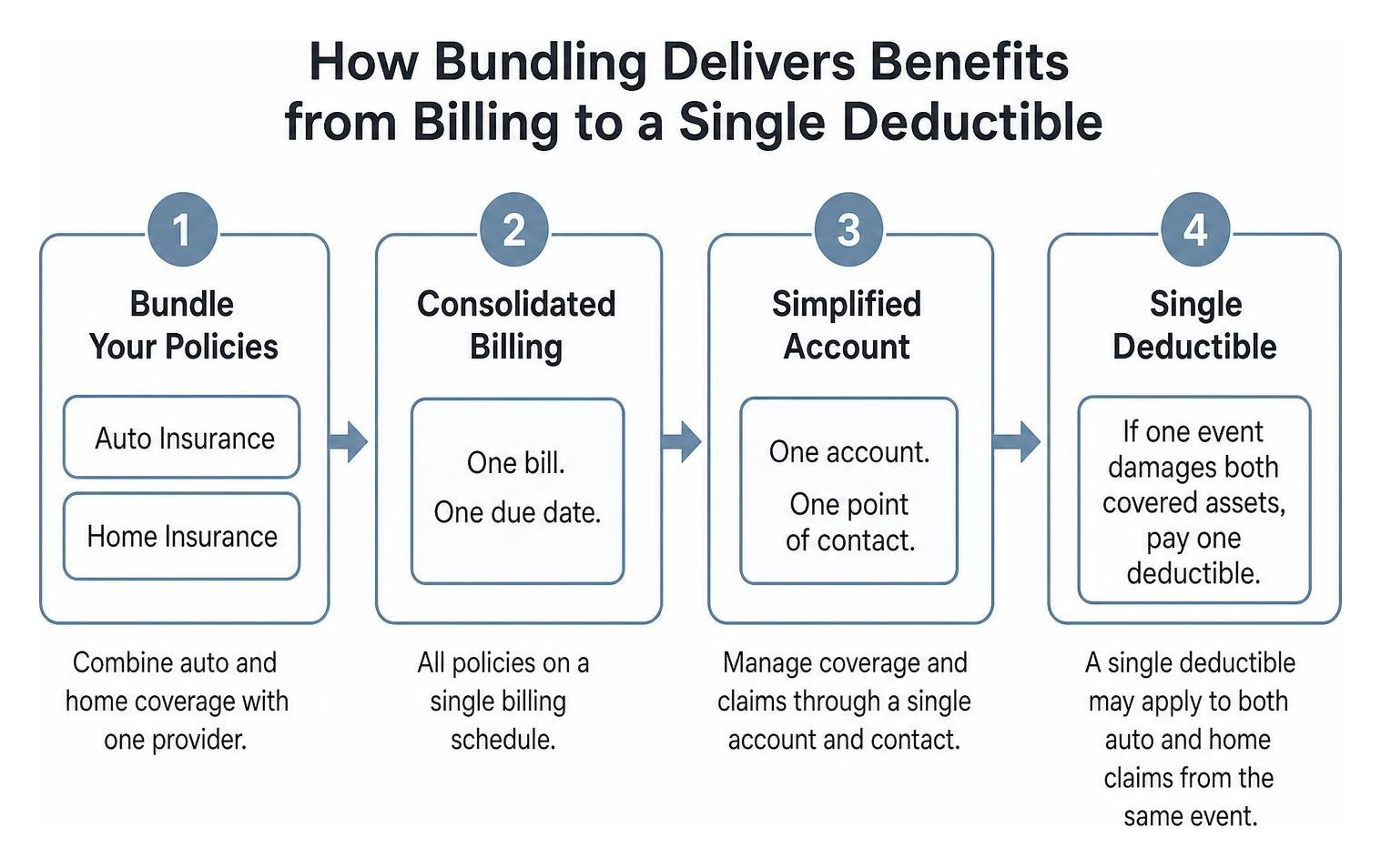
One valuable yet frequently overlooked feature is the single-deductible waiver. If a single catastrophic event damages multiple covered assets simultaneously—such as a severe storm causing a tree limb to crush your garage roof and the vehicle parked inside—a bundled carrier may require you to pay only one deductible rather than separate deductibles for both your home and auto policies.
These administrative perks extend further when combining car, motorcycle, and home policies, giving you a unified claims protocol and a single point of contact when disaster strikes.
Comparing the Best Insurance Companies to Bundle Auto and Home
To understand how individual carriers stack up, we must examine real-world premium data alongside advertised discount percentages. The table below illustrates national benchmarks and cost relationships across major carrier profiles:
| Carrier Profile | Average Advertised Bundle Discount | Average Combined Annual Premium | Average Annual Dollar Savings | Customer Satisfaction (Insure.com) | Claims Handling Satisfaction |
|---|---|---|---|---|---|
| National Multi-Line Leader | ~25% | $2,559 – $4,165* | $847 | High | High |
| Standard Nationwide Carrier | ~18% | $3,643 | $777 | 76% | 73% |
| Captive Agent Network | ~16% | $3,886 | $732 | 79% | 85% |
| Mutual High-Service Insurer | Up to 30%** | $5,142* | $735 | Industry-Leading | Industry-Leading |
| Regional Independent Carrier | ~11% | $5,285 | $580 | Moderate | Moderate |
| Direct Auto Specialist | ~6% | $3,380 | $223 | Moderate | Moderate |
| Military Affinity Provider | ~11% – 15% | $3,240* | $411 | Industry-Leading | Industry-Leading |
*Regional baseline rates vary; data reflects market study benchmarks including Pennsylvania and Northeast regional models.
**Multi-line discounts can reach up to 30% when bundling auto with home, umbrella, and life policies.
A deeper look reveals notable disparities. A national evaluation of home and auto bundles illustrates that the gap between the highest bundle discount ($847) and the lowest ($223) is larger than the total annual bundle savings offered by several other carriers. Furthermore, a carrier with a modest discount percentage might still deliver a lower total price if its baseline premiums are fundamentally competitive.
When evaluating the best insurance bundle options, look past promotional percentages to calculate the bottom-line figure you will pay each year.
What to Look for in the Best Insurance Companies to Bundle Auto and Home
Selecting the right carrier requires balancing price with comprehensive protection. When reviewing candidate insurers, evaluate the following criteria:
- Dwelling Replacement Precision: Ensure the home policy reflects accurate reconstruction costs, extended replacement cost endorsements, and realistic personal property limits.
- Auto Liability Thresholds: Avoid compromising on auto liability limits (such as dropping from 250/500/250 to state minimums) merely to make a bundled price look attractive.
- Endorsement Availability: Check for specialized endorsements such as water backup, service line protection, matching siding coverage, and gap insurance for vehicles.
- Baseline Pricing Balance: A carrier with aggressive auto rates but inflated homeowners rates can erase your savings entirely.
Before committing, consult a comparing insurance quotes complete guide to confirm that each policy line meets your baseline requirements independently.
Claims Satisfaction and Rate Stability Among the Best Insurance Companies to Bundle Auto and Home
A competitive premium means little if the insurer fails you during a loss. When comparing carriers, assess financial stability through AM Best ratings (aiming for A- or higher) and consumer satisfaction metrics via the National Association of Insurance Commissioners (NAIC) Complaint Index.
Customer service and claims fulfillment vary notably across top providers. For example, in head-to-head research, some major insurers earn an 85% claims handling satisfaction score compared to others at 73%, despite the lower-scoring carriers occasionally offering slightly lower average bundled premiums ($3,643 vs. $3,886).
Equally important is post-claim rate stability. Some carriers aggressively hike baseline rates or strip bundling discounts following a single minor loss, while others maintain predictable pricing structures over decades of coverage.
When Bundling Does Not Save Money and How to Audit Your Policies

Despite widespread marketing claims, bundling is not universally the cheapest option. In fact, purchasing separate standalone policies from two different carriers frequently outperforms a bundled quote.
This unbundled advantage typically occurs under three specific conditions:
- The Asymmetrical Carrier: A carrier may offer ultra-low auto rates but maintain uncompetitive property underwriting formulas, causing the expensive home policy to overwhelm the multi-policy auto discount.
- High-Risk Portfolios: If one line carries high risk (e.g., a driver with multiple moving violations or an older home with an aging roof), specialty standalone carriers often provide better tailored pricing than a standard multi-line carrier.
- Specialty Property Needs: Properties requiring specific endorsements, historic home protections, or unique detached structure coverages may face inflated rates from generic multi-line carriers.
For example, real-world rate testing shows that pairing a competitive standalone auto policy ($1,516) with an independent home insurer ($1,708) yields a combined annual premium of $3,224—beating a single-carrier combined bundle by $156 annually. Reviewing our guide to obtaining 2026 insurance quotes can help you identify these cross-carrier opportunities.
Step-by-Step 20-Minute Policy Audit
To determine whether your current bundle is serving your wallet or draining it, execute this simple four-step audit:
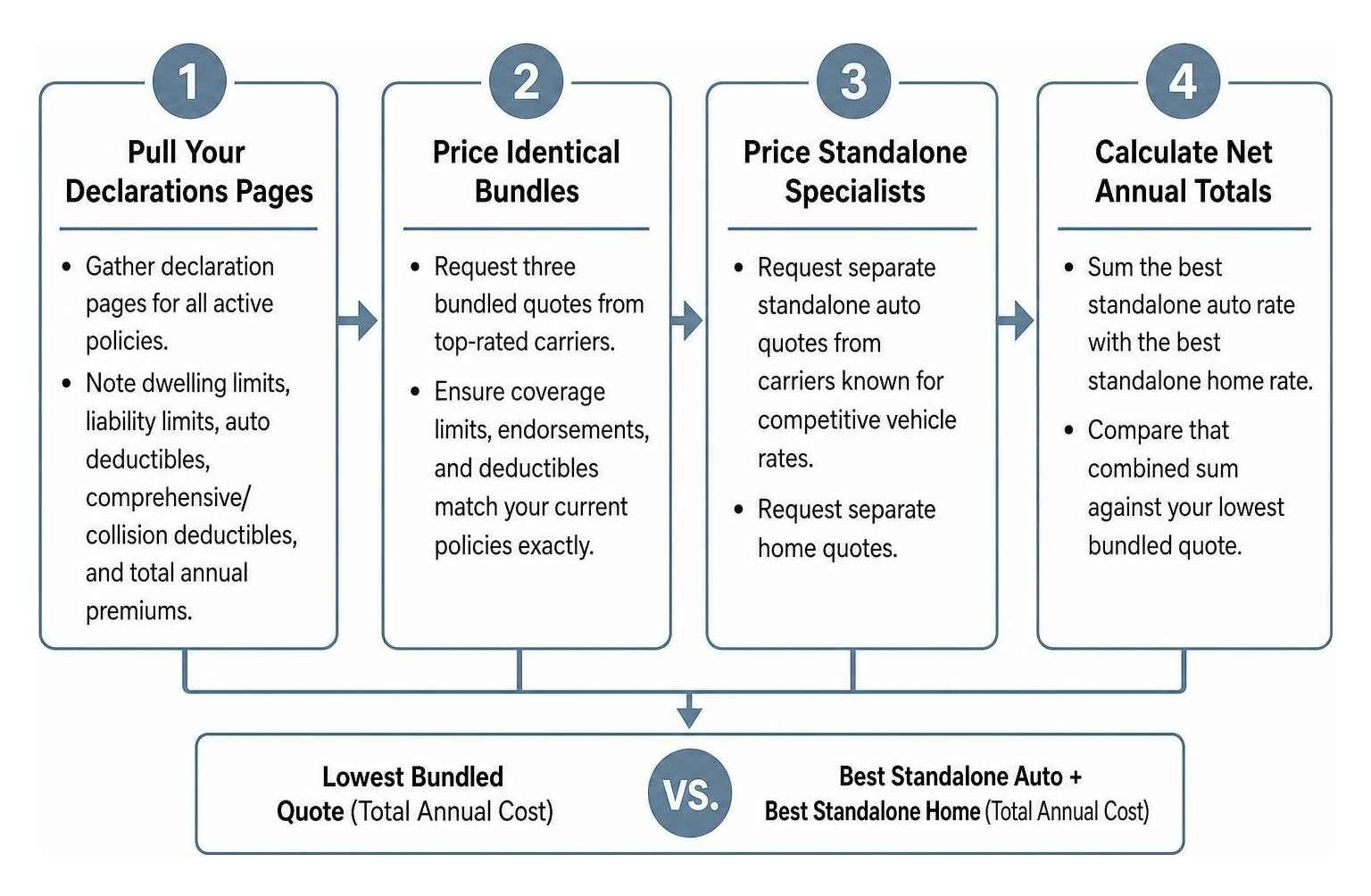
- Pull Your Declarations Pages: Gather the declaration pages for all active policies. Note your current dwelling limits, liability limits, auto deductibles, comprehensive/collision deductibles, and total annual premiums.
- Price Identical Bundles: Request three bundled quotes from top-rated carriers ensuring coverage limits, endorsements, and deductibles match your current policies exactly.
- Price Standalone Specialists: Request separate standalone auto quotes from carriers known for competitive vehicle rates, and separate home quotes using our accurate home insurance quotes guide.
- Calculate Net Annual Totals: Sum the best standalone auto rate with the best standalone home rate. Compare that combined sum against your lowest bundled quote.
If the standalone combination is cheaper by 10% or more, splitting your coverage across two carriers is often the smart financial choice.
Regional Factors and State-Specific Rate Variations
Insurance pricing is fundamentally local. Underwriting formulas, severe weather trends, and municipal claim frequencies create vast price swings from one community to the next.
In Pennsylvania, rate variations between urban centers and suburban communities like Newtown can alter bundle savings by hundreds of dollars. For instance, while some regional programs average up to a 25% multi-policy discount, localized underwriting guidelines dictate how that discount reflects on your final invoice. Reviewing our Pennsylvania home insurance guide will help you understand how local weather, freeze-thaw cycles, and territorial risk codes impact your combined premium.
Frequently Asked Questions About Home and Auto Bundles
How much can you actually save by bundling auto and home coverage?
On average, bundling home and auto insurance saves policyholders between $542 and $646 per year nationwide. However, dollar savings vary significantly depending on the carrier, your location, and your base premiums. Some major multi-line carriers offer average annual bundle savings of approximately $847 (a 25% discount), while others average closer to $223 (a 6% discount). Total dollar savings are always dictated by the carrier’s baseline rates rather than the advertised percentage alone.
Can you combine a multi-car discount with a multi-policy bundle?
Yes. Multi-car discounts and multi-policy bundles are distinct credits that stack together. When you insure multiple vehicles and your home with the same provider, the insurer applies the multi-car discount to the auto premium first, then layers the multi-policy bundle reduction across both the auto and property policies. This stacking can reduce auto premiums by up to 45% when combined with safe driver or telematics discounts.
Is it always cheaper to bundle home and auto insurance together?
No. Bundling does not guarantee the lowest total price. If a carrier has exceptionally high baseline rates on home insurance, even a 20% bundle discount may result in a higher combined cost than purchasing an affordable standalone auto policy from one insurer and a competitive home policy from another. Conducting an unbundled cost comparison ensures you never overpay for convenience.
Conclusion
Securing the right balance between cost savings and reliable protection requires looking beyond promotional discounts. While bundling auto and home insurance provides undeniable convenience, single-deductible advantages, and substantial savings for millions of households, the optimal choice depends entirely on your specific property, vehicle profile, and geographic location.
Carrying out an annual insurance audit is the most reliable way to ensure your coverage keeps pace with market changes and lifestyle transitions.
At Newtown Insurance, we specialize in providing Pennsylvania residents with transparent pricing, customized policy structures, and dedicated local support. Whether you want to optimize your existing multi-policy arrangement or compare unbundled alternatives, we are here to ensure you never overpay for quality protection.
Ready to find the ideal policy combination for your home and vehicles? Explore our comprehensive insurance solutions and connect with our team through our services and coverage portfolio today.