Key Changes in Health Insurance Pennsylvania 2026 Marketplace Rates
When state regulators reviewed filing requests for health insurance pennsylvania 2026 plans, the numbers were staggering. Initial requests from major carriers sought double-digit jumps, driven by a combination of rising clinical costs, increased prescription drug usage, and structural shifts in federal subsidy policies.
The Pennsylvania Insurance Department (PID) plays a vital regulatory role in evaluating rate filings to ensure they are actuarially justified and not excessively burdensome to consumers. During the 2026 rate review, PID regulators actively denied $50.1 million in unjustified requested rate hikes from insurance carriers. Despite these regulatory interventions, state officials ultimate approved an individual market average aggregate weighted rate increase of 21.5%, while the small group market saw an average rate increase of 12.7%.
You can read the full official press release via the Pennsylvania Insurance Department Releases Affordable Care Act 2026 Rates statement. For working families and self-employed individuals buying coverage through Pennie — Pennsylvania’s official state-based exchange — these increases represent real financial strain. To explore broader state insurance requirements, check out our Insurance Pennsylvania Complete Guide.
Why Costs Are Escalating for Health Insurance Pennsylvania 2026 Plans
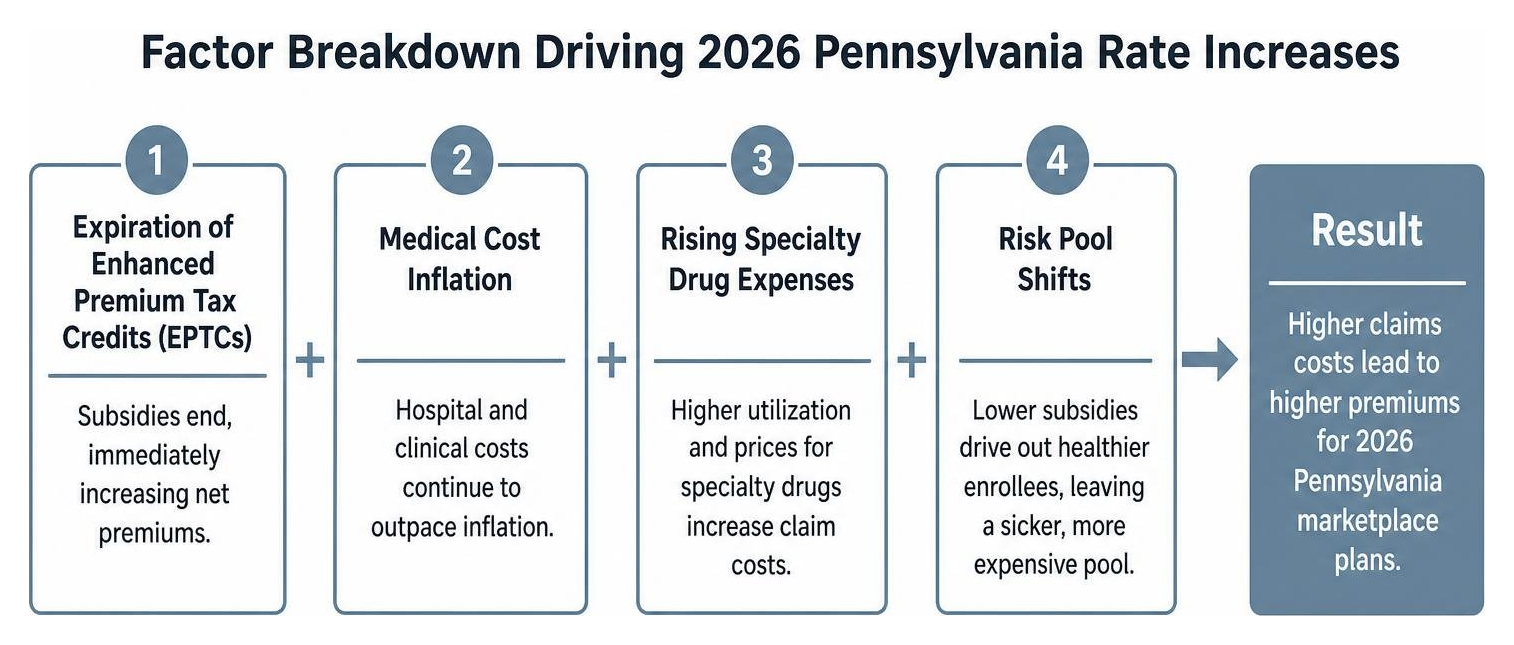
Understanding why monthly premiums skyrocketed for 2026 requires looking at a combination of national policy shifts and local healthcare utilization trends:
- Expiration of Enhanced Premium Tax Credits (EPTCs): Enacted originally during the COVID-19 pandemic and extended through 2025, federal enhanced subsidies lowered premium contributions significantly. Congress’s decision not to extend these enhanced tax credits created an immediate increase in net premiums for roughly 501,459 Pennsylvanians enrolled in private Marketplace plans.
- Medical Cost Inflation: The price of inpatient, outpatient, and specialty hospital care continued to outpace baseline consumer inflation throughout 2025 and into 2026.
- Rising Specialty Drug Expenses: Increased utilization and prices for GLP-1 weight-loss and diabetes drugs, advanced biologics, and gene therapies exerted heavy upward pressure on insurer medical loss ratios.
- Risk Pool Shifts: As net subsidies shrank, healthier enrollees dropped coverage or sought alternative options, leaving behind a sicker risk pool with higher average claims expenses.
Carrier Rate Approvals for Health Insurance Pennsylvania 2026
Rate changes varied widely among the 14 individual market insurance carriers operating across the Commonwealth. While some requested extreme increases, PID adjusted rates based on morbidity updates and financial solvency evaluations.
Below is a detailed breakdown of rate changes across key insurers offering coverage on the individual market for 2026:
| Insurer / Carrier Name | Requested Rate Change (%) | Approved Rate Change (%) |
|---|---|---|
| Ambetter Health of PA | +30.1% | +37.8% |
| Capital Advantage Assurance Company | +26.0% | +24.6% |
| Geisinger Health Plan | +14.1% | +11.6% |
| Highmark Inc. | +17.2% | +17.7% |
| Partners Insurance Company | -10.1% | -10.1% |
| UPMC Health Plan | +16.3% | +24.8% |
Notice that in a few cases, such as Ambetter and UPMC, the approved rate was actually higher than the requested rate due to updated federal morbidity factors and risk adjustments. Conversely, Partners Insurance Company was approved for a 10.1% rate reduction.
Navigating Pennie Subsidies and Tax Credit Adjustments
Pennie remains the exclusive online marketplace for Pennsylvania residents to qualify for and apply federal Premium Tax Credits (PTC) and Cost-Sharing Reductions (CSR). For a broad breakdown of PA marketplace mechanics, read the Pennsylvania Health Insurance Marketplace Guide.
Prior to 2026, enhanced subsidies capped individual premium contributions at 8.5% of household income regardless of how much money an enrollee made. With the expiration of those enhanced credits on December 31, 2025, the strict “subsidy cliff” returned.
For 2026, individuals earning over 400% of the Federal Poverty Level (FPL) — approximately $62,600 for an individual or $84,600 for a married couple — no longer qualify for any federal premium assistance.
Subsidy Eligibility and Cost-Sharing Reductions
Despite the expiration of enhanced subsidies, baseline ACA tax credits are still available through Pennie for low- to moderate-income residents:
- 80% of Pennie enrollees still qualified for baseline financial assistance in 2026, saving an average of $616 per month.
- 14% of consumers were able to secure plan coverage for less than $10 per month after basic subsidies.
- Cost-Sharing Reductions (CSRs): Enrollees with household incomes between 100% and 250% FPL who select a Silver-tier plan automatically receive extra savings that lower deductibles, copays, and out-of-pocket maximums. Approximately 23% of Pennie enrollees utilized Silver CSR plans for 2026.
To calculate customized plan options, refer to our comprehensive Health Insurance Quotes Guide 2026.
Federal Rules and Verification Changes
Alongside cost adjustments, federal statutory shifts under H.R. 1 of 2025 brought tighter compliance and verification measures to the health insurance pennsylvania 2026 market:
- Income Reporting Penalties: Mid-year income increases that go unreported now face elevated tax reconciliation penalties during annual filing.
- Document Verification: Pennie applicants must submit proof of household income, residency, and citizenship within strict 90-day response windows to maintain active subsidies.
- Path to Pennie Program: Uninsured Pennsylvanians can still indicate their uninsured status on state tax returns to trigger a 60-day special enrollment window. In previous years, over 900 residents successfully used this pathway to gain coverage.
- Reinsurance Program: Pennsylvania’s state-based reinsurance program continues to stabilize individual market risk by absorbing high-cost medical claims, which helped temper what would have been even higher baseline premium hikes for 2026.
Open Enrollment Windows and County Coverage Areas

Securing compliant health insurance requires staying mindful of strict open enrollment timelines. For coverage starting January 1, 2026, open enrollment runs from November 1 through December 15.
Details on annual kick-off events can be reviewed in Pennie’s 2026 Health Insurance Open Enrollment Starts Tomorrow.
Geographic Networks and Essential Health Benefits
When choosing plan coverage through Pennie or off-exchange, residents must reside within the specific county footprint served by the carrier. Full county availability can be verified at the official Coverage Areas Individual Market | Insurance Department | Commonwealth of Pennsylvania portal.
All individual and small-group ACA-compliant health insurance plans sold in Pennsylvania are legally mandated to guarantee coverage for 10 Essential Health Benefits without pre-existing condition exclusions:
- Ambulatory patient services (outpatient medical care)
- Emergency services and hospital care
- Hospitalization (inpatient surgical and medical care)
- Maternity and newborn care
- Mental health and substance use disorder services (including behavioral health treatment)
- Prescription drug coverage
- Rehabilitative and habilitative services and devices
- Laboratory services
- Preventive and wellness services (plus chronic disease management at zero cost-share)
- Pediatric services (including dental and vision care for children)
Alternatives for Missing Open Enrollment or High Costs
If you missed the annual open enrollment window or find current Pennie rates out of reach, there are strategic steps we can evaluate together:
- Qualifying Life Events (Special Enrollment Periods): You can enroll outside open enrollment if you experience events such as loss of job-based coverage, marriage, divorce, birth or adoption of a child, or a permanent move into Pennsylvania.
- Small Business and Group Coverage: Small business owners in Newtown and across PA can establish small group plans that offer tax advantages and stable rate structures.
- Evaluating Metal Tiers: Shifting from Gold or Silver down to Bronze can lower monthly premiums, provided your household maintains a health savings account (HSA) or liquid reserve for higher deductibles.
For additional actionable strategy tips, visit our guide on Insurance Savings Tips.
Frequently Asked Questions About Pennsylvania Health Insurance
What is the average health insurance premium increase in Pennsylvania for 2026?
The Pennsylvania Insurance Department approved an average weighted rate increase of 21.5% for the individual market and 12.7% for the small group market. These increases were driven primarily by the expiration of federal enhanced premium tax credits, medical inflation, and rising prescription drug costs.
When is the Open Enrollment period for 2026 coverage in PA?
Open Enrollment for 2026 health coverage in Pennsylvania begins on November 1 and ends on December 15. Coverage selected during this window becomes effective on January 1, 2026.
How did subsidy changes impact Pennsylvania enrollees in 2026?
The expiration of enhanced federal tax credits re-established the “subsidy cliff.” Individuals earning over $62,600 and families of four making over $128,600 lost tax credit eligibility entirely, leading to monthly premium jumps of several hundred dollars for mid-income households.
Conclusion: Finding Affordable PA Coverage
Navigating the 2026 Pennsylvania health insurance rate hikes can feel overwhelming, but you do not have to do it alone. At Newtown Insurance, based right here in Newtown, Pennsylvania, our team brings local expertise, transparent pricing, and personalized support to protect your family and budget.
Whether you need help selecting a plan through Pennie, exploring off-marketplace choices, or structuring business benefits, we are here to ensure you never overpay for high-quality coverage.
Contact our experts today to Get Tailored Insurance Solutions in PA and secure the right protection for 2026.