Why So Many Pennsylvanians Are Rethinking Their Medicare Coverage Right Now

If you’re trying to make sense of Medigap plans in PA, here’s the short answer:
Medigap (Medicare Supplement) plans are private insurance policies that cover the out-of-pocket costs Original Medicare leaves behind — things like deductibles, copays, and coinsurance. In Pennsylvania, you can choose from up to 10 standardized plan letters (A, B, C, D, F, G, K, L, M, and N). For most new enrollees in 2026, Plan G offers the most comprehensive coverage, and Plan N is the top pick for lower monthly premiums.
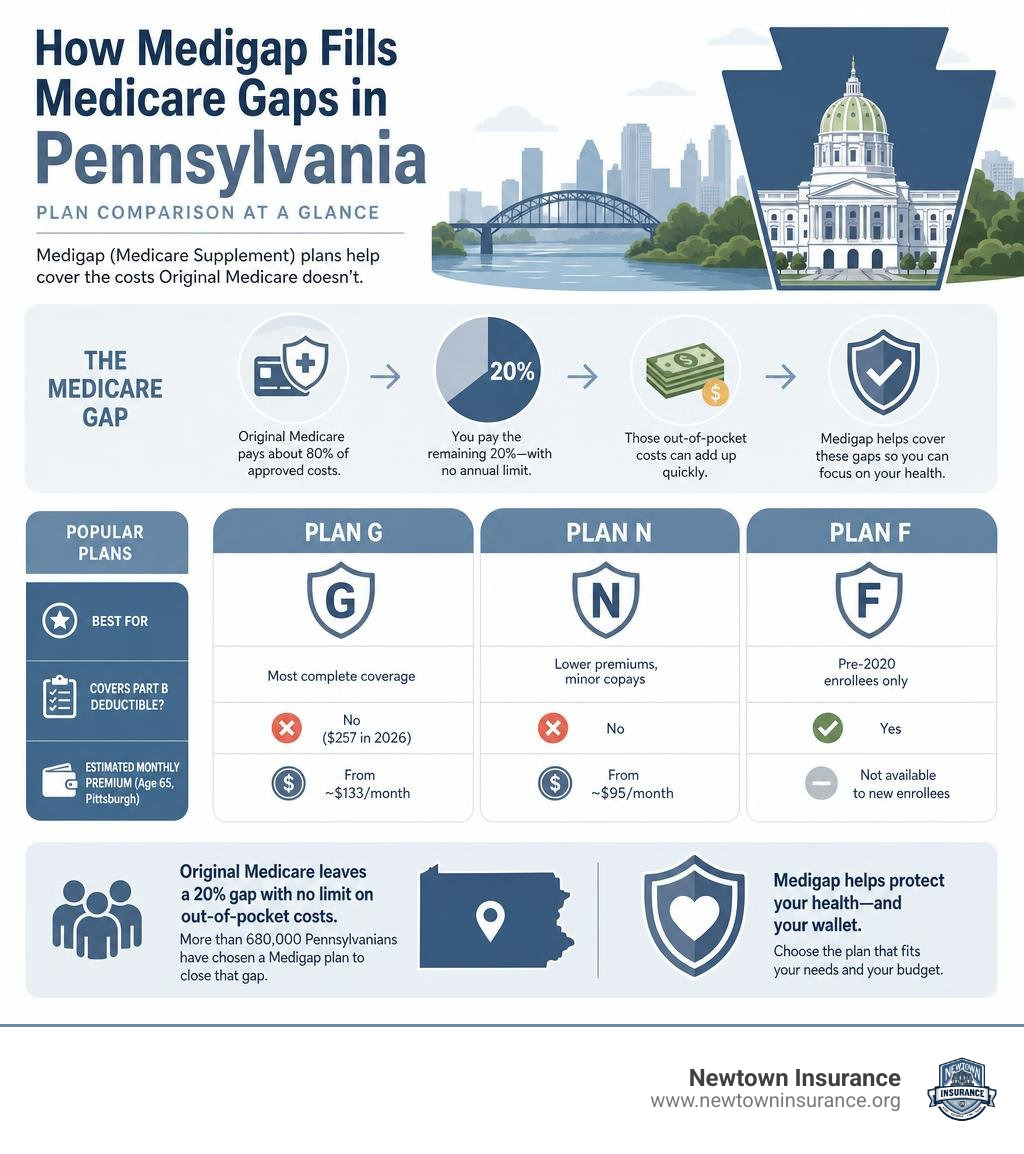
Here’s a quick-reference snapshot of the most popular options:
| Plan | Best For | Covers Part B Deductible? | Estimated Monthly Premium (Age 65, Pittsburgh) |
|---|---|---|---|
| Plan G | Most complete coverage | No ($257 in 2026) | From ~$133/month |
| Plan N | Lower premiums, minor copays | No | From ~$95/month |
| Plan F | Pre-2020 enrollees only | Yes | Not available to new enrollees |
Original Medicare only covers about 80% of your medical costs. That remaining 20% has no annual limit — which means a serious illness or hospital stay could cost you thousands of dollars out of pocket. More than 680,000 Pennsylvanians have already chosen a Medigap plan to close that gap.
And the PA landscape is shifting. With some major carriers stopping the sale of new Medicare Supplement plans in Pennsylvania, many residents are wondering where to turn next.
That’s where this guide comes in. We’ll walk you through every plan option, what things actually cost in Pennsylvania, and how to avoid the most common and expensive enrollment mistakes.
I’m Shawn Beihl from Newtown Insurance, and with over 15 years of specialty insurance experience — including health, life, and benefits management — I’ve helped countless Pennsylvania families navigate Medigap plans in PA to find coverage that actually fits their lives and budgets. Let’s cut through the confusion together.
What is a Medigap Plan and How Does It Work in Pennsylvania?
At its core, a Medigap plan (officially known as Medicare Supplement Insurance) is designed to work hand-in-hand with Original Medicare (Part A and Part B). Think of Original Medicare as the foundation of your house, and Medigap as the roof that keeps the rain off your head.
When you receive healthcare services, the billing process follows a simple “first-and-second” sequence:
- Original Medicare steps up first. It pays its approved portion of your bill (usually about 80% for outpatient care under Part B, after you meet your deductible).
- Your Medigap plan steps up second. It pays its portion of the remaining costs, such as your 20% coinsurance, copayments, or hospital deductibles.
Because these plans are designed to fill specific financial “gaps,” you must be enrolled in both Medicare Part A (hospital insurance) and Medicare Part B (medical insurance) to buy one. Additionally, Medigap policies are strictly individual contracts. There are no “joint” or family Medigap plans; you and your spouse must purchase separate policies to ensure you are both covered.
For official state-level guidelines and resources, you can always consult the Medicare Supplement | Insurance Department portal.
What Medigap Plans Do Not Cover
While Medigap plans are incredibly robust, they are not all-inclusive magic wands. By federal law, modern Medigap policies do not cover:
- Long-term care (such as extended stays in a nursing home)
- Routine dental care (cleanings, fillings, or dentures)
- Routine vision exams, glasses, or contacts
- Hearing aids and routine hearing exams
- Private-duty nursing
- Prescription drugs (since 2006, prescription drug coverage must be purchased via a standalone Medicare Part D plan)
If you are looking to secure coverage for these excluded categories, you can explore specialized riders or standalone policies. For example, some Pennsylvania insurers offer supplemental packages to add dental and vision benefits to your package. To understand how these auxiliary coverages fit into your broader financial strategy, check out our comprehensive Health Insurance Quotes Guide 2026.
Medigap vs. Medicare Advantage: Key Differences in PA
One of the most common points of confusion for retirees in Newtown and throughout Pennsylvania is choosing between Medigap and Medicare Advantage (Medicare Part C). They are entirely different systems, and you cannot have both at the same time.
Here is how the two pathways stack up:
- Provider Networks: Medigap plans do not use networks. You can see any doctor, specialist, or hospital in the United States, as long as they accept Original Medicare. Medicare Advantage plans, on the other hand, rely on localized networks. HMO plans generally restrict you to in-network doctors unless it is an emergency, while PPO plans allow out-of-network care but at a much higher cost.
- Cost Predictability: Medigap has higher, predictable monthly premiums but leaves you with virtually zero out-of-pocket expenses when you visit the doctor. Medicare Advantage often features low or $0 monthly premiums, but you pay copays or coinsurance as you go, up to a yearly Maximum Out-of-Pocket (MOOP) limit.
- Referrals: With Medigap, you never need a referral to see a specialist. Many Medicare Advantage HMO plans require you to see a primary care physician first to obtain a referral.
To make things clearer, let’s compare a standard Medigap setup against typical Pennsylvania Medicare Advantage plans, which often range from medical-only HMOs with a $6,750 Maximum Out-of-Pocket (MOOP) to premium-based plans with lower MOOPs or popular local HMO options with varying monthly premiums.
| Feature | Original Medicare + Medigap | Medicare Advantage (Part C) |
|---|---|---|
| Monthly Premium | Higher monthly premium | Often $0 or low premium |
| Out-of-Pocket Costs | Very low to $0 at the doctor | Copays for visits, hospital stays, etc. |
| Doctor Choice | Any doctor in the U.S. accepting Medicare | Restricted local network (HMO/PPO) |
| Referrals Required? | No | Often yes (for HMOs) |
| Maximum Financial Risk | Extremely low and highly predictable | Up to $8,000+ per year (MOOP) |
Choosing between these options depends on whether you prefer the freedom of choosing your own doctors and having predictable costs, or if you prefer a lower monthly premium in exchange for network restrictions. For a deeper dive into how health coverage works across the Commonwealth, refer to our Insurance Pennsylvania Complete Guide.
Standardized Medigap Plans in PA: Benefit Breakdown
In Pennsylvania, Medigap plans are standardized by the federal government. This means a Plan G offered by Company A must provide the exact same core benefits as a Plan G offered by Company B. The only differences are the price of the premium and the administrative track record of the insurance company.
There are 10 standardized plan letters available: A, B, C, D, F, G, K, L, M, and N.
- Plans C and F offer the most comprehensive coverage, but they are closed to new enrollees who became eligible for Medicare on or after January 1, 2020. This is because federal law now prohibits plans from covering the Medicare Part B deductible for new beneficiaries.
- Plans K and L act as cost-sharing plans. Plan K covers 50% of your Medicare cost-sharing, and Plan L covers 75%, both up to a set annual out-of-pocket limit.
- Plan A covers basic core benefits but leaves you responsible for major deductibles.
To explore the benefit matrices for all ten letters, you can use the interactive search tool at Find a Medigap policy that works for you.
Why Plan G and Plan N Are the Top Medigap Plans in PA
For the vast majority of Pennsylvanians entering Medicare today, the choice comes down to Plan G and Plan N.
Plan G is widely considered the modern gold standard. Once you pay your annual Medicare Part B deductible ($257 in 2026), Plan G covers 100% of your remaining Medicare-approved medical bills. This includes your hospital deductibles, 20% outpatient coinsurance, and even Part B excess charges (which occur if a doctor charges more than the Medicare-approved amount).
Plan N is the go-to alternative for budget-conscious seniors. It offers lower monthly premiums than Plan G in exchange for minor out-of-pocket copays:
- Up to a $20 copay for some office visits.
- Up to a $50 copay for emergency room visits (waived if you are admitted).
- You are also responsible for Medicare Part B excess charges (though these are rare in Pennsylvania) and the annual Part B deductible.

Average Monthly Premiums for Medigap Plans in PA
Because benefits are identical by letter, shopping for a Medigap plan in Pennsylvania is largely a comparison of premium pricing and carrier stability.
Rates can vary significantly based on your age, gender, tobacco use, and zip code. For example, in Pittsburgh, a 65-year-old female nonsmoker might find Plan G premiums starting around $133 per month and Plan N premiums starting as low as $95 per month. In eastern Pennsylvania, including Bucks County and Newtown, prices may trend slightly higher due to local healthcare costs.
When comparing quotes, it is critical to understand the three pricing structures used by insurance companies:
- Community-Rated: Everyone in the same geographic area pays the same premium, regardless of age. Premiums do not increase because you get older, though they can rise due to inflation.
- Issue-Age-Rated: Your premium is based on your age when you first buy the policy. The younger you are when you enroll, the lower your starting rate. Rates do not increase due to your age.
- Attained-Age-Rated: Your premium starts low but increases automatically as you get older. While these plans look attractive at age 65, they can become exceptionally expensive by the time you reach your 80s.
To compare current carrier ratings and price ranges across the state, check out the Best Medicare Supplement Plans in Pennsylvania 2026 report.
When and How to Enroll in Pennsylvania Medicare Supplement Insurance
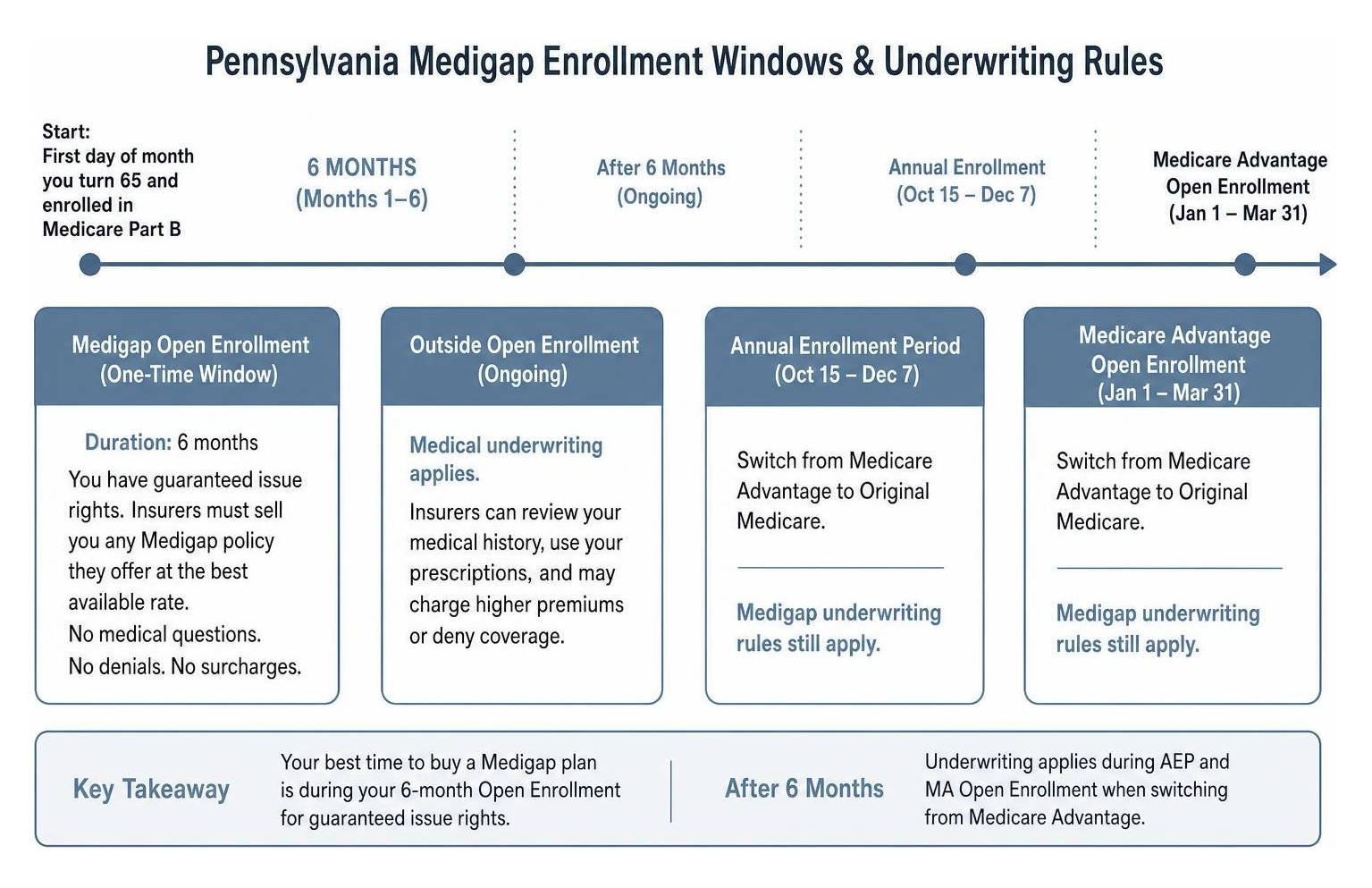
Timing is everything when it comes to Medigap. Your absolute best window to buy a policy is during your Medigap Open Enrollment Period.
This is a strict, one-time, six-month window that begins the first day of the month you are both age 65 or older and enrolled in Medicare Part B. During this period, you have guaranteed issue rights. This means insurance companies in Pennsylvania are legally required to sell you any Medigap policy they offer, at the best available rate, without asking a single medical question. They cannot deny you coverage or charge you higher premiums for pre-existing health conditions.
If you miss this six-month window, you lose your guaranteed issue rights. Outside of this period, Pennsylvania insurers are allowed to use medical underwriting. They can review your medical history, look at your prescriptions, and potentially charge you significantly higher premiums—or deny your application entirely.
How to Switch from Medicare Advantage to Medigap
Can you switch from a Medicare Advantage plan back to Original Medicare with a Medigap plan? Yes, but you must navigate the underwriting rules carefully.
Generally, you can drop your Medicare Advantage plan and return to Original Medicare during the Annual Enrollment Period (AEP), which runs from October 15 to December 7 each year, or during the Medicare Advantage Open Enrollment Period (MA OEP), which runs from January 1 to March 31.
However, dropping your Advantage plan does not automatically give you a guaranteed right to buy a Medigap plan. Unless you qualify for a specific exception, you will have to undergo medical underwriting to get approved for Medigap.
The primary exceptions are “Trial Rights”:
- If you joined a Medicare Advantage plan when you were first eligible for Medicare at age 65, and you want to switch back within your first 12 months, you have a guaranteed right to buy any Medigap plan.
- If you dropped a Medigap plan to join a Medicare Advantage plan for the first time, and you want to switch back within 12 months, you have a guaranteed right to return to your previous Medigap plan.
For a broader look at underwriting rules and general insurance transitions, check out our Insurance Quotes Guide 2026.
Free Pennsylvania Medicare Resources
If you want independent, unbiased guidance on your options, Pennsylvania offers excellent free resources:
- PA MEDI (Pennsylvania Medicare Education and Decision Insight): This is Pennsylvania’s State Health Insurance Assistance Program (SHIP). They provide free, personalized counseling to help you compare plans without any sales pressure.
- Local Area Agencies on Aging: These local offices offer community-based support and resources for seniors navigating retirement and healthcare transitions.
Frequently Asked Questions About Medicare Supplement Insurance
Can I have a Medigap plan and a Medicare Advantage plan at the same time?
No. It is actually illegal for an insurance agent to sell you a Medigap plan if they know you are enrolled in a Medicare Advantage plan, unless you are actively switching back to Original Medicare. The two types of coverage do not coordinate benefits or work together.
Do Pennsylvania Medigap plans cover prescription drugs?
Modern Medigap plans do not cover prescription drugs. To get prescription coverage, you must enroll in a standalone Medicare Part D plan.
The prescription drug landscape has improved significantly. The infamous “donut hole” coverage gap officially ended on December 31, 2024. For 2026, all Medicare Part D plans feature a hard $2,000 maximum out-of-pocket limit, protecting you from catastrophic drug costs.
How do insurance companies in Pennsylvania price Medigap policies?
In Pennsylvania, insurers use attained-age, issue-age, or community-rated pricing. Many popular plans in PA are attained-age, which means your premiums will rise as you grow older. It is always wise to ask an agent how a company historically handles rate increases before signing up.
Conclusion
Finding the right Medigap plans in PA doesn’t have to be an overwhelming chore. By understanding the differences between Plan G and Plan N, keeping a close eye on your six-month Open Enrollment window, and choosing a pricing structure that fits your long-term budget, you can secure your healthcare future with confidence.
At Newtown Insurance, we specialize in helping our Pennsylvania neighbors find tailored protection and smart savings. We believe in transparent pricing and customer-first support to make sure you never overpay for the coverage you need.
If you are also planning your broader financial legacy, read our Ultimate Life Insurance Guide 2026 or learn how a Life Insurance Premium is calculated.
Ready to compare your options and find the perfect plan? Visit us at Newtown Insurance today, and let’s make your transition into Medicare as smooth and stress-free as possible!